


Related

Portfolio Strategies
Factors have been proven to lead to higher returns. What you need to know about tilting your portfolio toward them.
by Charles Rotblut | June 2017

Charles Rotblut leads a class in AAII's new Essential Investing Video Course. Go to https://www.aaii.com/ves for more information and to subscribe.
Larry Swedroe’s article in the April AAII Journal, called “Factors Allow Investors to Think Differently About Diversification,” received requests from members for a more information about how to use factors.
This article is intended to complement Larry’s article and include ideas for how to apply it. It will also complement and overlap the “Factor Investing and Dividends” article included in the May 2016 AAII Dividend Investing newsletter.
To fully understand factors, a brief understanding of financial theory is required. The efficient market theory (EMT) holds that security prices reflect all known information. Financial theory further holds that a stock’s return reflects a risk-adjusted premium. Specifically, the capital asset pricing model (CAPM, pronounced “cap-M”) defines expected returns as being influenced by the equity premium—the excess return of the stock market relative to a risk-free asset (e.g., Treasuries)—and the relative volatility (beta) of the underlying stock.
Further academic research concluded that the CAPM does not fully account for the expected returns in all stocks. Specifically, the returns of certain stocks could also be attributed to other factors. These factors initially included size and valuation.
Factors are characteristics of a stock. A market capitalization of below approximately $1 billion is a characteristic of a small company. A stock trading at a low price-to-book-value (P/B) ratio of approximately 1.0 or lower is a value stock. In both cases, the returns of stocks are influenced by whether not they have these characteristics.
Over the long term, small-company stocks outperform large-company stocks. Similarly, stocks with low valuations outperform stocks with high valuations. The outperformance attributed to such characteristics is referred to as a return premium, or a premia.
These characteristics are also referred as risk factors. The word “risk” comes into play because the higher returns associated with such stocks are considered compensation for incurring a greater price volatility and risk of underperformance. According to the theory, higher returns for a security are only possible if there is a greater chance of relative downside.
Proponents of this school of thought can point to the performance of small-company stocks. These stocks have historically experienced greater price volatility then their large-company brethren. The higher price volatility is partially due to small companies having less diversified businesses, not being industry leaders and/or selling to larger companies instead of to the end users. In the eyes of those who hold to concepts of financial theory, investors “demand” higher long-term returns as an incentive to accept the risks associated with smaller-company stocks.
The number of factors has grown considerably over the years from professors Eugene F. Fama and Kenneth R. French’s 1993 Journal of Financial Economics paper, “Common Risk Factors in the Return on Stocks and Bonds.” In this study, Fama and French listed company size and valuation (specifically book-to-market, which is the inverse of the price-to-book ratio) as factors. As Swedroe noted in his April 2017 article, the literature has expanded the number of factors to more than 600.
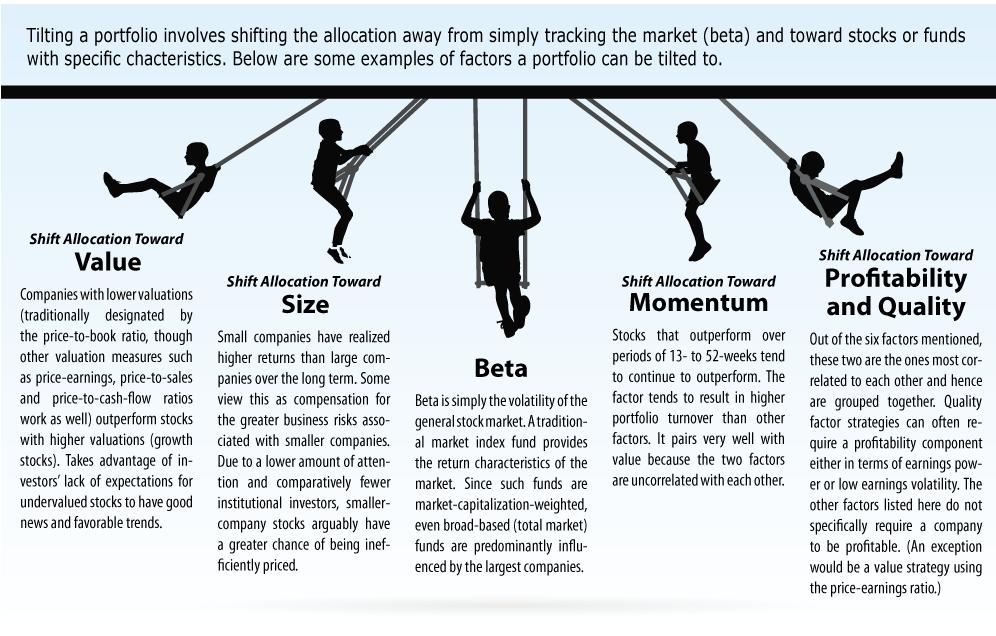
Some of these factors are subsumed by other factors. Fama and French observed this in 1992. They described company size and price-to-book ratio as seeming “to absorb the apparent roles of” leverage and the price-earnings ratio. Swedroe narrowed the current large list of factors to six key ones: beta, size, value, momentum, profitability and quality. The first four can be directly targeted by individual investors; profitability tends to be grouped in with another factor such as quality.
Before discussing how to get exposure to the various factors, it’s helpful to understand what tilting is. Tilting is simply a fancy way of saying creating or orienting a portfolio to target certain factors. It simply means a portfolio is built to take advantage of the returns associated with a certain factor or factors.
Many of you reading this article are already likely tilting your portfolios in some form, even if you are not familiar with the term “tilting” from the standpoint of investing. Say some of your portfolio is allocated to an S&P 500 index fund and another part of your portfolio is designated for following our Model Shadow Stock Portfolio. Your portfolio has two primary exposures: the market beta via the S&P 500 fund and the small-company and value factors via the Model Shadow Stock Portfolio.
Market beta is how sensitive a stock, fund or portfolio is to the price movement of the overall market. By holding an S&P 500 index fund, you are getting the returns of what many would consider to the stock market. The fund, by it’s very design, will give you the return characteristics of the S&P 500 index. Since the volatility of an S&P 500 index fund matches the index itself, the fund’s beta is 1.0. Hence, by buying such an index fund, an investor gets exposed to the beta factor.
The Model Shadow Stock Portfolio gives you exposure to Fama and French’s other two original factors: size and value. The portfolio specifically seeks out small-company stocks trading at low valuations.
By combining an S&P 500 fund with the Model Shadow Stock Portfolio, you are taking a market portfolio (allocated to the large-cap index and, therefore, the beta factor) and tilting it to size and value via the Model Shadow Stock Portfolio. Put another way, you’re making a conscious effort to give your portfolio different return characteristics than the market.
You don’t have to tilt just a portion of your portfolio. You could allocate solely to one factor. By only buying stocks with cheap valuations and selling them when their valuations become pricey, value investors solely target the value factor. The same applies with other factors, such as momentum or size.
A discussion of tilting raises the question of how much one should tilt and how many factors one should tilt to. The answer is partially one of financial mathematics and partially one of personal preference.
On the math side, the overall return volatility of a portfolio is reduced by including assets with different return characteristics. This occurs because the returns of the different assets are not perfectly correlated, meaning they don’t move in lockstep with each other. This is the argument Swedroe was making for tilting a portfolio.
Swedroe gave the example of a 60/40 portfolio. A 60/40 portfolio means having 60% of the portfolio allocated to stocks (such as the S&P 500, though Swedroe used a total market fund instead) and 40% to bonds. This basic portfolio does a fairly decent job of providing diversification because, over the long term, stocks and bonds are uncorrelated. Their long-term returns move independently of each other. He then altered the portfolio by switching out the total market fund for a fund targeting small-cap value stocks. The latter portfolio performed better even though the allocation to bonds was not changed.
The reason why has to do with the tilts. A broad traditional market-cap-weighted index fund, such as the Vanguard Total Stock Market Index fund  (VTSMX), holds both large- and small-company stocks as well as growth and value stocks. Since it is weighted by market capitalization, large companies have a much greater influence on performance than small companies. There is no valuation preference, so both growth and value stocks influence performance. As such, this fund, by its design, provides direct exposure to the market beta, but not to other specific factors.
By shifting out of the market fund and into the fund targeting stocks with characteristics (factors) shown to be associated with higher returns (in this case, small and value), portfolio returns are enhanced. The equity portion of the portfolio is now oriented to realize a higher return, boosting the overall performance of the portfolio. Furthermore, the portfolio’s overall risk (defined by price volatility) is reduced because the value and size factors are uncorrelated with each other, meaning their individual returns tend to be independent of each other.
Conceivably, as long as the individual factors themselves are uncorrelated, an investor can increase the diversification benefits of a portfolio by including a mixture of factors in the portfolios. For example, since value is uncorrelated with the beta, size, momentum and quality factors, an investor could start with a broad market index fund and then include specific funds targeting value, small-cap, momentum and quality stocks. By doing so, an investor is reducing overall risk (again, defined as price volatility) by mixing in factors with differing return streams. When one factor lags, another may outperform. The amount of diversification would depend on personal preference.
In seeking diversification, be careful not to overdiversify. The benefit of additional factors diminishes with the inclusion of each new factor—a point Swedroe makes in his book, “Your Complete Guide to Factor-Based Investing” (Buckingham, 2016). More importantly, since expense ratios are higher for factor funds, combining too many factor funds can result in having nearly the equivalent of a market portfolio, but at a higher cost.
Also use prudence when selecting funds (if individual stocks are not being targeted). Holding an S&P 500 index fund and then buying an S&P 500 value fund (or another large-cap value fund) causes much overlap in the stocks held. A small-cap value stock fund, conversely, will provide exposure to completely different stocks. The two big things to look at (beyond the obvious issue of expense) is what universe the fund is targeting and how it is weighting stocks. You want to avoid overlapping market-capitalization-weighted indexes targeting the same index, such as the S&P 500. (You can overlay a broad total market fund with a small-cap fund, however, since the former will have its biggest allocations in the largest stocks.) The key is to look at the prospectus. If the fund tracks an index, simply typing the name of the index into Google or another search engine will allow you to find the index’s methodology. Whenever possible, you want to combine funds that hold different portfolios. Otherwise, you are simply increasing exposure to the same stocks.
Similar advice applies to actively managed funds. Read the prospectus and examine the portfolio characteristics. Just because a fund presents itself as a value fund, for instance, does not mean that it actually is. Make sure it is following the strategy you desire, versus just having the appearance of doing so.
An investor solely concerned with maximizing return while minimizing risk could eschew the beta factor and solely allocate the equity portion of the portfolio to targeting specific factors. Such a step would allow for larger allocation to bonds because of the higher expected returns associated with the factors targeted on equity allocation. Effectively, the investor can get away with holding less in stocks because the factor tilts provide more bang for the buck in terms of performance. Swedroe showed an example of how a 40% stock/60% bond allocation can outperform the traditional 60% stock/40% bond allocation if the equity portion of the former is allocated to small-cap value instead of a broad index fund. Keep in mind that the outperformance is based on more than 20 years of return data. Over short periods, the higher returns may or may not be realized.
To tilt a portfolio, an investor simply needs to add investments targeting securities with specific characteristics (e.g., small size, value, momentum, etc.). Be sure to make the tilt a large enough portion of your portfolio to influence its overall returns. A 1% or 2% allocation won’t make much difference. A 20% allocation can. You can certainly go much bigger, up to completely tilting your portfolio to one or a few specific factors.
One way to get exposure to factors is to focus on individual stocks identified by specific strategies. Using an example previously given, an investor could simply follow the Model Shadow Stock Portfolio to get exposure to the value and small-company factors. An investor could also selectively choose from among the more than 60 stock screens AAII offers. (For example, the Driehaus screen could be used for momentum, Price-to-Free-Cash-Flow for value and Weiss Blue Chip Dividend Yield for profitability and dividends. There are many other combinations of screens investors could put together as well.
An alternative is to use funds. Start with a broad-based index fund, such as the Vanguard Total (U.S.) Stock Market Index fund (VTSMX) suggested by Swedroe, and add funds with the words value, small, momentum and/or quality in their names. There are a number of exchange-traded funds that do this. Examples include, but are not limited to, iShares Core S&P U.S. Value (IUSV), iShares Russell 2000 Value (IWN), iShares Edge MSCI USA Momentum Factor (MTUM) and iShares Edge MSCI USA Quality Factor (QUAL). There are also several passively and actively managed funds that do this.
The extent to which you tilt or completely orient your portfolio to specific factors is a personal decision. Any expectations for higher return should be paired with a long-term commitment to sticking with the chosen factors. All factors will undergo periods where they lag the broader market. These periods can be very short term or they can last a few years, if not even longer. For the six aforementioned factors, Swedroe calculated the odds of underperformance as being as high as 30% over five-year periods. At 10 years, the odds quite are favorable. They range between just a 3% chance of underperforming for the momentum factor to 23% for the size factor—good odds for the those who take a patient, long-term approach.
Portfolio Strategies
Portfolio Strategies


James Borgeson from NJ posted over 9 years ago:
You need to log in as a registered AAII user before commenting.
Log InCreate an account