


Related

AAII How-To
Research provides evidence that combining value and momentum strategies offers investors the opportunity to achieve higher rates of return with lower risk than would be achieved with either strategy individually.

Wayne Thorp leads a class in AAII's new Essential Investing Video Course. Go to https://www.aaii.com/ves for more information and to subscribe.
For value investors, the sweet spot in investing is being able to buy an undervalued stock right before its value is recognized by the market and just before its stock price begins to take off.
But how can a value investor tell when a stock is in the sweet spot? A technique that has started to find favor among investors is to identify stocks with good value that are just starting to exhibit good momentum characteristics.
At the surface, value and momentum appear to be at odds with one another. Momentum can be fast-moving. It seeks out stocks that are currently doing well from a return standpoint. A stock that is outperforming the market can be reflective of an expectation that the business is doing well and/or may improve in the foreseeable future. Investors may be attracted to such stocks because of their good returns. As such, valuations tend to be higher.
Value, in contrast, can be slow-moving. It seeks out stocks whose valuations are below the market’s average. The lower valuations can reflect concern about the business not doing well or being unlikely to realize better-than-forecast rates of return. Such stocks may be overlooked as investors fret about whether the valuation is cheap for a reason or if these stocks are riskier. As such, the relative strength (a gauge of momentum) can be lower.
However, in the article “A Better Bet” for the October 2012 issue of Chicago Booth Review, Tobias Mokowitz explains that momentum investing works well in the short term—a year or less—while value investing focuses on the long term. Combining value and technical/momentum characteristics is also a long-term proposition, as it is conditioned on price-to-fair-value convergence (the value premise).
Several other research studies—most notably a study done by Cliff Asness of AQR Capital and Lasse H. Pedersen of the New York University in their paper “Value and Momentum Everywhere”—make the argument that value and momentum strategies work well together. In their research, Asness et al. show that over time combining value and momentum strategies across diverse markets and asset classes results in significantly higher risk-adjusted rates of return.
From a quantitative standpoint, momentum and value are negatively correlated. Asness et al. found value to have a –0.4 correlation with momentum. To put this number into perspective, a correlation of 1.0 would imply that the two styles move in lockstep, a correlation of –1.0 would imply that they move in opposite directions and a correlation of 0.0 would imply that they move independently of each other. The correlation of –0.4 suggests that momentum and value lean toward being independent, but when one zigs, the other may have a tendency to zag.
Due to this lack of correlation, combining momentum with value results in diversification benefits. It not only helps to offset momentum crashes, but it can also reduce both volatility and turnover. Researchers Gregg Fisher, Ronnie Shah and Sheridan Titman found that portfolios using a 50% value/50% momentum mixture had less volatility and lower turnover than a pure momentum portfolio, as reported in their 2016 Journal of Investment Management article “Combining Value and Momentum.” Depending on whether large- or small-cap stocks were held and the buy and sell rules that were followed, absolute returns and risk-adjusted performance (as measured by the Sharpe ratio) were as good as or better than standalone value or momentum strategies.
It should be added that it’s more important to incorporate value and momentum strategies rather than to seek the exact optimal mix. While Fisher et al. used a 50/50 mix, Asness et al. looked at a 60/40 value/momentum portfolio. Using Kenneth French’s dataset, they found that this mix “effectively eliminated crashes in our long-term sample evidence—and not just those for momentum, but also the crashes that can occur for value investing.”
The conclusion of the Asness et al. study is that the negative correlation between value and momentum strategies coupled with their high expected returns make a simple strategy of equally weighting a portfolio with value and momentum stocks powerful—producing higher cumulative long-term rates of return than either value or momentum alone (across every asset class).
The Asness study also points out that combining value and momentum results in a significantly higher Sharpe ratio than either a value or momentum strategy alone and makes the portfolio less volatile across markets and time periods. [The Sharpe ratio measures how much return a strategy generates relative to the level of risk it incurs. Higher Sharpe ratios imply that a strategy produces more return for each unit of risk.]
AAII provides momentum and value ratings as part of its A+ Investor suite of tools. The Momentum Grade uses a weighted four-quarter relative strength price change for each of the past four quarters to rank companies. The most recent quarterly price change is given a weight of 40% and each of the three previous quarters are given a weighting of 20%.
The Value Grade is the percentile ranking of the average percentile rank across six value metrics: price-earnings ratio (P/E), price-to-book-value ratio (P/B), price-to-sales ratio (P/S), enterprise-value-to-EBITDA ratio (EV/EBITDA), price-to-free-cash-flow ratio (P/FCF) and shareholder yield (the percentage change in shares outstanding over the last year plus the dividend yield).
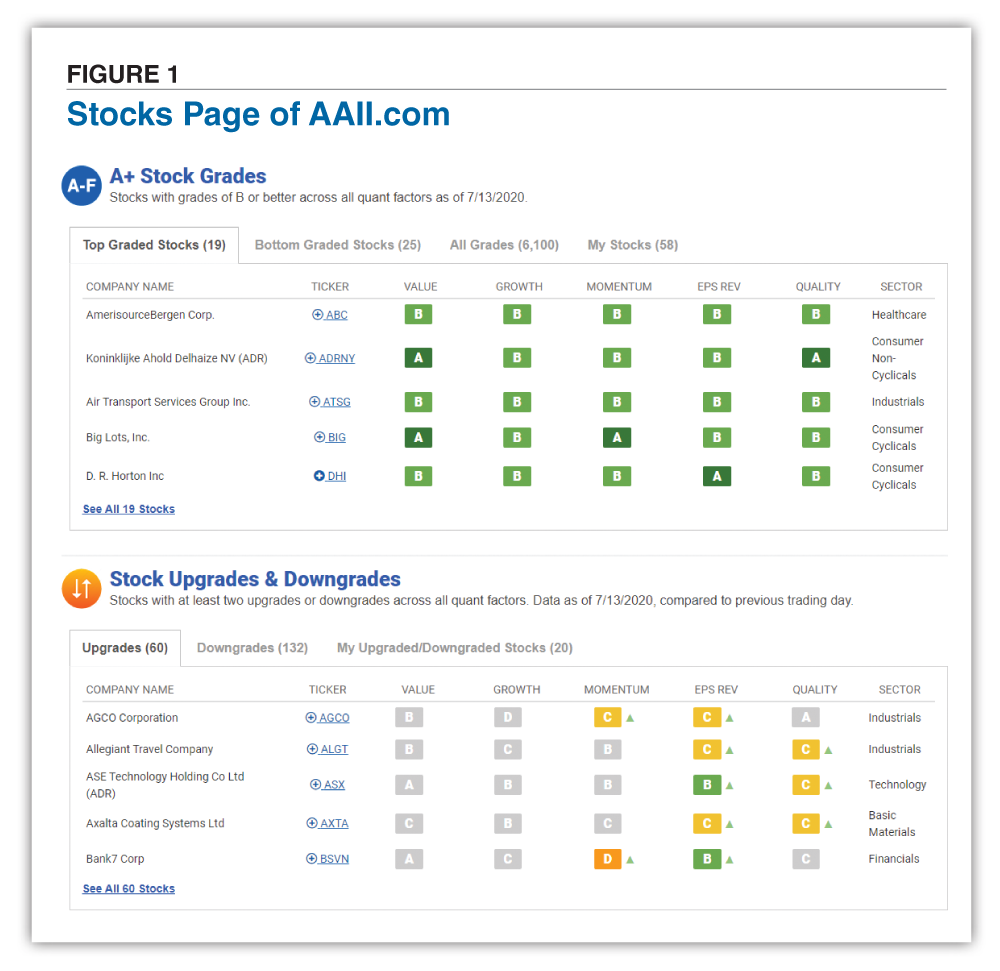
Available to all AAII members, the Stocks page of AAII.com notes if any stocks have consistently high or low grades across the five A+ Investor factors and separately reveals significant changes in their grades (Figure 1).
A+ Investor subscribers have access to the A+ Stock Grades Screener, where you can isolate companies from the more than 6,000 stocks in the universe based on their value and momentum grades, along with grades based on growth, quality and estimate revisions.
With the Stock Grades Screener, you can identify those stocks trading at low valuations but that are also exhibiting strong price momentum.
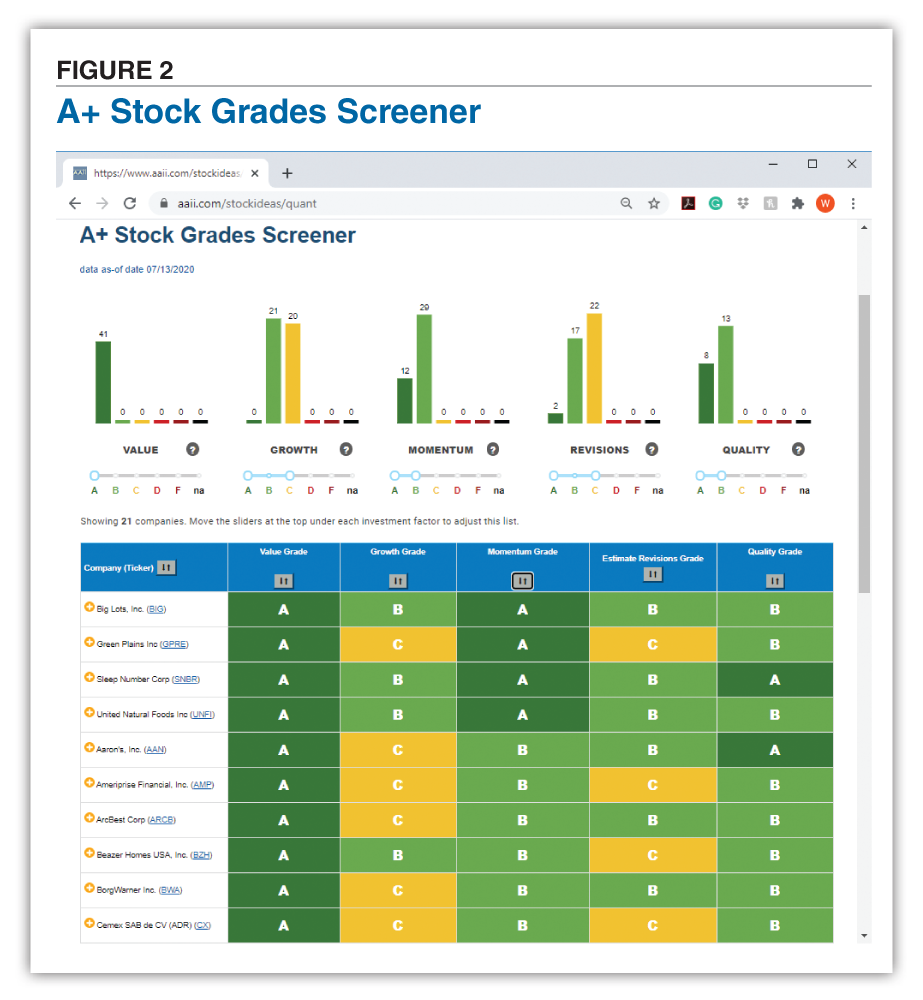
For the example, companies with a Value Grade of A, Quality and Momentum Grades of B or better and Growth and Estimate Revisions Grades of C or better are favored.
As of the close on July 13, 2020, 21 companies met these requirements (Figure 2).
This list is ranked by Momentum Grade, from the highest (A) to the lowest (B), with the top 10 stocks shown. Of the 21 stocks that passed the filters, four had Value and Momentum Grades of A: Big Lots Inc. (BIG), Green Plains Inc.  (GPRE), Sleep Number Corp. (SNBR) and United Natural Foods Inc. (UNFI).
Research provides evidence that combining value and momentum strategies offers investors the opportunity to achieve higher rates of return with lower risk than would be achieved with either strategy individually. Other studies highlight the benefits of focusing on those stocks possessing good value and momentum characteristics. As such, it is possible that combining low valuation and upward price momentum will be a useful strategy for individual investors.
AAII How-To

Value Investing
Value Investing

FRANK K from NY posted over 6 years ago:
ROGER G from FL posted over 6 years ago:
You need to log in as a registered AAII user before commenting.
Log InCreate an account