

Related

Mutual Funds
How to Choose a Mutual Fund


Mutual Funds
Mutual fund investors seeking higher income but wanting to avoid a higher chance of losing principal can strike a balance by looking at two fund characteristics: the category risk index and the yield.

Charles Rotblut leads a class in AAII's new Essential Investing Video Course. Go to https://www.aaii.com/ves for more information and to subscribe.
A challenge in the current interest-rate environment is realizing a higher level of portfolio income without incurring a higher level of risk. While income-producing investments are perceived as being risky, not all are. Higher yields often reflect a higher perceived level of risk.
Mutual fund investors seeking higher income but wanting to avoid a higher chance of losing principal can strike a balance by looking at two fund characteristics: the category risk index and the yield.
The category risk index compares how volatile a fund’s total return has been over the last three years relative to the typical variation in returns for all funds in its category. For example, a risk index of 0.90 for a fund indicates that it is 10% less volatile than the typical fund in its category. Values above 1.00 denote more risk than average and values below 1.00 denote less risk than average for the category.
Yield for mutual funds is calculated as income for the most recent 12 months divided by the month-end net asset value.
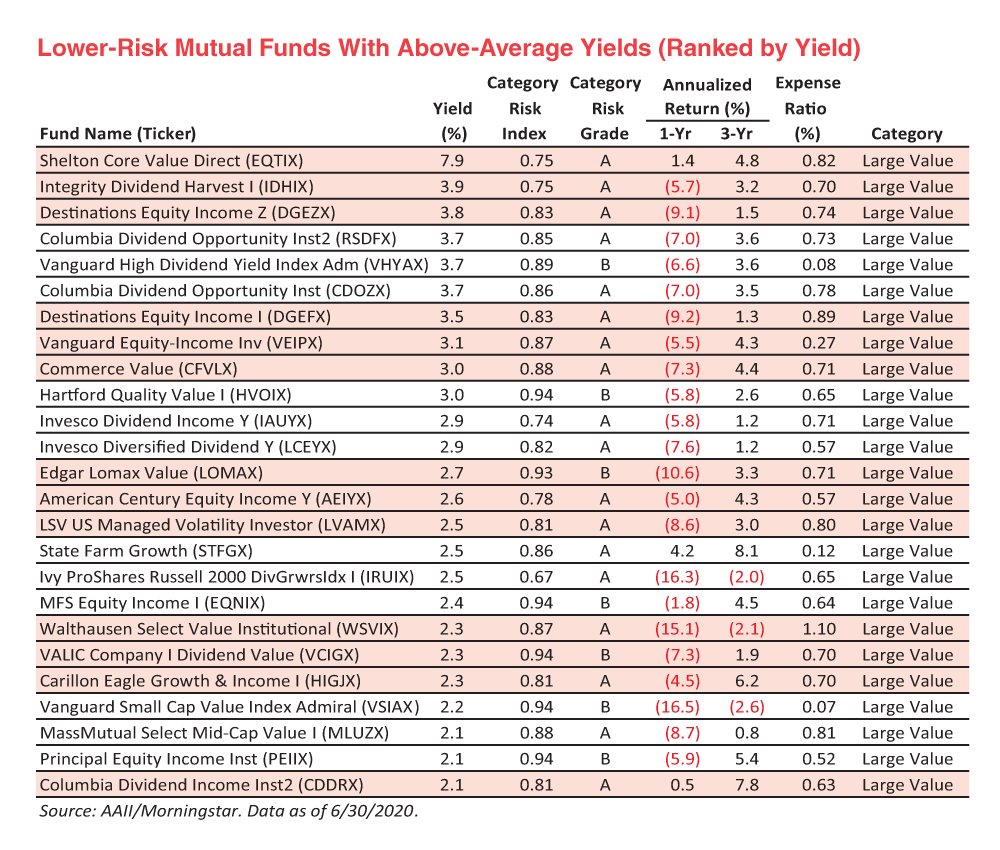
This month’s First Cut combines the two measures. It requires passing funds to have a category risk index ranking the bottom 30% of their respective categories (equivalent to a Category Risk Grade of A or B). It also requires passing funds to have higher-than-average yields. The funds considered are no load, have below-average expense ratios and are designated as being open to new investors. The table shows the top 25 funds passing this first cut screen, ranked by yield.
A+ Investor subscribers can access monthly updates to this Mutual Funds First Cut screen. ▪
Mutual Funds
Mutual Funds

No comments have been added yet. Add your thoughts to the discussion!
You need to log in as a registered AAII user before commenting.
Log InCreate an account