

Related

Mutual Funds
When selecting a fund, focus on whether a fund meets your current needs or is capable of meeting your future needs.

Charles Rotblut leads a class in AAII's new Essential Investing Video Course. Go to https://www.aaii.com/ves for more information and to subscribe.
Mutual funds follow a variety of strategies and invest in a variety of assets. The most widely held mutual funds mostly invest in stocks and/or bonds. Index funds tend to be the lowest cost and rank among the most tax efficient. Actively managed funds seek to realize higher returns by having portfolio managers and their analysts choose which securities should be held.
While it can be tempting to seek an advantage by buying a fund targeting a very specific industry or following a unique strategy, academic research has shown that the biggest impact on portfolio returns comes from the allocation decisions made (i.e., the percentage of total portfolio dollars allocated to stocks, the percentage allocated to bonds, etc.). Adhering to a well-thought-out allocation strategy over the long term will have a more beneficial impact than trying to make tactical decisions based on what you think will happen in the future.
A starting point for those looking to build a portfolio of mutual funds is AAII’s Asset Allocation Models (Figure 1). This model provides sample allocations for three types of investors: aggressive, moderate and conservative. The allocations range from 90% stocks/10% bonds for aggressive investors to 70% stocks/30% bonds for moderate investors to 50% stocks/50% bonds for conservative investors.
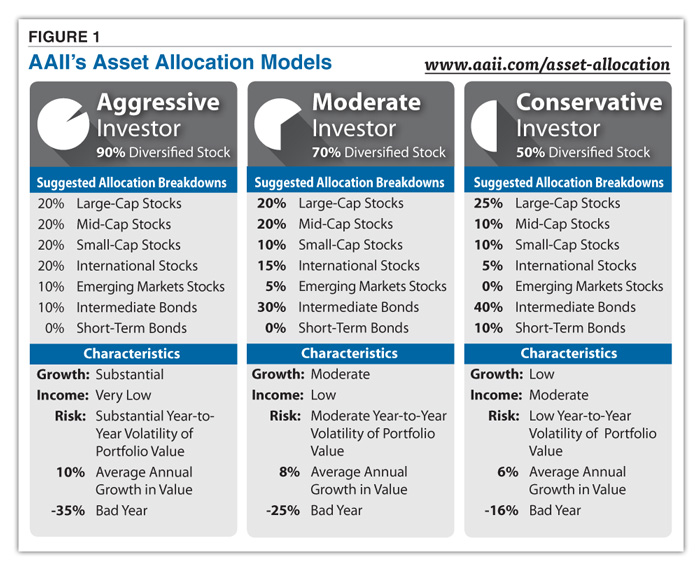
The models use varying combinations of large-cap, mid-cap, small-cap, international and emerging market stocks along with intermediate- and short-term bonds. The primary fund categories shown in our mutual fund guide in this issue follow those suggestions. Balanced funds can also be used to match these allocations. Target-date funds are an option for investors who would prefer to have a fund manager adjust their exposure to stocks as their retirement date nears.
Once you decide the asset classes you want to target, look for funds within each specific asset class. Cross-asset comparisons aren’t good measures because the performance of any fund will first and foremost be determined by its objective. A stock fund’s returns will be significantly influenced by the performance of the stock market. A bond fund’s returns will be significantly influenced by the performance of the bond market.
Risk also plays a role. Over long periods of time, stocks outperform bonds. The outperformance of stocks is, in part, compensation for their higher level of risk. Stock prices are more volatile than bond prices. The higher volatility leads to bigger gains during favorable market conditions and bigger losses during down markets. This is why stock funds have larger total risk ratios than bond funds do.
Risk also exists on the income side. Bond funds realize higher yields by taking on more risk. They can do so by holding fixed-income assets with higher levels of sensitivity to interest rate changes and/or issued by entities with a higher chance of default (credit risk). Both can result in more volatile returns and higher risk ratios.
A higher risk ratio is, in itself, not a reason to pass on a fund if you are psychologically and financially able to tolerate the swings in returns. Over the long term, investors are compensated for accepting shorter-term risk when following strategies with proven long-term upside. The danger occurs when short-term performance is emphasized without consideration for the level of risk taken.
The timing of when you will need to take withdrawals also matters. If you expect to make withdrawals within the next one to five years, shorter-term volatility becomes important. An ill-timed drop in the fund’s net asset value could leave you with less wealth than you need. Short-term bond funds can be used for such purposes. On the other hand, if you won’t need to take withdrawals for an extended period of time (e.g., more than 10 years), investment growth becomes far more important than minimizing volatility. To fund your long-term goals, you will need investments capable of delivering returns well in excess of the rate of inflation. Stock funds work better for funding long-term goals.
Those with both short- and long-term withdrawal needs can consider a combination of conservative bond and aggressive stock funds to achieve both goals.
When comparing the performance of two or more funds, always start by matching those in similar categories. The return patterns of different categories may not be comparable, especially over longer periods. The correlations between stock, bond, real estate and commodity funds all decrease over time. Even within broad asset classes, there can be differences. A large-growth fund may experience different returns than an equity energy fund or a small value fund.
Once comparable funds are identified, look at performance over a variety of periods. First, examine the year-by-year returns for each of the past five years. Ask if one fund has consistently been better than the other. Has either fund been volatile with big gains and big losses? Has either fund had a single year with a large gain or a loss that could skew its annualized returns?
Look at annualized returns for the past three-, five- and 10-year periods. Determine which funds have the higher returns and the better grades. If one fund’s annualized returns are better, go back and look at its past volatility. Is the better return attributable to consistency or just one or two big years?
Then look at the category risk index grade. This reflects how volatile a fund’s returns have been relative to its peers. A better grade implies less comparative volatility in returns. A worse grade implies more volatility. A fund with better returns but a worse category risk index will have realized its performance advantage by experiencing more volatility. Its performance advantage should exceed its higher level of risk. If it doesn’t, shareholders aren’t being adequately compensated for a higher level of risk.
A simple way to determine this is to compare each fund’s category risk index to its three-year returns. If the more volatile fund’s category risk index is, say, 20%, higher than the less volatile fund’s category risk index, its three-year annualized returns should be at least 20% higher.
The general rule for choosing mutual funds is to favor those with lower expense ratios. The expense ratio is the total of fees charged by a fund (excluding any loads) relative to its net asset value. Every dollar spent on fund expenses (and loads) is a dollar you will never see again.
The only way to overcome a higher expense ratio is to realize a higher return. It is this hurdle that makes it difficult for actively managed funds to beat index funds. For example, let’s assume a large-blend index fund charges an expense ratio of 0.10%. An actively managed large-blend fund charges an expense ratio of 0.50%. Though the difference may not seem large, the actively managed fund’s shareholders will have to see their investment realize a 0.4-percentage-point return advantage on an annualized basis (0.5% – 0.1% = 0.4%). This excess return is required just to keep those investors’ wealth even with what it would have been had they opted for the lower-cost index fund.
Can an actively managed fund outperform an index fund by a large enough margin to justify its higher costs? It’s possible, but it is difficult to identify those funds in advance.
There can be other reasons to favor active management. They include a high yield, exposure to securities not targeted or otherwise underweighted by index funds, specific strategies or less volatility. Many balanced funds also use active management. In all cases, be sure you are being compensated for paying the higher expense ratio.
Mutual fund investors get taxed in two ways when they hold a fund in a taxable account. First, they pay capital gains if shares are sold for more than they were purchased at. Secondly, they get taxed on distributions made by the fund. Investors can control when they sell their shares, but they cannot control the fund’s distributions.
The tax-cost ratio shows how tax friendly or unfriendly a fund is. It measures how much a fund’s annualized return is lowered by the taxes attributable to fund distributions. Higher tax-cost ratios indicate higher relative distributions. Lower ratios indicate a smaller tax impact. When two or more funds are being considered for a taxable account, reduce each fund’s returns by the tax-cost ratio to determine the aftertax return. It is possible for a fund with a lower stated total return to have a higher aftertax return if it is more tax efficient.
Those holding mutual funds in a tax-preferred account like an IRA or a Roth IRA do not need to worry about the tax-cost ratio. When both taxable and tax-preferred accounts are owned, asset location comes into play. Funds with lower tax-cost ratios—index funds, municipal bond funds, etc.—are suitable for taxable accounts. Funds with higher tax-cost ratios—actively managed funds with higher levels of portfolio turnover, real estate funds, general bond funds, etc.—are more suitable for tax-preferred accounts.
When selecting a fund, focus on whether a fund meets your current needs or is capable of meeting your future needs. The funds currently “winning the race” may not be the best funds for achieving your goals.
Read the prospectus. This document explains the fund’s objective and strategy. It is available on the fund family’s website, though you can also request a paper copy to be sent to you. If the strategy is different than what you expected or if you don’t understand what the fund is designed to do, it may not be the right fund for you. Keep notes of the objective and be prepared to reevaluate the fund’s place in your portfolio if the strategy changes.
Keep an eye on the manager and the management team. Leadership changes may lead to a shift in how the strategy is carried out. It may also make historical returns less indicative of future performance relative to a fund’s peers.
Look at the category’s returns when considering a fund. All asset classes and investment styles go through cycles of relatively good and bad performance. Just because an asset class (e.g., international stock funds) or investment style (e.g., value) is underperforming currently does not mean its returns will continue to underperform in the future. Likewise, the asset classes and investment styles with the best performance over the past few years may not be leaders over the next several years.
Avoid funds that do not match your goals and/or tolerance for risk. Funds with high expense ratios and/or loads should also be avoided. The extra return these funds need to provide to compensate you for their higher costs is often not achieved. Chasing last year’s winning funds just because they “won” is not a guaranteed way of realizing higher returns in the future. At the same time, be careful about buying the losers. While a fund whose category has underperformed can be good an investment, a fund that has underperformed its category peers may be a bad fund. Bad funds tend to stay bad.
Set a reasonable limit on the number of funds you hold. One fund per asset class is often sufficient to achieve your goals. Holding too many funds leads to unintentional overlaps, unnecessary complexity and potentially extra costs.
As is the case with any investment, having preset rules for determining when to part with a mutual fund can make you a better investor.
The biggest reason to sell a fund is simply because your objectives have changed. A big life event can mandate a shift in allocation strategy, warranting a shift to a more conservative strategy. Selling in this case may mean paring down how many shares you own of a riskier fund instead of pulling out of it completely.
A change in the fund’s objective or strategy would warrant parting with it. This may or may not follow a new manager or management team taking over. Again, read the prospectus.
The fund repeatedly underperforms its peers. One disappointing year may be attributable to differences in the fund’s approach or just temporary bad luck. Several years of underperformance would suggest the problem is with the fund itself and not its category.
Mutual Funds


Jeff from Ill posted over 6 years ago:
Jim from UT posted over 6 years ago:
Charles Rotblut from IL posted over 6 years ago:
You need to log in as a registered AAII user before commenting.
Log InCreate an account