

Related

Mutual Funds
How to Choose a Mutual Fund


Portfolio Strategies
Low expense ratios provide a performance advantage by allowing more of shareholders’ money to stay invested and thereby grow.

Charles Rotblut leads a class in AAII's new Essential Investing Video Course. Go to https://www.aaii.com/ves for more information and to subscribe.
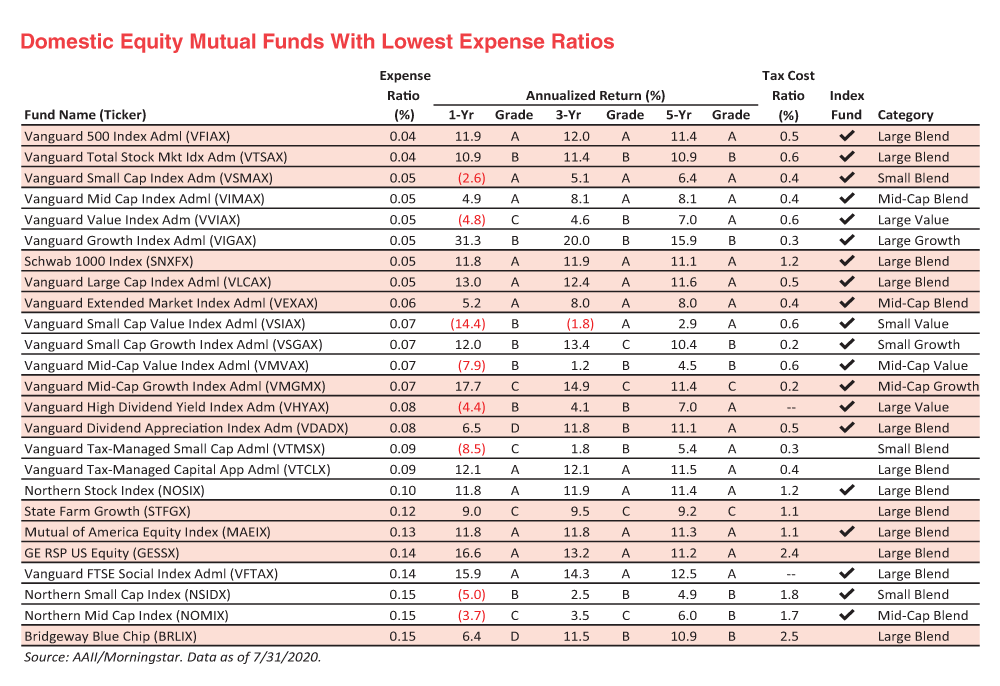
How low of an expense ratio can an investor pay? The answer is lower than many may expect. This month’s Mutual Fund First Cut lists 25 domestic equity mutual funds with expense ratios of 0.15% or less. An expense ratio of 0.15% is equivalent to $1.50 on every $1,000 invested. The majority of the passing funds have expense ratios below 0.10%, with the two cheapest charging just 0.04% (or $0.40 for every $1,000 invested).
No minimum level of relative performance was required. Nonetheless, most of the passing funds have outperformed their category peers, as evident by the AAII grades (scale of A–F). The low expense ratios provide a performance advantage by allowing more of shareholders’ money to stay invested and thereby grow. Most of the passing funds are also passively managed.
Not surprisingly, Vanguard funds are most prominent among the results. Other fund providers are also represented, including Schwab and Northern Trust.
Due to purchase restrictions, funds were excluded that are labeled as “institutional” (with the exception of Vanguard Admiral class) or as “other” share class, which includes Fidelity’s zero expense funds. The full screen results with monthly updates, available to A+ Investor subscribers, include such funds and can be found at First Cut Screens in the Funds section of AAII.com. ▪
Mutual Funds
Portfolio Strategies

EDWARD K from PA posted over 6 years ago:
CHARLES R from IL posted over 6 years ago:
EDWARD K from PA posted over 6 years ago:
WISE C from MA posted over 6 years ago:
CHARLES R from IL posted over 6 years ago:
V N from CA posted over 6 years ago:
STEPHEN R from CA posted over 6 years ago:
Sneha J from IND posted over 6 years ago:
CHARLES R from IL posted over 6 years ago:
You need to log in as a registered AAII user before commenting.
Log InCreate an account