


Related

Stock Strategies
With a SPAC, an investment firm raises cash from public investors with the goal of acquiring a private company to bring it public.

Derek Hageman leads a class in AAII's new Essential Investing Video Course. Go to https://www.aaii.com/ves for more information and to subscribe.
What do former Speaker of the U.S. House of Representatives Paul Ryan, LinkedIn co-founder Reid Hoffman, Oakland A’s vice president Billy Beane (of “Moneyball” fame) and hedge fund manager Bill Ackman have in common? They all launched a special purpose acquisition company (SPAC), or “blank check” company, in 2020 with a plan to merge it with a real company.
A SPAC is a type of pre-packaged initial public offering (IPO). Its sole purpose is to buy a private company and take it public. A shell company is set up by a sponsor. The sponsor is normally a private equity firm, venture capital company, hedge fund or a group of former senior level executives. The SPAC is listed on a stock exchange via an IPO.
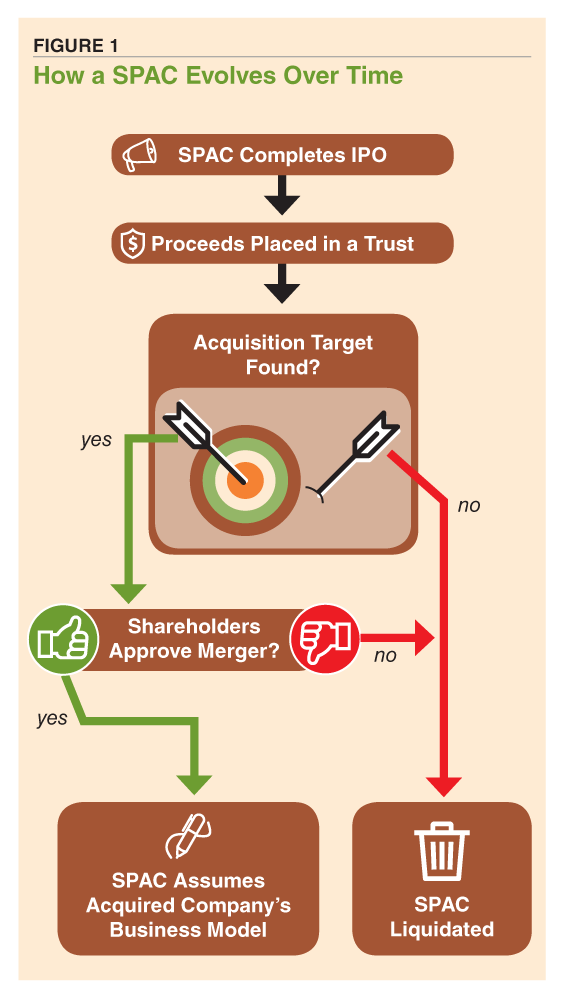
The sponsor then finds a private business for the SPAC to acquire with the proceeds raised from the IPO. Typically, this will be a late-stage private company, whose owners and venture capital backers are looking to cash out of. The private company merges with the SPAC, following a shareholder vote. It is then a public company. Figure 1 illustrates the process.
SPACs are not typical corporations with products or services. In their most basic form, they are simply pools of money with a management team. Their goal is to find an attractive investment opportunity or return the money to investors. With a SPAC, an investment firm raises cash from public investors with the goal of acquiring a private company to bring it public. There’s a limited period for a SPAC to merge with an existing company—usually two years.
 More companies are utilizing SPACs to get listed on U.S. public markets, as an alternative to traditional IPOs. SPACs may offer investors a unique way to get in on the ground floor with innovative growth companies or unicorns. A unicorn is a term used in the venture capital industry to describe a privately held startup company with a value over $1 billion.
If a private company needs capital to scale and capture a growing market share quickly, going through a traditional IPO may not always be the best way. A traditional IPO can take over a year to complete and involves significant uncertainty in terms of the outcome. It is a very demanding and distracting process for a private company. SPACs provide a fast-track process for becoming publicly traded.
Because this is a merger, the process is different. An IPO typically involves a series of roadshows to institutional and other large investors along with the filing of a registration statement (Form S-1) with the U.S. Securities and Exchange Commission (SEC). The pricing of the IPO is publicly disclosed and will change depending on investor interest and demand. The SPAC, once publicly traded, will analyze and negotiate directly with the company it seeks to acquire. Shareholders do not see information until the proposed merger is announced and a proxy statement is filed. The SPAC negotiates with funds already raised while IPO companies seek to raise capital through their initial offerings.
Ventures such as Virgin Galactic Holdings Inc.  (SPCE) in space tourism, Nikola Corp. (NKLA) in electric vehicles and DraftKings Inc. (DKNG) in digital sports entertainment and gaming have become listed companies through the SPAC route.
This investment vehicle has gained in popularity in 2020, with much of it due to market volatility from the coronavirus pandemic. According to the SPACInsider website, this has been a record year for SPACs, with nearly $36.2 billion raised in SPAC gross proceeds so far through August 2020. That’s far higher than the $13.6 billion in gross proceeds for SPACs in 2019 or the $10.8 billion in 2018.
Ackman’s SPAC is the largest so far to complete a public offering. Pershing Square Tontine Holdings Ltd. (PSTH) raised $4 billion. The hedge fund manager is seeking “to pursue merger opportunities with private, large-capitalization, high-quality, growth companies,” according to the SPAC’s regulatory filings.
One of the reasons that makes investing in a SPAC intriguing is that equity investors can often buy them just like a stock. They trade on public exchanges. The catch is that investors don’t know what they are investing in until the SPAC makes a deal, but investors have the right to get their money back if they don’t like the deal.
For example, the SPAC VectoIQ Acquisition Corp. said it was going to focus on real estate. But this did not end up being the case. Rather, VectoIQ merged with Nikola and trades under ticker symbol NKLA.
When SPACs complete a deal, they merge with a company and its existing product or service. It is typical for the SPAC to adopt the acquired company’s name and change its ticker symbol. If no acquisition is completed by the deadline established by the SPAC, the corporation is liquidated with the trust’s assets distributed to shareholders.
The reputation of SPACs has improved over the decades as governance practices have also improved and made them more shareholder friendly. As mentioned, shareholders are now able to vote either in favor of or against a deal and still ask for their cash back. SPACs offer “redemption rights” to investors: If investors don’t like the deal, they can exercise their redemption rights and get some of their money back. (The prospectus should be carefully read to find out what the redemption rights are concerning both shares and warrants.)
SPACs can provide private-equity-like returns but with greater liquidity as SPAC shares can be bought and sold like any other stock. They are a non-traditional investment that can help diversify the source of returns of a portfolio. In terms of downside protection structure, when a SPAC initially raises cash, it’s put in a trust. Shareholders unhappy with a proposed merger can opt to take advantage of their redemption rights or sell their shares. If the SPAC makes a promising merger deal with an existing company, shareholders approve of the acquisition and the market looks favorably upon the deal, the possibility for shares to rise in price exists. Shareholders can then make the decision to continue holding or take the potential profits. (Traditional private equity investments typically come with restrictions on selling.)
As with any investing opportunity, SPAC investing involves risk and requires appropriate due diligence. Investors should consider assessing the track record of the SPAC founder to determine if their past investments or ventures have been successful. After the SPAC makes a deal with an existing company, the investor will want to evaluate the transaction, consider the valuation and assess the acquired company’s management team, business model and growth plans. It is also critical to look at how invested the SPAC founder is in the deals it makes and how the SPAC is structured in terms of common stock and stock warrants.
Instead of “shares,” SPACs are typically sold in “units.” A unit of a SPAC will often contain both common stock and stock warrants. On average, an investor receives a certain number of warrants per share of common stock—usually one warrant per three shares of stock. So, a SPAC investor gets a common share as well as a sweetener, which is in the form of a warrant, an option to buy more shares at a specific price in the future. This allows the investor to participate in the growth opportunity as the value appreciates.
A warrant is a contract that gives the investor the right, but not the obligation, to buy shares at a certain price from the company. For example, if the investor bought units of a SPAC for $20, the warrant might be for $23. If the stock goes to $30 after the SPAC completes a merger, the SPAC investor still has the right to buy shares at $23.
SPACs are risky because of their unknowns, but they can be potentially lucrative if the SPAC founder is an experienced institutional investor who is able to find the right opportunities. A blank check company provides an opportunity for those who are looking to speculate on emergent companies or for potential special opportunity situations not otherwise available to individual investors. ?
Stock Strategies
Stock Strategies


BARRY J from TX posted over 5 years ago:
Hugh R from OR posted over 5 years ago:
You need to log in as a registered AAII user before commenting.
Log InCreate an account