


Article Highlights:
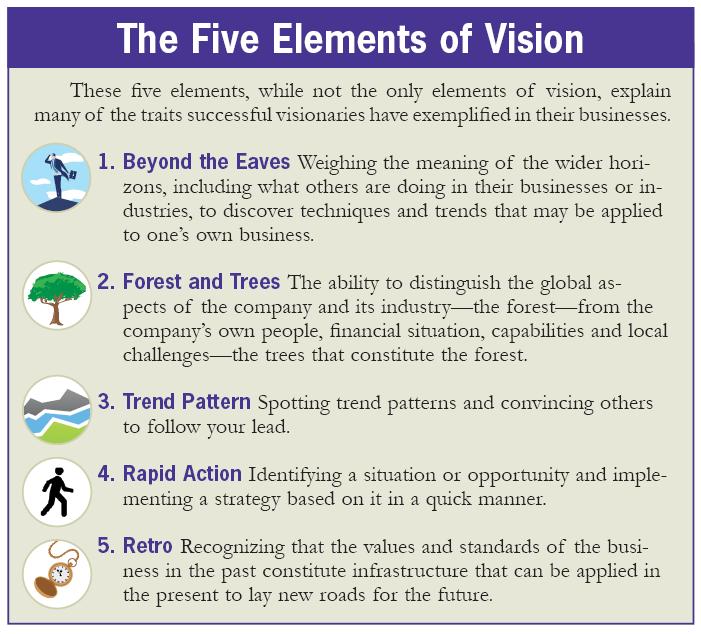
- Five elements of vision that explain much of business success are: beyond the eaves, forest and trees, trend pattern, rapid action and retro.
- Investors should look for executives who are adhering to their own vision, whether it is the original vision or some adaptation or modification to a new vision.
- To determine if progress is being made on turning a vision into reality, investors can access annual reports, investor meetings and conference calls. It’s also helpful to consider what the competition is doing and what is occurring outside of the company’s industry.
Lloyd Shefsky recently retired as a clinical professor of entrepreneurship at the Kellogg School of Management at Northwestern University and serves on AAII’s board of directors. AAII president John Bajkowski and I spoke to Shefsky about how investors can apply the insights he shared in his latest book, “Visionaries Are Made Not Born: Your Vision Can Lead to Breakthrough Success” (2017), when analyzing publicly traded companies.
—Charles Rotblut, CFA
Charles Rotblut (CR): In your book, you discuss business visions. Could you explain what you mean when you describe someone as having a vision when it comes to running a business?
Lloyd Shefsky (LS): Vision is very simple: It’s a goal. It’s something you see out in the real world. It’s something you believe you’d like to get involved with making real. It can be an opportunity, it can be a challenge, it can be any of those things.
The question I’m usually asked is, “Can you be successful without a vision?” The truth is probably. There are lots of ways to become successful in this world. Luck—I believe in luck, but I don’t like to rely on it. You can adopt someone else’s vision. You can also just implement really well.
Vision is seeing something out there. In one of my classes I used a slide referencing the film “Back to the Future,” where they go to the future, get an idea and come back. We know that doesn’t really happen, but it seems that way when some of these visionaries do it. It almost seems as if they’re somewhere out there in the future, coming back with an idea and making it into their vision.
CR: Is there a way that someone who’s outside the company can look at the CEO and tell whether there actually is a vision there versus just hype about what they might want to do?
LS: Yes, there are ways. The other side of that question is, “Can everyone do it?” Probably not, but some people can. By some, I don’t mean just a few, I mean a lot of people can do it. It takes real homework. Real homework is when nobody gives you an assignment, nobody tells you where the resources are, nobody gives you a deadline, nobody does any of those things and you have to go do whatever it is. That’s homework.
One of the people I interviewed for my book was Bob Walter. Bob started a company called Cardinal Food, a grocery distribution business, which he later converted to Cardinal Health.
What Bob did when he was still in the grocery distribution business was figure out what his customers were doing. His customers were grocery stores, so he went into grocery stores. That’s part of the homework. Go see what’s going on in this world, in the real world, the customer’s place of business.
Bob noticed that every month, for a period of days or a week, certain goods were on sale at deep discounts. Shoppers came on that week of the month and bought the items on sale. He eventually figured out that manufacturers were giving discounts to the grocer.
How do you compete with that? Well, as a distributor, Bob couldn’t go to the manufacturers to get deep discounts, he was too small for that at that time. So, he had to come up with a very clever way of matching or even beating what they were doing. In order to do it, he had to figure out, “How long does this food last? What is the likelihood of them buying it? When will it go bad, and how do those two match?”
This is what I call the forest and trees vision in my book. He could look inside at what he had and see what the whole world was, the forest if you will, and there was a mismatch; the two didn’t come together the right way. So, he had to figure out how to do that.
Bob hired Doug Linton, who was an algorithmist. All Doug knew how to use his algorithmic science on was investments. So, Bob converted groceries to investments and then gave Doug the parameters of what would be good and what would be bad. It worked, it really worked.
So, it’s homework, astounding homework. When you’re an outsider, when you’re an investor in a public company, you can’t get inside information. You can’t get inside the company to see how their meetings go, what they are thinking. You have to use the things that they publish—whether they say it or they write it or however it happens.
I’ll share another type of vision, this one involving IBM. The company’s PR chief saw my second book, “Invent, Reinvent, Thrive” (McGraw-Hill Education, 2014), being discussed on CNBC. She emailed me saying she read my book and asked if I would like to know more about IBM. She then introduced me to Ken Keverian.
Ken had been part of a small group running Boston Consulting Group—he had a pretty prestigious position with a great firm. Ginni Romety, IBM’s CEO, asked him to join her at IBM. When I asked Ken what caused him to accept Ginni’s offer, he said “She asked me to direct part of her vision.”
What is the vision? Ginni wants IBM to improve the living standard of every person in the world.
Now, that’s what I call a big vision. Not many people have visions anywhere near that big, but she does. If you’re a shareholder of IBM, you know IBM stock has just been hammered, but it’s been hammered because this is so difficult. It is like turning an aircraft carrier. There’s only one way to do it. You can’t fire everyone, get rid of all your businesses and companies and then start over. You really have to do a little down and a little up, and a little down and a little up.
As an IBM shareholder you have the opportunity to read everything they publish—all of their publications about acquisitions and dispositions of companies or businesses. You probably couldn’t have made heads or tails out of it in the very beginning of this process. But now, they’ve had pronouncements and explanations of how this fits into the game plan—which is a vision. You start to see these pieces coming and going, and you can start to see what they’re trying to accomplish.
I have to add another thing. I’m a believer that nobody should buy stock in a company they don’t understand at all. You may not understand it the way the CEO or the experts in the company understand it, but you better understand something about it. One of the reasons for this is so that you can follow these ins and outs to see if it fits the vision.
Now, you won’t know if it’s going to work. There’s always risk in all of this. But you can start to see the pieces coming together over a period of time. What you’re really looking for in a visionary is whether they are adhering to their own vision. Whether it’s the original vision or some adaptation or modification to what we would call the new vision doesn’t matter. They’re actions adhering to the principle of that vision. That’s a kind of visionary that is long, long term. Big and long, long term.
John Bajkowski (JB): It almost sounds like this is an area where individual investors might have some opportunities, because to the extent that a company has a visionary leading them, they could take a longer-term perspective. And if a company has a couple of bad quarters, as they jettison perhaps some old areas and work on their strategic initiatives, individual investors might be able to take advantage of any price weakness.
LS: Exactly. But it’s more than that. Bad quarters or bad years—they also have to look at what causes them. If part of it is a write-off related to the sale of a business that doesn’t fit their vision, it’s not a bad quarter. It may be bad numbers, but it’s not a bad quarter because they accomplished something to get to their vision. If they bought a company but had to spend a lot on research and development to build up capacity that they didn’t have, it could kill their financial numbers for the quarter but it’s not a bad quarter. It’s a good investment toward that vision.
JB: Could you go over the five types of visions you discuss in your book?
LS: Before I start, I want to say that these are not the only or exclusive elements of visions. There are probably a million more. These are the five that I picked because I think they explain an awful lot. Sometimes they operate independently, but most often they operate in various permutations. So, one, two, three and four can be together.
Let’s start with the first one, the forest and trees vision. Your company or business can really excel if you can understand what you’ve got—what your and your company’s skills are, what the capabilities are—and then simultaneously look out there and see what’s needed.
All too often, we don’t do that. All too often, we’re so fixed on one or the other of those that we forget that you have got to have both. If you’re going to have a vision anyway, you’ve got to say, “Here’s where I want to get to, because that’s what’s needed out there. And here’s what I’ve got.” Then you can work out how you’re going to get there. So, being able to have that forest and trees vision is very important. Sometimes it’s a technological need, sometimes it’s marketing, sometimes it’s financial. I mean they’re all different things, but that type of dual vision is very important.
The second one is a beyond the eaves vision. Beyond the eaves vision is where you really look beyond your acreage. So, whatever the size of your lot line is, you’re looking beyond that to figure something out. I mentioned earlier Bob Walter looking at the customers. Sometimes it’s in other directions, in other ways, trying to understand what’s going on out there. And one of the ways that beyond the eaves vision is handled is with the third vision, trend pattern vision.
We always know that trends are really important. They’re important to everything in life, but the truth is that it’s not just the trend, it’s the pattern of the trend. Not just which direction it’s going now, but is it going to change, is it going to zigzag? How long will it take to get to each zig or zag? All those combinations of factors become very important and the development of that vision means you really have to be studying something way out there.
Let me stop and give you an example that I think will help. One of the people I interviewed is Fred Smith, who started Federal Express.
Fred reads. Fred doesn’t read fiction or business books, he reads about the world—what’s going on in Africa or what somebody is saying. When I asked him if he is reading to solve a problem at FedEx, he responded by saying he never does that. He just reads to try to put a picture together. Now, that’s what I call trend pattern vision.
I will also give you three little examples of something I noticed years ago. Three different people talked to me about what I now call trend pattern vision.
One was the guy who founded Fuddruckers, Phil Romano. Later, he started Macaroni Grill. In his office, he had this huge wall in all cork with little pins. On it were little scraps that he had torn out of things. I walked up to see what they were and they were like little pieces of a restaurant. He’d see something somewhere, tear it out and put it up. I asked, “Do you see something here?” He said sometimes he does, while other times he just moves the pieces around. It’s experimentation; Phil moves the pieces around until they mean something.
The second person is Maria Pinto, she’s a clothing designer in Chicago who used to dress Michelle Obama and Oprah Winfrey, but now she’s more into dressing “normal” people. In her office, she also has a cork wall. Her pictures were all pages out of magazines. They weren’t pictures of clothing, but rather pictures of nature, pictures of travel and pictures of life. She moves them around until she gets next year’s clothing design.
The last one is a Nobel laureate in medical chemistry who spent his life looking in microscopes. When I asked him what he sees, he said that he sees patterns. When I asked how he knows whether it is the right pattern or the wrong pattern, he explained that this is where scientific exploration and experimentation and all that comes in.
So, trend pattern vision is something that encompasses more than just business vision, but business vision is no different than any of those I just mentioned.
The fourth vision is rapid action vision. I came to this actually in my second book. A former client of mine was a venture capitalist who brought Check Point Software Technologies to the market.
He told me the story of when he was in the war in Lebanon. He was standing next to his commanding officer when a burst of gunfire occurred. He was wounded; the superior officer died instantly. All of a sudden, he was in charge of a group of soldiers. How did he know what to do? He was trained to be dropped into a situation, see it instantly and adapt or die.
Now, it’s a little less serious in business. You won’t die, but you can be wiped out if you don’t have rapid action vision or if it doesn’t work.
The fifth one is retro vision. There are two different types of retro vision, but they’re essentially the same. You find them often in family businesses. It’s looking backward to the original or early culture and principles—some people call them mission statements. But whatever they are, it’s looking at the “what you want to be like” type of principle of a company and somehow using that to move forward. So, there are two examples of that.
One example of retro vision at work is Rick Waddell. Rick is now the chair of Northern Trust Company. He had the unfortunate timing to become CEO in 2008. Unlike other banks, most of Northern Trust’s revenue comes from managing people’s wealth.
During the financial crisis, our government decided that they had to loan money to banks in order to keep the banking system afloat. Because it’s technically a bank, Northern Trust was put in the same position as every other bank. The government was afraid that if Northern didn’t take the money, it would give them some advantage by appearing healthier than the other banks, and they couldn’t do that. Rick put the money in escrow and left it there until he was allowed to pay it back.
Many of his company’s customers had debt instruments of some kind. These investments weren’t sold by Northern, but the company managed their customer’s portfolios. Because of the high fluctuation in the market, nobody could price these things. No one could sell them, and everybody was stuck with them. These were the liquid reserves, if you will, that customers had in their accounts. If they wanted to go on a trip or they wanted to buy a new house or a car, this is what they would usually tap into, but they couldn’t during the crisis.
Northern Trust wound up taking the risk on the debt securities and got the money to the customers when they needed it. In doing so, the bank had to book a loss of half a billion dollars right away. That kind of a loss could really affect the stock price, which meant that somebody could buy Northern cheap. Because it was a loss, it also meant that Rick eliminated the bonuses to officers. Here was a guy who was risking the bank, risking his job, risking his relationship with his officers whose support he was going to need. He just did it because he had always been looking back at the customs and principles of the bank’s founders and so forth.
The second kind of retro vision occurred around the same time: Starbucks had problems, not just with net profit, but also with revenue that had dropped dramatically.
The problem was that a new CEO was instructed by the board to open 10,000 stores that year. He performed perfectly in the sense that if you want to open that crazy of a number of stores quickly, you must make some changes in the stores. Then revenue dropped like crazy. They let him go and asked the founder and former CEO Howard Schultz to come back.
What had gone wrong? Well to make those coffee machines work more efficiently, the fired CEO had put in this gigantic machine. It stopped the hissing sound of coffee brewing, it stopped the aroma from coming out, and it stopped the visual of the barista seeing the guy coming in where he could say, “Hey Joe, you want your regular?” He prevented all of the senses from experiencing the enjoyment of Starbucks.
So, the first thing Howard did was go visit stores to see what was going on. Then he got rid of those machines and retrained the employees. Sure enough, revenue went up.
If you think about it, what Howard did was to make Starbucks something old. He went back to what he called the spirit of Starbucks. It’s what taught me the concept of retro vision.
Let me give you what I consider the ultimate example of the value of retro vision, and it involves everyone’s favorite investor: Warren Buffett. His Berkshire Hathaway had never acquired a business outside the U.S. until it acquired Iscar, an Israeli company, whose founder and son (successor CEO) I interviewed. The complete story is in my new book. Buffett bought Iscar after hearing from the son about how the company adhered religiously to the founder’s vision.
CR: Regarding indicators, if an individual investor is looking at a company, what metrics can they use to determine whether a company is making progress on its vision?
LS: There are instruments out there—such as annual reports, investor meetings, telephone conference calls, etc. —where you can see what the company is doing. But almost no executive says, “Here’s my vision and here’s how I’m implementing it.” It’s just not done that way. Wall Street participants would faint if they heard the word “vision,” because they’re all such short-term thinkers. But the truth is, there are places where companies talk about their vision, and if you do your homework, if you go read this stuff and listen to this stuff, you can see if they’re implementing things according to the plan of the vision.
The second thing is to look at the competition. There may be direct competitors, but sometimes they’re not direct competitors, and even the ones you think are direct competitors aren’t. For this book, I interviewed Fred Smith of Federal Express and David Abney from UPS. Almost everyone would say these two companies are competitors; well, they’re really not. If they’re competitors, it’s the two of them against
Amazon.com. Which is interesting, because Amazon.com is also their customer. So, it’s very complicated to figure out who a competitor is these days. And sometimes the competitor is the proverbial two guys in a garage getting ready to eat your lunch. So think about and read all you can and compare what you find out to how a company is doing.
The third thing is what I talked about with Fred Smith. Read about the world—where it is going. But while you’re reading, don’t think about a company. Just read and learn. And then when you’ve read X number of books on a bunch of different topics, you should train your mind to start pulling this information together and figuring out some trend pattern vision to watch for.
JB: You bring up a good point in the book about how in the past people looking farther out into the distance were the big visionaries, whereas today perhaps it’s the people who are able to think more rapidly about vision. Can you elaborate on that?
LS: The times have changed, technology has caused that. If you were to found a company that turned out as good as Apple, you’d be a visionary, right? Steve Jobs was a real visionary. But you don’t have to be Steve Jobs to be a visionary. There was also another guy, Ronald Wayne, who was the third founder of Apple. In 1976, he sold his 10% for $800, which today would be worth $78 billion.
Was he a visionary? You bet. Anyone who was involved in the founding of Apple was a visionary. Was he THE visionary? Maybe not, maybe that was Steve Jobs. But he was still a visionary to even be willing to put up with Steve Jobs. Was he as good a visionary when it came to his personal investments? Clearly not. Now, does that make him less of a company visionary? If I use Ronald Wayne as the example, it would be of a guy who had two different visions, business and investment—one was great and one was not so great.
You also have to think about why he did it in 1976. I think it was 1977 when the first Apple II came out. That means he sold before there was a product. So, what he was probably selling on was either that he couldn’t get along with Steve Jobs or, maybe more importantly, that he couldn’t believe that they could implement anything. So, sometimes, implementation gets in the way of vision, and that goes back to the question, how do you watch all this? You have to start thinking about whether it is implementation or a vision that is failing.
There’s nothing wrong with a vision failing or having to be fixed or modified or even totally changed.
CR: I know you’ve done a lot with startup companies, but right now we’re seeing more and more companies staying private. How’s that impacting individual investors’ ability to invest in new visions or invest in innovations, or impacting the next generation of visionaries, for that matter?
LS: You’re absolutely right about the reduction in the number of public companies. It’s more than reduction, it’s the falling off of IPOs (initial public offerings). You can’t be a startup IPO, that’s gone. If your business has less than a couple hundred or a quarter of a billion dollars in revenue, you shouldn’t even look at IPO status. You can’t afford it—not just the regulatory and professional costs, but also the time costs. That’s the time it takes top management to manage the stock. It’s ludicrous, you just can’t do it.
Everyone needs liquidity events. Friends and family who invest in a company, the professional individual investors, the institutional investors and the venture capitalists all need a liquidity event someday. M&A (mergers & acquisitions) turns out to be the primary way of doing this.
Let me use IBM as the example. IBM is anything but a startup, and they’re not buying startups for the most part, but they’re buying pretty small companies. They’re not buying a revenue stream or an income stream or anything like that. They’re buying people, they’re buying technology, they’re buying some strange kind of business model implementation that worked. Whatever it is that they’re buying can be visible in a small company. You can have proof of concept level without having tons of revenue.
IBM is just one example. There are a lot of big companies buying these small companies. I do a lot of work with small companies coming out of Israel, and they’re all high-tech companies. They’re being bought up left and right, and they’re being bought up globally.
There’s no magic to the numbers I’m using, I have to preface with that. These companies have under $10 million of revenue and they’re being acquired for unbelievable amounts of money. What used to be unbelievable is now almost routine. A company with under $10 million in revenue being bought for nine figures is astounding in my way of looking at things. But it’s happening. They’re not buying a revenue stream, obviously; they’re buying technology and people.
Let me put this in perspective. Intel has real competitors out there, big companies. But their vision became impaired: They forgot to be in mobile chips. So, they went out and bought a couple of small companies that knew mobile, ramped them up in their atmosphere and created an Intel that is now back on track again.
Two other things came up more recently. One, we have a ton of entrepreneurs who sold their businesses for lots of money, and they have become the investors that venture capitalists used to be.
The second phenomenon is crowdfunding. There are two kinds of crowdfunding. There’s crowdfunding as we all know it: Set up something and a lot of people send in a couple hundred dollars each. The second kind of crowdfunding is groups that have come together that are organized, crowdfunding funds. Some of them are general, while some of them are very specific. Now, will they be successful? I don’t have a clue. But they’re wonderful opportunities for those people who want to make smaller investments maybe in little pieces of a bigger pie or for companies that want to get funded but can’t go the traditional or old routes.
One example is OurCrowd, which happens to invest almost totally in Israeli startups. You can’t get these startups in a public offering. This is an opportunity to go with a fund that then invests in what you wish you could’ve done individually.
We don’t know which investments will be good and which will be bad. But the opportunity is there, it’s exactly what you’d expect. You just named a problem, somebody saw an opportunity, and that’s what they’re doing.
As a special gift to AAII members, videos of Lloyd Shefsky’s interviewees (Ross Perot, Fred Smith, Rick Waddell, Kay Koplovitz, Rocky Wirtz, Bob Walter, etc.) are available online.
Simply go to www.lloydshefsky.com, click on “Book Registration” at the top, fill out the form, enter the promo code “AAII” (but leave the Special Offer ID field blank) and follow the instructions.

Related

Stock Strategies
What You Can Learn From Shareholder Letters
Related

Discussion
FREE REPORT

Get your free copy of our special
report analyzing the tech stocks
most likely to outperform the
market.
Dave Gilmer from WA posted over 8 years ago:
You need to log in as a registered AAII user before commenting.
Log InCreate an account