

Related

Retired Investor
Our Big Question survey gives insights into what types of accounts are favored by AAII retirees, and how they make withdrawal decisions.

Charles Rotblut leads a class in AAII's new Essential Investing Video Course. Go to https://www.aaii.com/ves for more information and to subscribe.
Many retired AAII members use the tax code as their withdrawal strategy. Close to half told us that they limit their withdrawals to the amount required to be taken each year.
This insight came from our latest “big question” survey. The survey focused on strategies for taking retirement withdrawals. Among the subjects we asked AAII members about were what guides their withdrawal decisions, what causes them to adjust their withdrawals and the role taxes play.
The survey is part of a periodic initiative to give individual investors a chance to talk about their investment decisions and challenges. Each survey asks what we’re describing as a “big question” about a subject affecting many investors. A randomly selected group of AAII members is asked a specific question, as well as follow-up questions intended to provide more clarity and background.
This sixth survey in the series was emailed to AAII members in October 2020. The results were tabulated based on responses sent to us. We received 538 responses from the survey invitation; 471 said they were currently taking retirement withdrawals from their portfolios. The average age of those taking withdrawals was 74, while the median age was 73. The oldest was 95, and the youngest was 57 years old. Respondents said they have been taking retirement withdrawals for an average of nine years and a median of seven years.
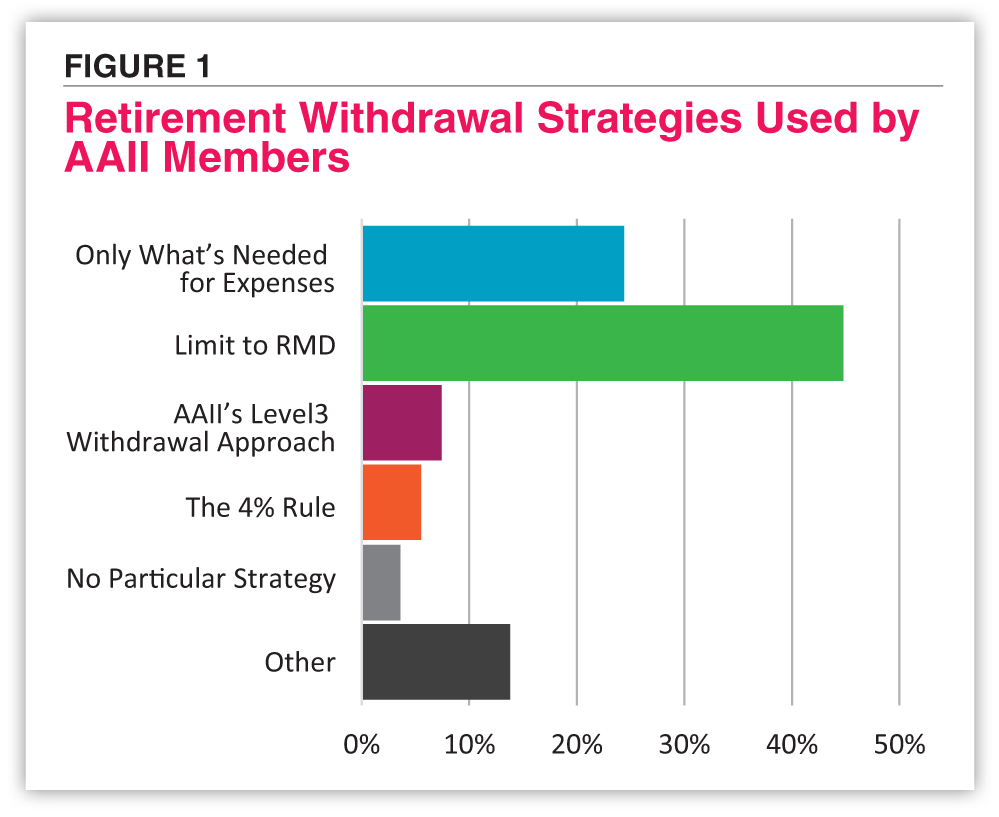
The most commonly used withdrawal strategy was to simply take the minimum amount required by the tax code (Figure 1). This was the approach followed by 45% of respondents. Required minimum distributions (RMDs) are mandated from tax-deferred retirement accounts, including traditional individual retirement accounts (IRAs), 401(k) plan accounts and 403(b) accounts, among others. Roth 401(k) accounts are also subject to the RMD rules.
The answer “only what I need for expenses” was chosen by nearly one-quarter of all respondents (24%).
More than 7% said they are using AAII’s Level3 withdrawal approach. This strategy, developed by AAII founder James Cloonan, calls for holding the equivalent of four years’ worth of living expenses in safe assets (cash and cash equivalents) and allocating the remainder to growth assets (equities). Whenever the market is within 5% of its high, withdrawals are taken from growth assets. During years when the market is below 5% of its high, withdrawals are taken from safe assets.
The 4% rule was followed by slightly less than 6% of respondents. This approach, developed by former financial planner William Bengen, calls for taking the equivalent of 4% of one’s retirement savings at the start of retirement. Each year thereafter, the starting amount is adjusted by the rate of inflation.
When asked why they chose their current strategy, two out of five respondents (42%) chose “a desire to limit withdrawals to what government requires” as their reason. Many respondents mentioned taxes and/or Medicare premiums. The answer from J. G. Traeger was representative. He limits withdrawals to “the RMD plus additional funds to convert to a Roth IRA before hitting the next federal tax bracket. He also stays “mindful of the potential impact of Medicare surcharges.”
The existence of other sources of retirement income was another reason why many members just rely on RMDs to guide withdrawals. Robert Wheeler explained that his “RMD plus pension plus Social Security provide more income than is needed for inflation-adjusted spending. The excess gets invested in non-retirement accounts to protect against future needs.”
Several respondents told us they try to stay below a certain percentage, including Kevin Lewis. He uses “the 4% withdrawal rate as the maximum to withdraw in a given year.” Lewis added “My expenses are much less than that maximum. I only withdraw what I need.”
Douglas Hudson limits his withdrawals to “generally between 4% and 5% per year.” He describes it as being “enough to live on without materially decreasing principal value.”
Most respondents have been sticking with the same withdrawal strategy since they first retired. Among the 16% who said they’ve changed their strategy were many who retired when the mandatory age for when RMDs must start was 70½. (The age is now 72.) Some other respondents are taking advantage of the CARES Act RMD waiver for 2020.
To gain more insight about the decisions individual investors make regarding their retirement portfolios, we asked how frequently they increase the size of their withdrawals. Respondents were nearly evenly split between those who adjust annually in accordance with their required minimum distributions (41%) and those who only make adjustments as needed to cover expenses (40%). RMDs change annually based on a person’s age and the amount of savings in accounts subject to mandatory distributions.
Only about 4% of respondents use inflation as a guide for adjusting their withdrawal amounts.
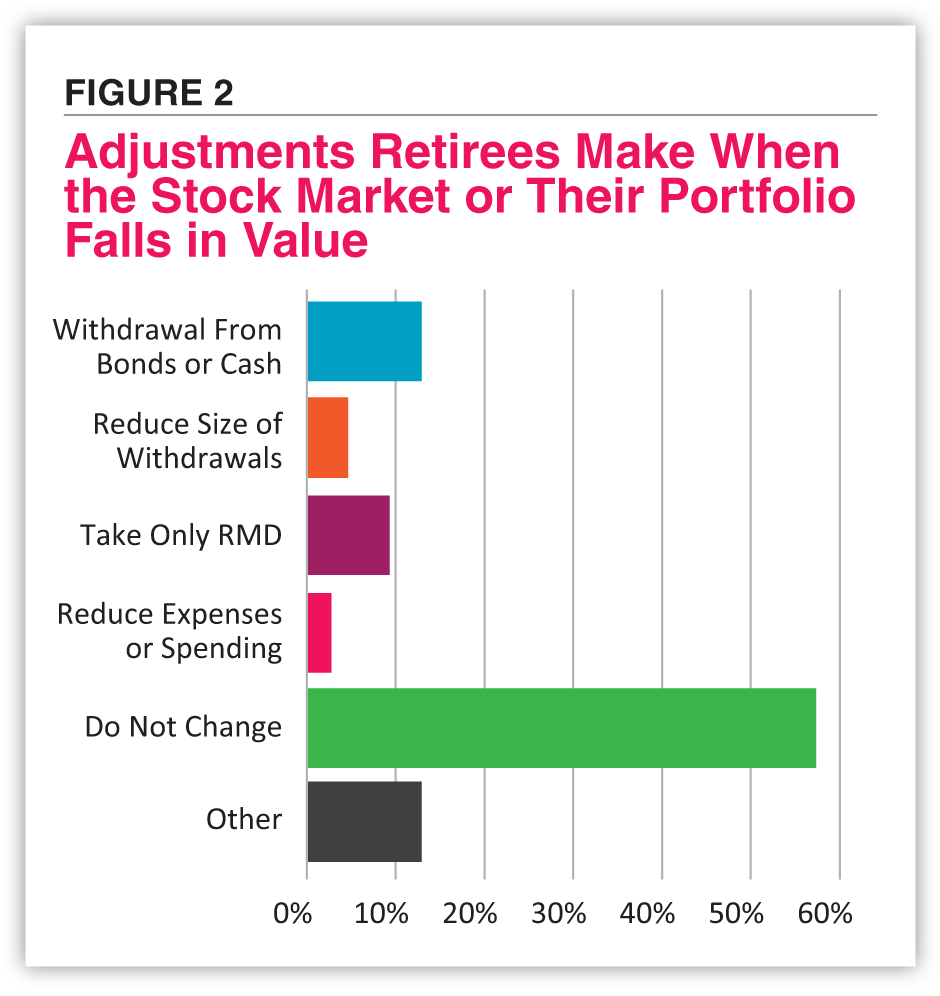
As a follow-up question, we then asked respondents what adjustments to withdrawals they make when their portfolio or the stock market falls in value. The majority (57%) do not make any changes (Figure 2). An additional 9% said they take just the RMD amount. This is not surprising, given the high reliance on using RMDs as a guide for taking withdrawals and the fact that RMDs are mandatory.
About 13% of respondents take withdrawals from their cash savings, as opposed to selling stocks or equity-based funds. Just 5% reduce the size of their withdrawals and only 3% said they reduce spending or expenses.
When asked how taxes impact their withdrawal decisions, 13% of respondents described taxes as being a major consideration. An additional 19% limit withdrawals to the RMD amount or otherwise minimize withdrawals to reduce taxes. Almost 7% use qualified charitable distributions (QCDs) to reduce taxes. QCDs can be made in lieu of RMDs for amounts up to $100,000 per year. Slightly more than 3% cited Medicare premiums as a consideration.
Conversely, more than one-third of respondents said taxes either have no impact (22%) or a minimal impact (14%).
Mark Hammer is among those who are actively doing Roth IRA conversions: “We figure this is about the lowest federal tax rate we’ll ever see so we are withdrawing some, paying taxes and redepositing the remainder into a Roth IRA.” J. B. Mitchell takes the RMD and then converts just enough to a Roth IRA “to exhaust 12% federal income tax bracket.”
“Tax considerations do not have a significant impact,” responded R. F. Leinig. “I minimize taxes by using QCD withdrawals for charity. I don’t typically sell taxable securities, but I will do some tax harvesting by selling gains and losses if it makes sense to me. I do Roth conversions, but I make sure not to jump into higher federal tax or Medicare brackets.” In a follow-up email, he added, “If you are in the RMD age group, and you don’t need the money, 2020 is an excellent time to maximize Roth conversions.”
When asked specifically about qualified charitable donations, more than half of respondents (61%) said they do not make QCDs. The difference between this answer and the percentage of respondents who specifically listed QCDs when describing how taxes impact their withdrawal decisions may be attributed to factors such as not needing the full RMD and/or a desire to make charitable donations.
Most respondents (89%) make use of traditional IRAs, SEP IRAs and similar types of accounts. Nearly half (46%) say they own a Roth IRA. Employer-sponsored plans—401(k), 403(b), Thrift Savings Plans (TSPs)—were less frequently used but still owned by 22% of all respondents.
There is a high usage of taxable accounts. Almost two-thirds of respondents (66%) say they use a traditional brokerage account, a taxable mutual fund account or a similar type of account. Slightly more than 39% use a bank or savings account.
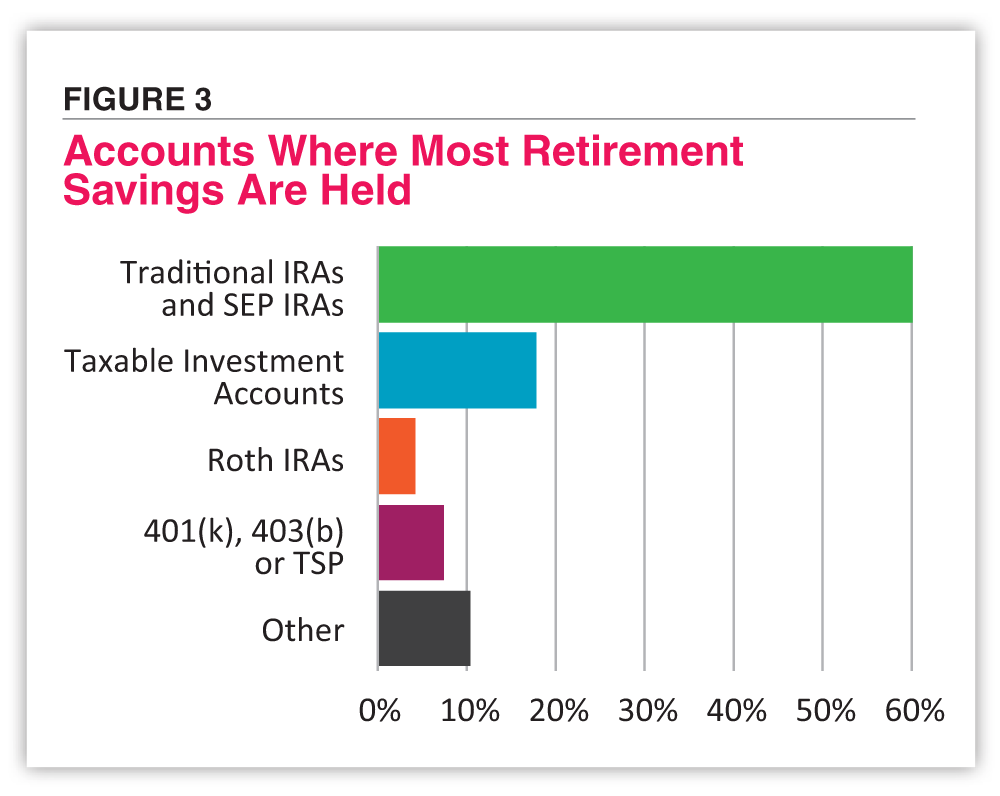
When we followed up by asking respondents which type of account most of their retirement savings are held in, the answers shifted. More than half (60%) listed traditional IRAs or SEP IRAs as the primary account for their retirement savings (Figure 3). Traditional brokerage accounts, taxable mutual fund accounts and a similar type of accounts were a distant second, named by 18% of respondents. Slightly more than 7% said employer-sponsored plans, while 4% have most of their retirement savings in Roth IRAs. The “other” in Figure 3 includes annuities and bank accounts.
Nearly two-thirds of respondents (62%) described retirement savings as a primary source of retirement income. This is a larger percentage than either Social Security or pensions, which were chosen by 46% and 34% of respondents, respectively. (Respondents were allowed to choose more than one answer.)
As far as sources of cash to fund portfolio distributions are concerned, dividends are most commonly used. They were named by 19% of respondents. An additional 4% use interest from bonds and/or bond funds. About 10% free up cash by selling investments.
Maintaining a cash allocation is common, with 18% of respondents saying they do so. An additional 11% said the amounts required for their withdrawals are already funded. About 13% said they use Social Security benefits, RMDs and/or pensions to provide cash.
When asked about how confident they are about maintaining a comfortable lifestyle through the remainder of their retirement, three-quarters (75%) of respondents described themselves as being very confident. An additional 15% chose “somewhat confident” as their answer.
Finally, we asked respondents what guidance regarding withdrawals they would share with those nearing retirement. The most common advice centered around limiting the amount of withdrawals and having a budget to live on that withdrawal amount. Less frequently given were suggestions to maintain a cash balance or to follow a strategy incorporating safe assets. Other advice included doing Roth IRA conversions, limiting taxes and delaying retirement.
“Create an accurate spending budget before retirement and compare it to your income sources to determine cash flow,” advised R. P. Chichester. He suggests that “one should calculate RMDs before being required to take withdrawals to understand the tax impact and possibly withdraw from IRAs earlier to mitigate the tax burden when full RMD withdrawals are required.” ?
Retired Investor

Portfolio Strategies

Financial Planning

ALAN H from MO posted over 5 years ago:
ROBERT A from FL posted over 5 years ago:
CHARLES R from IL posted over 5 years ago:
DAVID G from NJ posted over 5 years ago:
RICHARD F from MN posted over 5 years ago:
ALAN W from FL posted over 5 years ago:
JOHN W from NC posted over 5 years ago:
PETER T from NM posted over 5 years ago:
ERIC P from NE posted over 5 years ago:
DONALD M from AZ posted over 5 years ago:
WILLIAM M from AK posted over 5 years ago:
MARK S from VT posted over 5 years ago:
CHARLES R from IL posted over 5 years ago:
Gary S from TX posted over 4 years ago:
ROBERT A from NC posted over 4 years ago:
You need to log in as a registered AAII user before commenting.
Log InCreate an account