Creating an Inventory of Your Investment Accounts

Learn to create an inventory of your savings and investment accounts to help you evaluate the costs and fees you are paying and to aid in your allocation and risk assessment when doing portfolio reviews.

Charles Rotblut leads a class in AAII's new Essential Investing Video Course. Go to https://www.aaii.com/ves for more information and to subscribe.

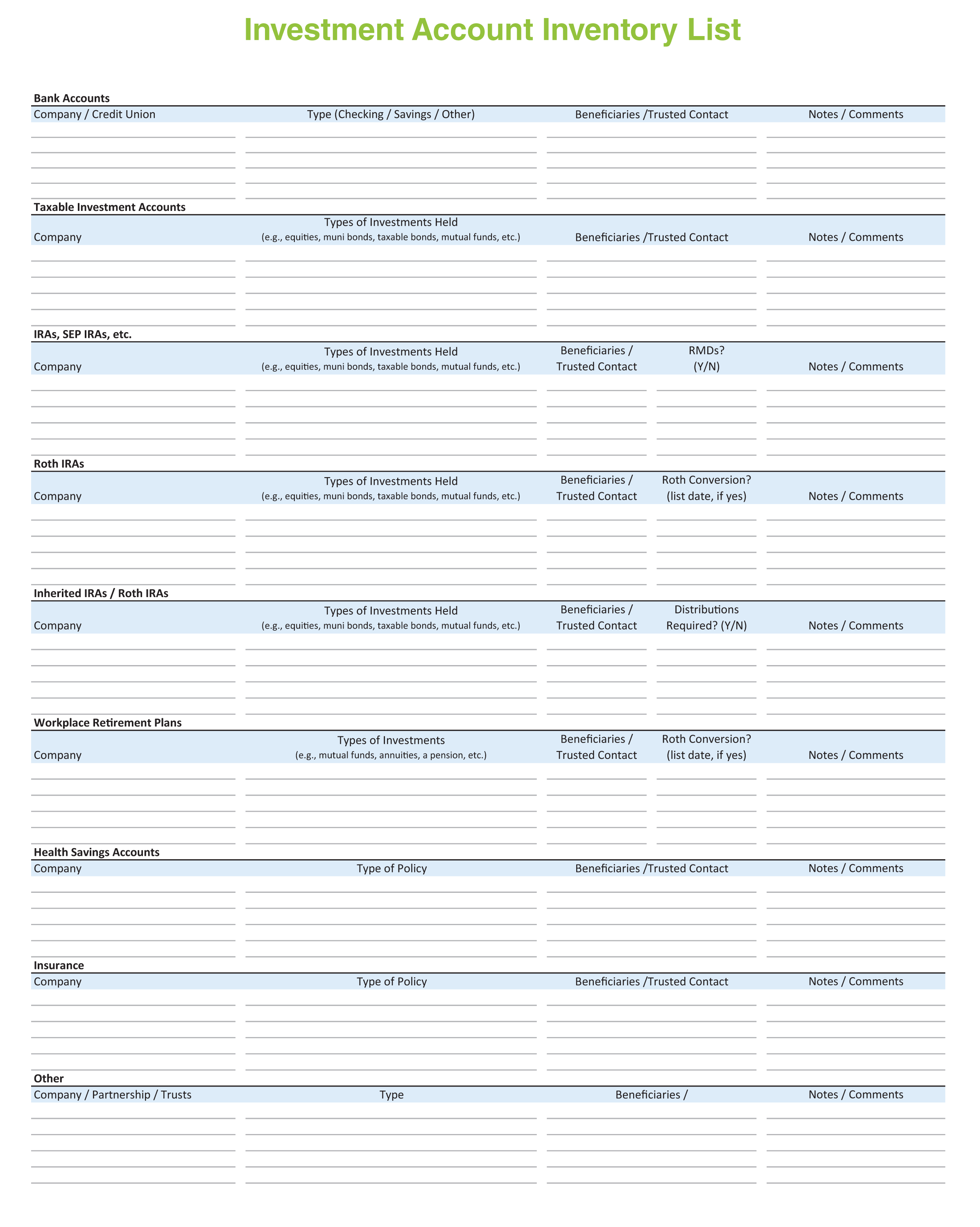
This month’s InvestoGraphic will help you create an inventory of your savings and investment accounts. It’s a document we think everyone should have. Considering it in the context of an overall investment policy statement will help you to understand why it’s being included in the Individual Investor Wealth-Building Process.

If you consider yourself to be an index investor or someone who is focused on costs, the list can be a prompt to take a look at what you’re paying in fees and costs. From the standpoint of ensuring that your allocations are in line with your tolerance for risk and/or doing your periodic review, the account inventory serves as a useful checklist to ensure that you haven’t overlooked anything.

The inventory may also help you spot opportunities for consolidation. Over time, the number of accounts you have may have grown due to job changes, Roth IRA conversions, changing brokers or other reasons. Combining these accounts would make it easier for you to manage your investments.

Then there is asset location. Asset location matches the tax characteristics of investments with the tax characteristics of accounts. Strategically placing less tax-friendly investments—such as real estate investment trusts (REITs), corporate bonds and funds with higher tax-cost ratios—into tax-preferred accounts (IRAs, Roth IRAs, etc.) can help you reduce your tax bill.

Key Characteristics of Investment Accounts

The inventory worksheet separates accounts by their characteristics.

Traditional IRAs, for instance, are separated from Roth IRAs and inherited IRAs. Traditional IRAs are funded with pretax dollars. Starting at age 72 (age 70½ pre-2020), required minimum distributions (RMDs) must be taken. Roth IRAs are funded with aftertax dollars. Withdrawals—which are never required—made after a period of five years have no tax impact (presuming you meet the age requirements, generally age 59½ or older). Mandatory withdrawals generally exist for both inherited IRAs and inherited Roth IRAs. These accounts also do not receive bankruptcy protection in most states.

Taxable accounts, which include brokerage accounts and mutual fund accounts, give you the most flexibility in terms of what you can invest in, how much you can deposit and when you can take withdrawals. They are most suited for strategies and investments with a low tax impact (index funds, municipal bonds, long-term stock holdings, etc.).

Workplace accounts like 401(k), 403(b) and 457(b) plans are funded with pretax dollars but have much higher contribution limits than IRAs ($19,500; $26,000 if age 50 or older in 2020). Investments are generally limited to the plan’s menu, unless there is a brokerage window. Costs are generally higher than with an IRA or a traditional IRA, though it varies. A big advantage of these plans is that contributions come directly out of your salary, which automates the savings process.

Some employers offer pensions (though much less so than in years past). They provide a stream of cash flow that can allow for more aggressive allocation to stocks in other accounts. Annuities may also be offered; such offerings should be scrutinized against other plan offerings—particularly based on costs and redemption fees.

Health savings accounts (HSAs) are unique for the triple tax advantages. Qualified contributions are deductible. Capital gains realized, dividends received and interest earned are not taxed. Distributions are tax-free as long as the dollars are spent on qualified medical expenses. The caveats are that contributions are limited to those covered by a high-deductible health plan (HDHP) and not enrolled in Medicare. ▪

Discussion

TIM H from FL posted over 5 years ago:

I was ALL excited as I read the title - "Creating an Inventory of your Investment Accounts" (!) The commentary nicely captures the essential differences /requirements of various asset groups. The example(?) of the 'Investment Account Inventory List' looks nice but is only a pnf graphic - nothing I can use to do something I have been wanting to do for a long time - create an inventory of my investment accounts. Perhaps there can be a followup with sample real world working data base layouts that be evaluated and built upon to consolidate all the 'stuff' laying around in cyberspace. Or a discussion of available commercial programs whose function is limited to recording information needed by myself and, after I suddenly depart the biosphere, heirs - something with a short program that automatically updates investment data - nice and easily. It may well be a topic in need of development/discussion. tim houghtaling san mateo - N/E florida 32187 TimHoHere@gmail.com


ROBERT B. T from MA posted over 5 years ago:

At the bottom of the first paragraph is a hyperlink to a worksheet. With a PDF file to print. I would caution building an online version of this (Google docs/sheets) if you intend to list account numbers. https://www.aaii.com/latest/article/12932-a-worksheet-for-listing-all-of-your-investment-accounts


Patrick B from NJ posted over 5 years ago:

For asset allocation purposes, do you consider defined benefit pension plan payments as a fixed income asset? Thx. Example, if I’m targeting a 60% equity/ 40% fixed income portfolio, do I consider the present value of the future DB pension payments as a fixed income asset?


GREGORY C from NC posted over 5 years ago:

You should mention that many 401k plans now have a Roth option, although the companies do not make it easy to choose the Roth option. Some companies will only do the employer match on deductible contributions. You can choose the deductible option to get the match and then switch to the Roth option for additional contributions. But again, it is not intuitive or easy to do this. Inasmuch as 401k plans are the primary savings/investment vehicles for many people, AAII might want to do some in-depth articles on how to navigate the choices and get the most out of your 401k plan. Corporate HR departments do not seem to be providing much help in this area.


WILLIAM K from CA posted over 5 years ago:

William K from CA I have been using Quicken for over 30 years. With its downloading features, it is a snap to keep all transactions up to date. Between my wife and I we have a combination of 6 separate accounts with two different brokerage firms. I also have my credit cards and bank accounts included. It does have a feature to keep other assets (home, cars, etc.) in their own accounts. I can print out a Net Worth report up to date in less than a few minutes. It has features to look at securities sorted by account, or sort all investments by security or several other criteria. There are many other features such as budgets, long term financial planning and portfolio performance. Don't waste your time trying to develop a spread sheet. Spend less that $100/yr and make life easier. I keep my file in a cloud account and can access it on several computes as it syncs the last used file.


ALEXANDER M from FL posted over 5 years ago:

NOT INTENDED FOR PUBLICATION May I suggest you leave out ''etc." seen several times in the "Type" column as redundant since they are paired with "e.g.", meaning here are examples, a partial list.


STUART O from AR posted over 5 years ago:

I have used excel for the last 18 years as an aid to log all assets including individual stock holdings setup as a profit and lost monthly statement. Each investment shows by column, the company or fund name, ticker symbol, original cost, value today, ex date, payment date. listed by broker and account, sub divided by broker. This gives me an accurate accounting of cost. profit/lost. income expected and total asset holdings. By adding a section category for total bonds, annuities etc., it gives me an easy reference to see where and how we are doing month to month. 20 minutes are usually spent adding or logging any changes form the month, and con firming the status of money market and checking account end of month values. I then print out a copy for myself and my wife so she can watch the financial health of our household., Being old school and a previous small business owner of 3 separate businesses I still like to hold a financial statement in my hand, put my feet up and study the statement to get a real feel of how we are doing. At the same time it gives my wife a felling of security to see that, in the case of my surmise, she has immediately on hand all the contact, account numbers and values that she can reference if/when she needs to probate the estate., with the help of the professional probate attorney that has previously been appraised.


RANDY L from UT posted over 5 years ago:

Please be aware that IRA accounts ARE protected in bankruptcy proceedings up to $1,362800 Indexed to inflation and revised every three years). Based on state law, an IRA can b e protected above this level.


CHARLES R from IL posted over 5 years ago:

There is an important distinction between IRA and inherited IRA accounts. While IRAs are eligible for bankruptcy protection, inherited IRAs are not because they are not considered to be retirement accounts. Certain states may provide specific protections, however, for inherited IRAs. See this 2019 Dispatch for more information.

-Charles


Rich B from WA posted over 5 years ago:

Stuart O - would you be willing to share your excel spreadsheet? I tried to build one but just don't have the skills. If so, please post here and i will figure out how to get in touch with you. Thanks! Richard B


... C from PA posted over 4 years ago:

i have grown to like Personal Capital's interface (personalcapital.com) to enter, maintain, automatically update & trend all my assets (investments, savings, home, cars..) and liabilities (mortgage, credit cards, loans...). It's free as long as you ignore their telemarketing calls trying to interest you in their active management services.


You need to log in as a registered AAII user before commenting.
Create an account

Log In

Get your free copy of our special report analyzing the tech stocks most likely to outperform the market.

Download the FREE Report Here: