


Related

Exchange-Traded Funds
A study found that portfolios of ETFs created to match a target-date fund can offer average higher returns for lower costs.
by AAII Staff | January 2021

A study found that portfolios of ETFs created to match a target-date fund can offer average higher returns for lower costs.
The use of target-date funds has become common in retirement plans because they adjust their allocations conservatively as shareholders near retirement. However, the total costs of target-date funds are driven up by their holdings. Portfolios of replicating funds attempt to match target-date funds using low-fee ETFs. These portfolios were found to outperform their target-date counterparts by 0.08 to 0.11 percentage points per month, or 0.93 to 1.28 percentage points per year. Those small returns when compounded lead to a significant difference in long-term wealth. The portfolios of replicating funds were found to earn excess returns, not to suffer from the drag of holding excess cash and to exhibit little tracking error relative to their target-date fund counterparts.
The authors of the study created portfolios of replicating funds by obtaining the holdings of similar target-date funds, like the Fidelity Freedom 2030  (FFFEX), and matching those holdings to comparable low-fee ETFs. Target-date funds are “funds-of-funds” because their portfolios are composed of other mutual funds. The study states that 97% of target-date fund assets are mutual funds, therefore the investor pays fees for both the target-date fund itself as well as the fund’s holdings. Replicating funds eliminate those fees, which thereby boosts their returns.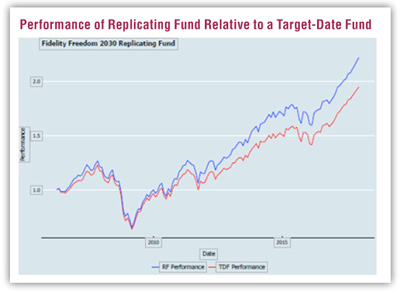
The study used what the authors called “passive replications of funds,” which were composed of the weighted holdings of all target-date funds over a certain period. The authors created four passive replications made up of a different number of ETFs: 50, 21, 13 and six. The study found that the passive replication with 50 ETFs outperformed by 1.07% annually, the replication with 21 ETFs outperformed by 1.00%, the replication with 13 ETFs outperformed by 1.03% and the replication with six ETFs yielded an annual advantage of 0.99%.
Though target-date funds can be improved upon, portfolios of replicating funds have disadvantages. Target-date funds are actively rebalanced by their managers to reflect investors’ changing risk tolerances. With replicating funds, the portfolio must be rebalanced by the investor themselves, a potentially painstaking process. A portfolio of replicating funds is also not a perfect match for a target-date fund, since some mutual funds do not have perfect ETF counterparts.
Source: “Off Target: On the Underperformance of Target-Date Funds,” by David C. Brown and Shaun William Davies; SSRN, October 2020.
Exchange-Traded Funds


No comments have been added yet. Add your thoughts to the discussion!
You need to log in as a registered AAII user before commenting.
Log InCreate an account