


Derek Hageman leads a class in AAII's new Essential Investing Video Course. Go to https://www.aaii.com/ves for more information and to subscribe.

AAII has been developing, testing, refining and tracking a variety of quantitative stock strategies for over 20 years using Stock Investor Pro, AAII’s fundamental stock screening and research database program. Many of these methodologies follow the approaches of popular investment professionals, while others are tied to basic investment principles. These strategies cover a wide range of investment styles, from those that are value-based to those that focus primarily on price momentum and growth.
In the January 2021 issue of the AAII Journal, we published our annual recap article, “An Unprecedented Year for Stocks: 2020 Review of AAII Stock Screens,” discussing the best- and worst-performing strategies for 2020 with data through the end of November 2020.
At the time, the top AAII guru strategy for 2020 (through November 30) was the Inve$tWare Quality Growth screen, a growth-oriented factor strategy. This approach led all AAII strategies with a 100.3% gain through the first 11 months of the year. The Inve$tWare Quality Growth methodology finished 2020 strongly, with an increase of 113.4% for the full year. Despite this solid 2020 performance, the Inve$tWare Quality Growth approach finished the year as the second-best-performing AAII screening strategy.
Driven by positive coronavirus vaccine trials, vaccine administration ramping up and improving economic expectations, there was a feeling of optimism among investors, especially among smaller firms, at the end of 2020. Small-cap companies tend to be more sensitive to economic conditions, and investors rotated into economically sensitive stocks as the positive results of coronavirus vaccine trials surfaced during November.
Shares of small U.S. companies soared past larger firms to end 2020 and to start 2021, after last quarter’s rally continued into January. The gain for the small-cap Russell 2000 index for the year surpassed that of the mid- and large-cap S&P 500 index for the month of January. The small-cap index is up 5% this year through January 29, compared with a loss of 1.1% for the mid- and large-cap index.
There are a few positive trends contributing to small-cap stocks’ strong growth: A relatively small percentage of companies announced earnings disappointments; investors who had been selling value stocks abated a bit; fundamental news has been encouraging, especially from companies supplying auto, food, housing and capital goods companies, where there had been little capital investment and inventories were tight; and the risk-reward proposition was attractive.
After two consecutive years as the second-best-performing AAII screening strategy, the Foolish Small Cap 8 methodology finished 2020 as the top strategy. This approach led all 60 AAII stock screening strategies with a 142.5% gain for 2020. The AAII Foolish Small Cap 8 screen blends growth, momentum and size factors. The screen is a method for investing in profitable and rapidly growing small-cap companies with strong price momentum.
In this article, we discuss the Foolish Small Cap 8 methodology for screening for small-sized stocks and how it can be used in the investment decision-making process. AAII’s Foolish Small Cap 8 strategy is based on an approach developed by David and Tom Gardner, founders of The Motley Fool.
Tomorrow’s Future Market Heavyweights
Small-cap companies have long captured the attention of investors looking for tomorrow’s market heavyweight. However, with thousands of small caps out there, finding the most promising firms that warrant further research is a daunting task.
Stock screening allows you to narrow the universe of companies down to a more manageable group that you can then analyze more closely.
The attraction of small caps is their potential to become large companies, with their share price growing in the process. However, the risks—the greatest of which is failure—eliminate them from consideration by many individual investors.
Small-cap companies also do not garner the attention of the financial media or analysts that larger firms do. However, the Foolish Small Cap 8 strategy is partly based on the premise that the lack of coverage and interest in small-cap companies presents a better opportunity to locate undiscovered, attractive investment candidates.
The Foolish Small Cap 8 strategy uses eight criteria to look for profitable and rapidly growing small companies with strong price momentum. The filters are shown in the box at the end of this article. The screen was designed to flag potential growth companies based upon a combination of market- and business-related factors.
Performance
The Foolish Small Cap 8 screen is built into Stock Investor Pro. The companies meeting the criteria of this strategy each month are used to calculate hypothetical performance.
Figure 1 shows that the Foolish Small Cap 8 approach has outperformed the S&P 500 and the S&P SmallCap 600 index since the beginning of 1998. It has generated a compound annual price gain of 14.9% over the period from January 1998 through January 2021, while the S&P 500 is up 6.0% and the S&P SmallCap 600 is up 8.5% annually over the same period.
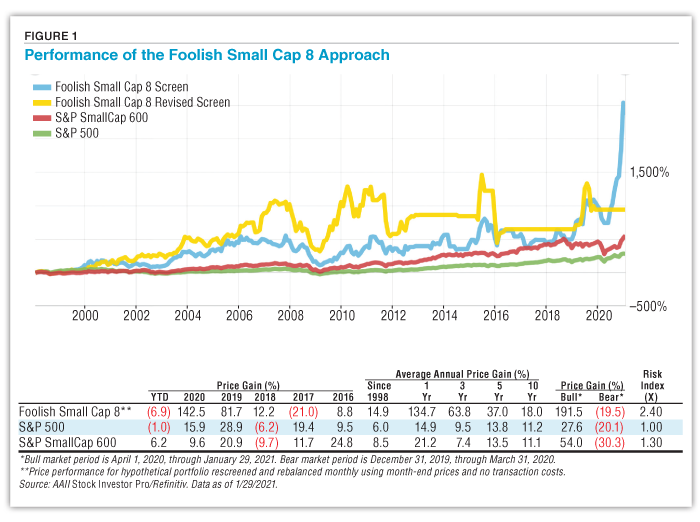
The Foolish Small Cap 8 approach has outperformed the S&P 500 and the S&P SmallCap 600 for each of the last three years. The three-year average annual price gain for the Foolish Small Cap 8 strategy through the end of January 2021 is 63.8%, while the S&P 500 gained 9.5% and the S&P SmallCap 600 is up 7.4% annually over the same period.
The Foolish Small Cap 8 strategy has underperformed year to date through January 29, 2021, down 6.9% versus a loss of 1.0% for the S&P 500 and a gain of 6.2% for the S&P SmallCap 600.
You, as an AAII member, can follow the Foolish Small Cap 8 strategy’s performance, and see how it compares to the other stock approaches that AAII tracks, at the Screening area of AAII.com.
Profile of Passing Companies
Table 1 highlights the characteristics of stocks meeting the Foolish Small Cap 8 screening criteria as of February 12, 2021.
Many of AAII’s screening approaches search for stocks that are attractively priced relative to some measure of intrinsic worth. Of course, determining the intrinsic value is the heart of fundamental valuation. These screens usually incorporate traditional valuation metrics such as price-earnings ratio or price-to-book value ratio as the primary screening criteria.
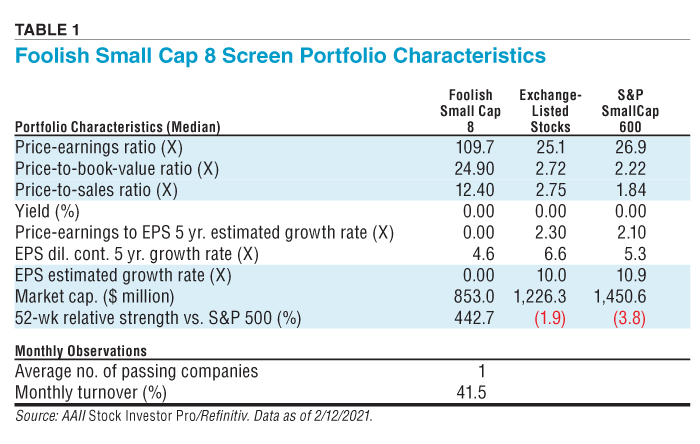
The Foolish Small Cap 8 screen does not have an explicit valuation metric as part of its screening filter. The stocks currently matching the approach have a median price-earnings ratio of 109.7, which is significantly above the 25.1 median value of all exchange-listed stocks and the 26.9 median value of S&P SmallCap 600 stocks. The median values of the price-to-book ratio and price-to-sales ratio are also well above the median values of these metrics for all exchange-listed stocks and S&P SmallCap 600 stocks.
One of the drawbacks of the Foolish Small Cap 8 strategy is that the monthly average number of passing companies is very low. Two companies met AAII’s Foolish Small Cap 8 criteria as of February 12, 2021, and they are listed in Table 2, ranked in descending order by 52-week relative strength.
In Table 2, Zedge Inc.  (ZDGE), operates a digital publishing and content platform worldwide. The company’s platform enables consumers to personalize their mobile devices with ringtones, wallpapers, home screen application icons and notification sounds. Zedge had recent sales and earnings growth of 32.3% and 131.5%, respectively. It has a net margin of 11.5%, well above the software industry median of negative 8.9%.
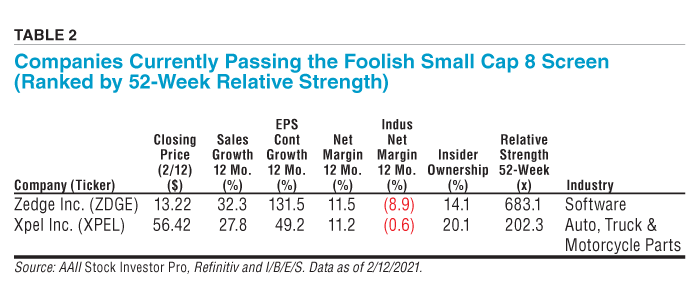
Xpel Inc. (XPEL) manufactures, sells and installs after-market automotive products, including automotive paint protection film, headlight protection film, automotive window films and other related products. In the U.S., Canada and parts of Europe, it operates primarily by selling a turnkey solution directly to independent installers and new car dealerships. Xpel had recent sales and earnings growth of 27.8% and 49.2%, respectively. The company’s net margin of 11.2% is above the auto, truck and motorcycle parts industry median of negative 0.6%.
Stocks Passing the Screen During 2020
In Table 3, we show all the companies that met the Foolish Small Cap 8 criteria during 2020. There were 11 companies that powered AAII’s top strategy between the end of 2019 and the end of December 2020. At least one company passed the screen each month, except for April 2020.
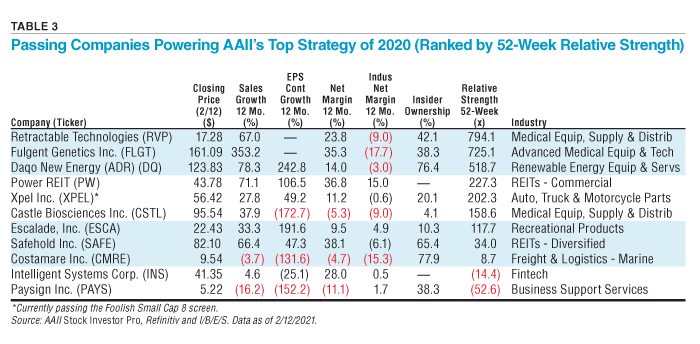
One stock in Table 3, Escalade Inc. (ESCA), sells sporting goods in North America, Europe and internationally. The company manufactures, imports and distributes various sporting goods brands in basketball, soccer, indoor and outdoor game recreation and fitness products. Escalade does not currently meet the Foolish Small Cap 8 screen criteria. The company had recent sales and earnings growth of 33.3% and 191.6%, respectively. It has a net margin of 9.5%, above the recreational products industry median of 4.9%.
When following a given strategy, spreading your investment around into more stocks will lower your volatility, as investing in a small number of companies makes a portfolio more susceptible to individual stock price movements.
Final Thoughts on Foolish Small Cap 8
Stock screening such as this is a useful way of identifying potential investment candidates. However, the final list of companies passing the Foolish Small Cap 8 screen—or any list of passing companies you generate—is by no means a buy list. It is up to you to perform your own due diligence to see whether the companies truly warrant your investment dollars.
This is especially true when dealing with small companies, where the price of making a mistake tends to be greater than when dealing with larger firms. ▪
What It Takes: Foolish Small Cap 8 Criteria
- Sales for the last four fiscal quarters (12m) are less than or equal to $500 million;
- Sales and earnings per share from continuing operations growth rates over the last four fiscal quarters (12m) are at least 25%;
- Net profit margin is at least 7%;
- Cash from operations for the last four fiscal quarters (12m) is positive;
- Share price is at least $7;
- Average daily dollar trading volume is at least $1 million but no more than $25 million;
- Insiders own at least 10% of the company’s outstanding shares;
- Relative price strength over the last 52 weeks ranks in the 90th percentile or higher;
- Companies that are traded over the counter (OTC) are excluded.

Related

Investor Professor
Company Size and Investment Returns
Related

Small Cap Value Investing
How Much Small Cap Should Be in Your Portfolio?
Discussion
FREE REPORT

Get your free copy of our special
report analyzing the tech stocks
most likely to outperform the
market.
No comments have been added yet. Add your thoughts to the discussion!
You need to log in as a registered AAII user before commenting.
Log InCreate an account