

Related

PRISM Wealth-Building Process
How to create a high-level summary of an intended bequest that ensures you reach your goal.

Charles Rotblut leads a class in AAII's new Essential Investing Video Course. Go to https://www.aaii.com/ves for more information and to subscribe.
Many individual investors seek to leave an inheritance to heirs or bequests to charities, congregations and other organizations. To the extent excess wealth can be designated and set aside for such bequests, a plan for managing those assets can be created.
In this article, we present a one-page PRISM Wealth-Building Plan for leaving an inheritance or other bequest using individual retirement accounts (IRAs). The plan provides an example of how designated assets can be managed separately from assets intended for other purposes, such as funding retirement. It also includes considerations for factors specifically tied to estate planning. Though Roth IRAs are used in the sample plan, we also provide a discussion of traditional IRAs.
The example uses an affluent retired couple. Lee and Lori are in their early 70s with children and grandchildren. Between their Social Security and pension benefits plus taxable savings, they have enough to cover their spending needs. As such, they do not need their required minimum distributions (RMDs) to cover their financial obligations.
This is admittedly a simplistic example. Depending on the investor, various other assets may be intended to be bequeathed. Examples include, but are not limited to, residential real estate, mineral rights, farmland, collectibles and interests in private enterprises. Though it is impossible to address all situations, we provide suggestions on how to incorporate different considerations into a one-page wealth-building plan for inheritances and bequests.
The AAII PRISM Wealth-Building Process starts by asking investors to prioritize their goals. The idea is that the most important goal(s) should be funded first.

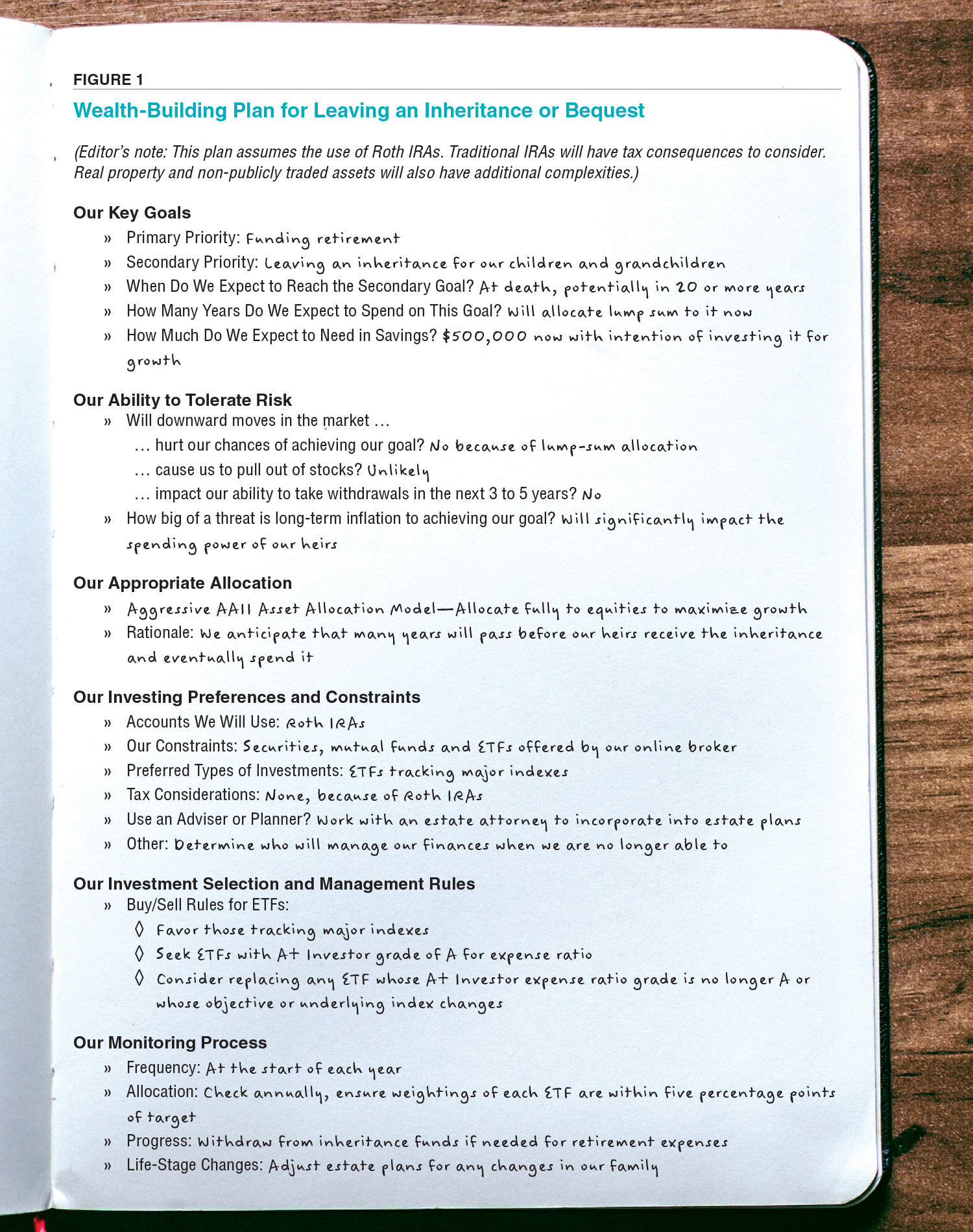
Lee and Lori’s primary goal is funding retirement. They first and foremost do not want to be a financial burden on their family. Even if they have little expectation of this ever happening, designating a secondary goal of leaving a future inheritance acknowledges that the primary goal of funding retirement takes priority.
The couple choose to first create a master PRISM Plan that prioritizes all of their goals, makes note of their key risk tolerances and covers their investment preferences, constraints and monitoring process. They opt for a modified bucket approach to separate assets by goal. Their primary bucket is for managing retirement, spending and related expenses. Their secondary bucket is for their planned bequests.
Lee and Lori create a separate subset PRISM Plan for leaving an inheritance. This enables them to set an allocation specific for this purpose as well as address considerations related to estate planning. While doing so can add complexity, it better helps the couple visualize achieving this specific goal.
The couple start their wealth-building plan by determining how much they want to allocate to a future inheritance. They opt to set aside $500,000. This is not the full amount of their retirement savings; they opt to leave a significant cushion in case either of them eventually needs long-term care.
Lee and Lori allocate an amount for inheritance based on what they can currently set aside. They intend to leave the inheritance as a lump sum at death. Based on the initial amount, the couple’s expected life-span and assumptions about market returns, they set a goal of eventually leaving double or triple the current amount they are setting aside now.
Were Lee and Lori to make annual gifts—or gifts at some other planned interval—it would modify their one-page PRISM Wealth-Building Plan. In this case, they would instead list the intended time span for making such gifts with the potential amount they expect to give. The couple still would make note of any final bequest(s) they intend to make.
The level of volatility that is acceptable for assets intended to be bequeathed can be much higher than for assets designated for retirement. This is because of the potential time horizon before the inheritance is given (or a different bequest is made). Lee and Lori’s estate might not be passed on to their heirs for another 20 years or more. Plus, even after the estate has exchanged hands, inherited IRAs and Roth IRAs do not need to be fully drained for another 10 years. (Even longer distribution periods are allowed under certain circumstances. See “Update Your Estate Plan for Your IRAs” by Ed Slott in the October 2021 AAII Journal for more information.)
Furthermore, because a single lump-sum allocation is initially being made in this example, there are no short- or intermediate-term withdrawals to consider. This makes inflation the primary risk, given its ability to erode the purchasing power of future dollars. The risk of a bad sequence of returns will get smoothed over by the lengthy time horizon.
There are two caveats. First, the couple should consider their psychological tolerance for risk. If Lee and Lori have historically become unnerved by market corrections and bear markets, they would want to note this in their wealth-building plan. In such instances, they can indicate a preference for a less volatile approach so that they are able to sleep at night.
The second caveat would exist in cases when there is an expected shorter time horizon before the assets are bequeathed and spent. An example would be a person with a short expected life-span—due to age or terminal illness—and an heir who is expected to spend the assets soon after receiving them. This type of scenario can come with a lower tolerance for risk because of the damaging impact of an ill-timed bad sequence of returns if the dollars will need to be spent upon inheritance.
What if Lee and Lori were to instead allocate a portion of their excess retirement savings at set intervals, such as annually? It wouldn’t change the allocation for the bequest amount that is set aside if the inheritance isn’t expected to be spent all at once. What would change is their ability to fund this secondary goal. A down market may result in little to no excess cash to shift into the inheritance bucket during certain years. This is a risk they would note in this section of their plan. The couple would also adjust their goals section to state the intention to annually add to the inheritance. This statement would include an acknowledgement that their ability to do so is dependent on what is left after addressing the needs of their primary goal: funding retirement.
For the purposes of our example, we assume Lee and Lori are willing to withstand the volatility of stocks, given the lengthy period before the assets will be passed along. They note this in their one-page PRISM Wealth-Building Plan (Figure 1).
The appropriate allocation stems from the goal prioritized and the risk tolerance recognized. Once these first two steps are done, choosing an appropriate allocation becomes much easier.
Here’s what we know so far. The couple are in their early 70s and in good health. They are financially sound enough to segment the assets they intend to bequeath to heirs from what they need to cover their daily expenses. The lengthy period before the assets will be passed down and spent makes inflation the primary risk.
Given these factors, the couple opt to use AAII’s aggressive Asset Allocation Model for these assets. This model calls for being either mostly or fully invested in stocks to maximize the growth of capital.
Note that the focus here is the risk tolerance of the couple and not their heirs. This is because the couple still own the assets and expect to continue to do so for many years.
As previously noted, a more moderate allocation might be considered if the couple has a shorter life expectancy and if their heirs are expected to spend the amount soon after the assets have been inherited.
The type of assets matters here too. Lee and Lori are assumed to own exchange-traded funds (ETFs) in IRAs and Roth IRAs. Were they planning on bequeathing real estate (a house, farmland, etc.), mineral rights, interests in a privately held business, etc., the allocation decisions could be altered. There may also be liquidity considerations. For instance, a certain allocation to cash-like instruments—money market funds, certificates of deposit (CDs), etc.—may be desired to help heirs cover costs related to fees or expenses of such assets.
Step 3 of the PRISM Process for identifying investment management preferences and constraints is more than just listing favored types of investments or acknowledging any restrictions, such as only mutual funds being available in a 401(k) account. It also covers issues like tax considerations and the desire or need to work with a professional.
We start with the assumption that Lee and Lori prefer to use ETFs that track major indexes. This simple assumption allows us to focus on more complex issues.
Our base case also assumes Lee and Lori have located the assets they plan to bequeath in Roth IRAs. Roth IRAs require no withdrawals during retirement. Inherited Roth IRAs do not have any RMDs for non-eligible designated beneficiaries, but all amounts must be fully withdrawn within 10 years. (Eligible designated beneficiaries, a group that includes children meeting specific rules, can follow the stretch IRA rules.)
If the assets designated for a future inheritance were in a traditional IRA instead, an additional layer of complexity would be added. Lee and Lori would be required to include those assets in the calculation of their annual RMDs upon turning age 73. They could then take the aftertax balance of the RMD and invest it in a taxable account for their heirs. Their heirs would have to take annual RMDs from any amounts in inherited IRAs if the couple die after having reached their required beginning date (currently age 73).
The couple could also choose to directly gift what’s left after taxes have been paid on the RMD. As a consenting couple, they could have gifted up to $34,000 per heir in 2023 without the gift tax being triggered. The limit is $36,000 in 2024. Gifting has the bonus of reducing the future size of their estate. (This would be a consideration when state estate taxes or inheritance taxes come into play.)
Alternatively, the couple could decide to make Roth IRA conversions now. This could make financial sense if Lee and Lori’s current marginal tax rate is below what they anticipate their heirs’ future marginal tax rate will be. Lee and Lori would have to be cognizant of their thresholds for income tax brackets, for having more of their Social Security benefits taxed and for paying higher Medicare premiums two years into the future.
If assets that are not publicly traded are intended to be bequeathed instead, then considerations for handling them should be included here. There may be constraints to make note of (e.g., a partnership agreement), specific experts that will need to be consulted (e.g., an appraiser) and tax and legal considerations.
The right steps will vary for each person and couple. Trust and college financial aid considerations may come into play as well. Consulting with an estate attorney and potentially a tax professional may help to avoid unintended tax and estate issues.
Lee and Lori include a note in their PRISM Plan to consult with an estate attorney to limit the odds of encountering unintended problems.
This section can also be used to note any preferences about who will take over managing the accounts when Lee and Lori are no longer able to. This person could be the future executor of the couple’s estate or it could be someone else. Designating this person in advance of cognitive decline will allow for a better choice to be made.
Whereas preferences define what types of investments the couple consider, rules—even basic ones—establish clear standards for what makes an investment a buy and, more importantly, what makes it a sell. These rules should always be tailored to the type of investment being purchased, with the inclusion of any style, factor or other preferences.
As previously noted, Lee and Lori prefer to invest in ETFs tracking well-known indexes. Their rule is therefore to seek index ETFs with expense ratios ranking in the cheapest quintile (20%) of their respective categories, which is an A+ Investor grade of A.
The couple will only consider selling these ETFs if their underlying index changes or if their A+ Investor expense ratio grades are no longer A. They will monitor the ETFs to ensure there are no unexpected changes.
The final step of the PRISM Wealth-Building Process calls for periodic monitoring. The portfolio’s allocation is checked to ensure it remains within an acceptable range of the specified target. Progress toward the goal is reviewed to ensure it is still on track. Changes in their life stage are considered to determine whether the specified goal is still valid or if it needs to be revised. This step ensures that Lee and Lori’s wealth-building plan evolves as their life does.
Lee and Lori will check their portfolio once per year to ensure the weighting assigned to each ETF is reasonably close to their targeted ranges. They will adjust the allocation if any ETF accounts for too much or too little of the portfolio.
If traditional IRAs are being used instead of Roth IRAs, the couple would ensure they are taking their RMDs each year. They would also want to monitor the allocation of the taxable accounts designated for retirement just as they would the IRAs.
The couple will check the progress toward their primary goal of funding retirement as well. Remember, leaving an inheritance is a secondary goal. Should Lee and Lori determine that they need to allocate more than expected toward covering their retirement expenses, they will tap assets currently designated for future bequests. Part of the PRISM Wealth-Building Process is having the willingness to sacrifice lower-priority goals to achieve the highest-priority goals.
Lee and Lori will also monitor any life-stage changes involving them or their intended heirs. A deterioration in either or both spouses’ health could alter the timeline for when the assets are expected to be bequeathed. The death of an heir or the addition of new one (e.g., a new grandchild) should prompt a review of estate documents and a possible revision to the couple’s PRISM Plan. The couple note such considerations on their one-page plan.
Estate planning can be complex. A thorough estate plan will encompass more than a single page.
What creating a one-page PRISM Wealth-Building Plan for leaving an inheritance or bequest can do is better align your portfolio decisions with your estate planning goals. It provides a high-level summary of what you intend to do from an investing and allocation standpoint. This simplicity can be helpful for ensuring your investing process moves you toward your goals.
There is certainly no one-page PRISM Plan we could present that would cover everyone’s intentions for leaving a bequest. However, this exercise can help you think through some of the bigger issues and it provides a useful example of how you can create your own one-page PRISM Wealth-Building Plan.
PRISM Wealth-Building Process

Financial Planning

Financial Planning

Don P from USA posted over 2 years ago:
ROBERT A from NC posted over 2 years ago:
C R from TN posted over 2 years ago:
FRED E from TX posted over 2 years ago:
N E from CA posted over 2 years ago:
JAMES M from MT posted over 2 years ago:
You need to log in as a registered AAII user before commenting.
Log InCreate an account