

Related

Financial Planning
The PRISM Wealth-Building Process can assist with communication when passing along your investing knowledge, your inventory of important documents and your final wishes.

Charles Rotblut leads a class in AAII's new Essential Investing Video Course. Go to https://www.aaii.com/ves for more information and to subscribe.
 Ask any estate planning expert and they will tell you that one of the most important aspects of the process is communication. Sharing your wishes, your key financial and estate information and the knowledge you’ve gained throughout your life with your heirs and those you trust to manage your affairs will be invaluable at the time they are needed.
Some of you reading this may have already done this. For those of you who haven’t or have only partially done it, the PRISM Wealth-Building Process can assist with such communication. While the PRISM Process focuses on investing and wealth goals, it also provides a framework you can use to start such conversations. Step 1, Prioritizing Your Goals, can be used as a catalyst to talk about why money is important to you, along with any wishes you may have for how an inheritance will be used. The recognition of risk tolerance and investment selection rules in PRISM Steps 2 and 4 can be used to guide your heirs with the investing lessons you’ve learned throughout your life.
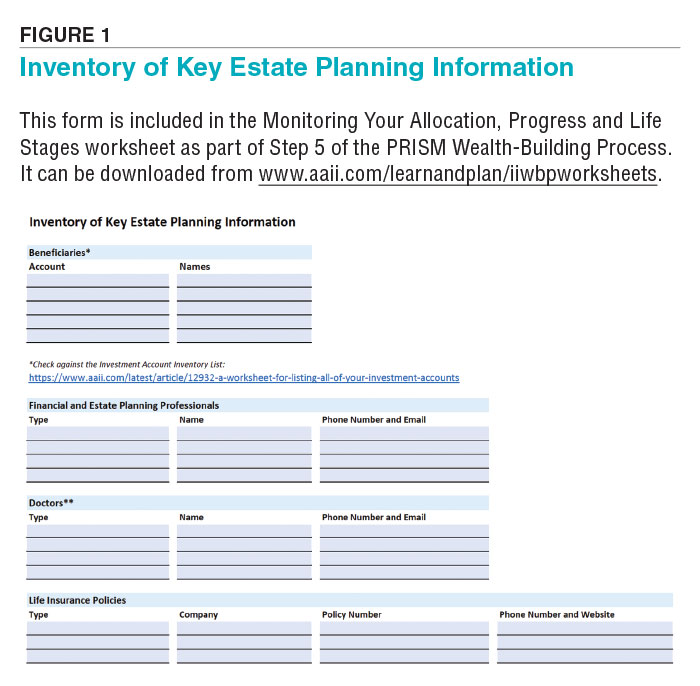
From the time we first started developing PRISM, we have considered how it could complement broader estate planning. For example, Step 5, Monitoring Your Allocation, Progress and Life Stages includes the Monitoring Your Life Stages worksheet, which contains an “Inventory of Key Estate Planning Information” section (Figure 1). This worksheet also provides a section where you list out beneficiaries, contact information for key professionals, the location of your wills and trust documents and more. Such a list will be invaluable at the time it is needed.
There are a few key topics to bring up when talking about estate planning:
When discussing estate plans, consider what information your heirs will need to step in on your behalf. Do they know what accounts you have? Do they have the contact information for your lawyer, accountant, primary physician, financial planner (if used) and close friends? Would they be able to quickly locate your will, trust documents, powers of attorney, health care directive, life insurance policies, pension documents, military ID, tax returns, etc.? How about the passwords for your online accounts, computer and phone?
A way to think about these questions is to ask yourself what information would be helpful if you were in their situation. The moment your heirs will need this information could occur suddenly and without much warning. Even if you consider yourself to be organized, don’t assume your heirs will be able to make sense of your filing system.
One of the smartest things I’ve done was to have my father-in-law show me where all his key documents were. Having this information was invaluable when he died.
The aforementioned inventory of key estate planning information can work well for this process. Even if you wish to create your own document—a blank piece of paper or electronic document can work well for this—the worksheet will provide you with prompts for what to include.
If you have created an advance directive governing the type of medical care you want and don’t want, be sure to include this on the list. Also, be sure to verbally share your wishes with those who will be carrying out such decisions.
The first step of PRISM focuses on identifying and prioritizing your goals. These goals can extend beyond your life. Perhaps there are specific members of your family you wish to leave more to than others (e.g., a grandchild with special needs). There could be a charity or congregation you wish to leave assets to. If you’ve remarried, there could be relatives from your prior marriage(s) you’ve included in your estate plans.
Discussing such intentions with your heirs while you are alive can reduce the odds of conflict later on. Incorporating your goals and what you envision into the PRISM Process can provide helpful context for your intentions. Consider sharing what you listed in PRISM Step 1, Prioritizing Your Goals, as part of these discussions. And always share your rationale in a loving and caring manner.
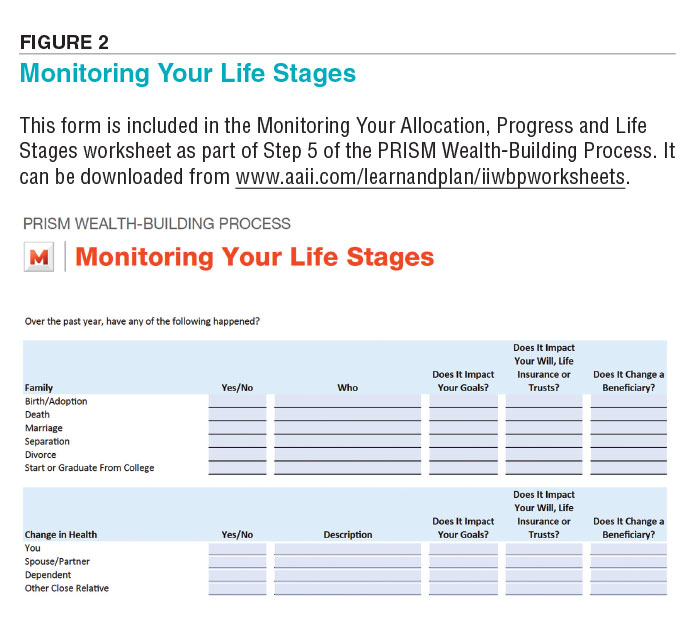
In the fifth step of the PRISM Process, we include a checklist to identify any changes in your personal life that could impact your goals and time frame for reaching those goals (Figure 2). It works well for estate planning as it asks about changes in your and your spouse’s health as well as any family changes that could impact your beneficiary designations. Use it to talk about your personal wishes as you progress through the later part of your life.
If you have a long-term care insurance policy or could eventually be eligible for the Veterans Affairs (VA) Aid and Attendance benefit, let those you trust to act on your behalf know. Similarly, share any desires you have regarding care at home versus in an independent, assisted living or memory care environment. Certainly, make clear which funds you have designated for such care if you have not previously done so. Be sure to inform those you trust to manage your affairs on where to find your long-term care policy if you have such insurance.
Though not included in the PRISM Process, it is helpful to share any plans or wishes you have for your final arrangements. Have you preplanned your funeral? Are there certain people you want to be notified? Is there something you’d like your gravestone or marker to say? Where should your obituary be published? A broader talk about estate planning is a good time to bring up these subjects.
The PRISM Wealth-Building Process can also help guide talks with your loved ones about how you invest. The five-step process is a framework for aligning your investment decisions with your goals.
Here is a high-level overview of PRISM and how it can be used to share your personal investing strategy.

We have already addressed goals from the standpoint of leaving a legacy. Explaining the “why” behind your goals gives you the chance to talk about why money is important to you. Expand upon it by discussing how your goals have acted as a beacon, guiding your financial decisions throughout your lifetime.
You can also use your goals to talk to your heirs about their goals. Doing so may provide the opportunity to discuss how a future inheritance or gift could help them.
If you have heirs who are less knowledgeable about investing, use goals to discuss the importance of taking time horizons into account. This can help guide them toward understanding the difference between short-term savings and long-term investing—a key concept.
An open and honest conversation about how you approached and dealt with market volatility over the years may provide valuable lessons. It may help your heirs better understand the trade-off between investing risk and reward.
Providing the logic behind your allocation will give those tasked to take over your portfolio a greater understanding of how you’ve structured your portfolio. It is particularly important to have such talks if you have certain accounts set aside for care and others designated for your financial legacy. The guidance you share may help your heirs better allocate their own portfolios as well.
There are several ways this step ties into estate planning. It can directly lead to conversations about the location of your accounts. It addresses whether you work with a professional, and why. When discussing the tax considerations included in this step, talks about asset allocation and the rules for inheriting IRAs and taxable accounts can be started.
As previously stated, it is important to supply the contact information of the professionals you work with. Be sure to also let those professionals know who from your family may contact them. Establishing trusted contacts with all the financial professionals and firms you work with—including your bank(s) and broker(s)—is an additional step to consider taking. Trusted contacts are people the financial firms and professionals you work with can contact if they suspect financial exploitation or have problems reaching you.
If you’ve included preferences related to taxes, you can use PRISM to talk about it. Perhaps you’ve been strategically using a combination of traditional and Roth IRA accounts to keep your tax bills and Medicare premiums as low as possible. If your required minimum distributions (RMDs) are not automated, use this discussion to ensure that those you trust to step in for you know when to take them (along with any preferences about where to take them from). Conveying this information before you are no longer able to manage your finances yourself (e.g., because of cognitive impairment) can help ensure such a strategy continues to be carried out.
The PRISM Process prompts you to write down your buy and sell rules. If you’ve invested for many years, you’ve likely learned quite a bit about identifying, buying and selling investments. Your family members could benefit greatly from this investing knowledge.
If there are investments you wish to pass along, you may wish to convey what you hope your heirs will do with them. Such a discussion also provides an opening to guide your heirs about the law regarding inheritance, such as the step-up basis. The step-up basis adjusts the “cost” of the asset to its value at the time of the owner’s death.
We talked about this step earlier in the article, but there a few other aspects to bring up here.
The Monitoring Your Life Stages worksheet asks about any changes in your family as well as any changes in your, your spouse’s or a family member’s health. Alongside these questions is a column asking whether those changes alter your beneficiary information (Figure 2). Checking your beneficiary information annually and ensuring it is correctly updated is critical. Listing a contingent beneficiary and having their information updated is also important in case something happens to your primary beneficiary.
Retirement plan administrators and the courts will make decisions based on the beneficiary information. Failure to keep it current and/or to get the proper signatures on all documents that require them can cause your assets to be distributed differently than you wish.
The Monitoring Your Allocation worksheet can be used in conjunction with any lessons you share about your buy and sell rules. The focus of the conversation in Step 5 should cover what steps you take to keep your allocation near your target.
We think you’d like this related webinar! Monitoring Your Allocation, Progress and Life Stages
Though your PRISM Wealth-Building Process can play a key role in talking about your financial legacy, it is just one part of the conversation about estate planning and investing. There are many other aspects.
One is the person (or people) who will be the executor of your estate. It is important that they know as much key information as possible or at least where to easily find it. They will need a list of your accounts, key professionals and the location of all important documents. Include them on any talks about tangible property too, especially anything that may be of high sentimental value to one or more family members. It’s better to address such issues before conflict arises.
Trusts that affect one or more individuals should be made known. An example would be a special needs trust that becomes effective the moment one spouse dies. Similarly, the existence of a durable power of attorney should be communicated before it takes effect.
Oversight of your personal finances, such as paying bills, should also be taken into consideration. Before adding a future heir to your checking account, realize that it necessitates the filing of a gift tax return since the heir would become a joint owner. If a daily money manager is hired, inform your trusted contacts who it will be in advance. (The same advice applies to a professional trustee, if you hire one.)
Ensure your will is updated. If it has been years since you last revised your will, speak to an estate attorney about whether any changes are needed. Laws change over time and you want to ensure your will is current with them. You may also need to have it, and any trust documents, reviewed if you move to a different state.
Invite your heirs to help you reduce your physical items. Doing this before you have to downsize—if moving to a retirement community—or before you die will help them greatly. It will also give your heirs a chance to take certain items you no longer need. Most importantly, it will reduce how much stuff they will have to go through when they are stressed and saddened by your passing. As a bonus, it will give you the chance to show where your important papers and items of value are located.
It is impossible to provide a guide to estate planning and investing discussions that will apply to every situation. Some estate plans are far more complex than others. Family dynamics and the age of heirs are considerations. Still, communication is important to ensure a smooth transfer of your financial legacy, and the PRISM Process can help with having such conversations.
Financial Planning

Financial Planning

Financial Planning

Don P from USA posted over 3 years ago:
You need to log in as a registered AAII user before commenting.
Log InCreate an account