


Related

Investor Professor
EBITDA can be used to analyze and compare profitability among companies and industries, as it eliminates the effects of financing and accounting decisions.

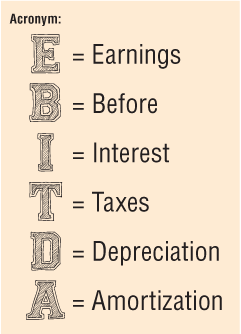
EBITDA is an acronym for earnings before interest, taxes, depreciation and amortization, pronounced ee-bit-dah. It is a measure of a company’s operating performance that excludes non-operating expenses and certain noncash expenses. EBITDA provides insights on the profitability of a company’s operating decisions by looking at core operations. Profitability measured in this manner excludes the impact of capital structure, leverage and noncash items, which are financial as opposed to operating decisions.
EBITDA ignores depreciation and amortization because they are noncash expenses. Depreciation reflects the gradual loss in value experienced by fixed assets through age and wear and tear. Fixed assets include buildings and equipment. Amortization expense is used to account for the deterioration in value over time of intangible assets, such as intellectual property and goodwill.
 Taxes and interest are ignored because proponents argue that these elements are not related to the company’s core line of business. Not only do tax rates vary by jurisdiction, but tax expenses are also influenced by the decisions a company makes regarding deductions, credits, carryforwards and the timing at which certain transactions are recognized. Since these decisions are not reflective of a company’s operating performance, EBITDA excludes them.
Why would a firm discuss earnings using this measure? Companies like to report or emphasize EBITDA instead of reported, non-adjusted earnings when they have a large amount of debt and high depreciation costs. EBITDA can help to show the earnings available to support and pay off debt.
Capital-intensive industries as well as companies with a high level of intangible assets may prefer to use EBITDA, especially if they have low or negative earnings under generally accepted accounting principles (GAAP). Low or negative earnings make it hard to compare some industries on a valuation basis.
Companies use depreciation accounts to expense the cost of property, plants and equipment or capital investments. Cable and communications companies are a good example because the high annual and quarterly depreciation rates of their capital investments coupled with high-interest payments of debt used to finance their investments can leave them with negative GAAP earnings. EBITDA figures report the earnings available for debt payments and place them high enough in the income statement to create positive figures necessary for valuation models.
Amortization is often used to expense the cost of software development or other intellectual property. This is one of the reasons that early-stage technology and research companies feature EBITDA when communicating with investors and analysts.
EBITDA is easy to calculate with public financial statements. On a fundamental level, you are adding to net income the total of any expenses from taxes, interest, depreciation and amortization (or subtracting any income). A simple way to think about this is that net income includes these expenses, while EBITDA excludes them.
Formula:
EBITDA = Net Income + (Interest + Taxes + Depreciation + Amortization)
Shortcut:
EBITDA = Operating Income + (Depreciation + Amortization)
Start by finding the necessary components of EBITDA as stated on the company’s annual 10-K or quarterly 10-Q reports, which are publicly shared via filings with the U.S. Securities and Exchange Commission (SEC). The earnings, tax and interest figures are on the income statement (Table 1), while the depreciation and amortization figures are usually on the cash flow statement. They may also be listed in a company’s earnings reports.
EBITDA equals net income plus the expenses of interest, taxes, depreciation and amortization. Add up all the line items that are expenses—or subtract any line items that are income—and add the total to the net income or net loss figure.
There is also a shortcut to calculating EBITDA using a company’s operating income. Operating income, or earnings before interest and taxes (EBIT), represents income generated for the period after all costs except for interest, taxes, non-operating costs and extraordinary charges. Add the depreciation and amortization costs to operating income and you have EBITDA.
Investors and analysts should use multiple profit metrics when analyzing the financial performance of a company. While some investors equate EBITDA to cash flow, it is based upon the income statement and therefore relies on accrual, not cash, accounting. The statement of cash flows does a better job of examining actual cash flow from operations, investing and financing during a given period.
EBITDA can be used to analyze and compare profitability among companies and industries, as it eliminates the effects of financing and accounting decisions. However, EBITDA is not a substitute for other business measures such as net income. Interest, taxes and noncash expenses have real financial implications that cannot be totally dismissed when discerning the quality of a stock to invest in.
It is also important to note that EBITDA is not regulated. The figure can be manipulated to make a company look more profitable. Potentially, a company could use one method to calculate EBITDA in one year and change to another method the next year. If the calculation method remains consistent, however, EBITDA is a useful metric for comparing historical performance.
How would you use EBITDA as an investor?
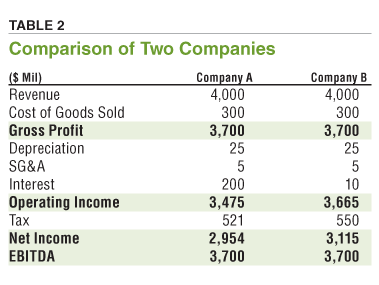
Say that two companies have similar businesses within the same industry. On a surface level, both companies have matching revenue and EBITDA; however, their net incomes differ greatly because of their capital structures (Table 2). Company A uses more debt to fund its operations than Company B. Because of this, Company A is less profitable than Company B in terms of net income, despite the companies having the same revenue and same EBITDA.
For investors, Company B should have a higher market value reflected in the price of its shares. Its operations are more efficient at producing value for shareholders because it doesn’t carry the debt expense of Company A. Company B is better able to turn EBITDA into net income and cash flow. Since Company A is less efficient with its profit, investors should pay a lower share price.
EBITDA is usually calculated by adding amortization and depreciation expenses to operating income or EBIT. EBITDA is best used to compare companies that are in a given industry with widely different capital structures, tax rates and depreciation schedules and is helpful in measuring growth companies that are spending cash on building out their operations.
It also can provide a basic measure of a firm’s ability to generate cash to meet interest payments. But EBITDA ignores the impact of depreciation, thereby overstating profits and failing to consider the capital needed to reinvest in a business. It can also be manipulated through aggressive accounting policies related to revenue and expense recognition.
Investor Professor

Financial Statements


VAIDY B from CAN posted over 5 years ago:
JAMES M from MT posted over 5 years ago:
Thomas L from MA posted over 5 years ago:
You need to log in as a registered AAII user before commenting.
Log InCreate an account