


Charles Rotblut leads a class in AAII's new Essential Investing Video Course. Go to https://www.aaii.com/ves for more information and to subscribe.
Most investors have made one or two big mistakes that stand out from the others. When we asked AAII members about their biggest investing errors, missteps related to selling decisions topped the list. There wasn’t one single type of mistake that stood out, but rather a broad mix of blunders involving selling along with other decisions.
This finding came from our latest “big question” survey. The survey focused on mistakes AAII members have made throughout their investing journey. The survey not only asked individual investors what their biggest mistake was but also asked about mistakes involving specific areas of investing.
The survey is part of a periodic initiative to give AAII members a chance to talk about their investment decisions and challenges. Each survey asks what we’re describing as a “big question” about a subject affecting many investors. A randomly selected group of AAII members is asked a specific question, as well as follow-up questions intended to provide more clarity and background.
This seventh survey in the series was emailed to AAII members in April 2021. The results were tabulated based on responses sent to us. We received 331 responses from the survey invitation. The overwhelming majority of respondents have been investing for more than 10 years. About 53% characterized their knowledge of investing as intermediate, while 42% characterized it as advanced.
Mistakes More Commonly Occurred With Selling Than Buying
The survey’s big question was: “What is the biggest investing mistake you’ve made?” Answers related to the selling decision top the list.
Several respondents lamented selling a stock they owned too soon. Many of these respondents thought they could have made a greater profit had they held on to their investments for a longer period. Other respondents wished they had sold their holdings sooner than they did. We also saw respondents who said they simply held on to a bad stock for too long.
“I got spooked by a Wall Street Journal article and sold my recently purchased 2,000 shares of Apple,” explained William Mitchell. “I lost about $10,000 from my original investment but would have made a couple of million if I’d held like I normally do.” He told us separately that this was the only time he’s placed a market order. “The trade sat there all day as Apple tanked, then executed right around market close. I recommend limit trades.”
There are also investors who wish they hadn’t sold during a down market.
“Back in the early 1970s, we were investing in two mutual funds and the stock market was going down. It seemed futile to be sending money to a mutual fund and have $100 be worth $82 the following week. So, we stopped sending in money (and we also sold out),” recalled James Langley. “If we hadn’t stopped, we would have accumulated more shares at lower prices and what a great multiplier all those shares would have been when 1982 arrived!”
“After seeing Lehman Brothers go bankrupt, I thought any stock or company could go under,” wrote Thomas Cundey. In a follow-up note, he added, “To top it off, my selling spree was only a few days before the market bottom.” Cundey says he regrets “selling nearly all [of his] stocks during the 2008 financial crisis.”
Among those who cited buying mistakes, one of the more common ones was not buying near a market bottom and waiting too long after the market started to recover to buy stocks.
Other responses we saw included comments related to either getting bad recommendations, bad advice or using a broker they wish they hadn’t. Several respondents said they were too conservative with their long-term savings and wished they had started earlier in terms of investing and building up their portfolios. Security selection mistakes also popped up, including investments in private real estate companies.
When asked what led to the buying mistakes, responses varied as well. The most common response was either emotions or lack of experience. Several members blamed overconfidence, while some said they were either following the crowd or following media recommendations. We also saw a sizable group blame not doing enough of their own research.
Regrets About Pulling Out of Stocks
In terms of allocation, pulling out of stocks and stock-focused mutual funds at the wrong time was listed by 44% of respondents. Closely tied for second and third place were following too conservative of an investment strategy (34%) and buying stocks or stock funds at the wrong time (33%).
Holding too concentrated of a portfolio was an allocation mistake listed by 19% of respondents. Other allocation mistake categories included, but were not limited to, holding too much cash, not buying during a bear market and being too conservative.
“Due to fears of another market crash,” Sam Crane said he “held too high of an allocation to cash for over 20 years, which significantly reduced [his] retirement assets.” Crane was waiting “for lower market valuations that never came.”
Several AAII members shared similar stories when commenting about their asset allocation mistakes. Craig Borgardt said his portfolio held “too much cash from 2010 to 2017. Doom-and-gloom fears overwhelmed my normally rational thinking. And, mostly, I did not yet document a written investment plan.”
Failing to Do Adequate Research
When it came to individual investments, 40% of respondents said they acted on a suggestion without doing their own research first (Figure 1).

Approximately 37% held onto an investment even though it was meeting one of their sell rules. Trying to bargain hunt was also a common error, with 36% of people saying they bought a stock simply because it was beaten down or because its price was low.
Selling too soon, selling too late or just waiting to get back to breakeven were commonly named as mistakes involving individual securities. Combined, 25% of respondents listed one of these three reasons. An additional 14% said they were either buying or selling based on emotions or simply did not do enough research before buying or selling.
Jay Stewart’s buying and selling mistakes had more to do with his portfolio than individual securities: “I tried to time the market by buying when prices were down and selling when prices were high. I learned if I invested on a consistent, regular basis (dollar-cost average) that I would have better returns and have less emotions affecting my decision.”
Investing Too Conservatively for Retirement
More than one out of four (28%) regretted investing their retirement savings too conservatively. An additional 17% said they failed to start saving early enough. However, more than half of all respondents (56%) said they didn’t make any of the retirement savings mistakes we listed in the survey.
Lawrence Iuso was among the many who wished they had saved more aggressively, describing “not increasing my IRA and 401(k) contribution amounts very early on” as a mistake. “I did all right due to tax-deferred compounding, though I could have done much better.” Iuso also wished he had bought “Berkshire Hathaway very early on, but I’m sure everyone feels the same way.”
“From day 1—when I was in my low 30s—I probably put too big a percentage into fixed income,” answered Henry Oppenheimer. “Furthermore, I did not, in those early years, put enough extra into my defined-contribution plans.”
A Lack of Clear Buy and Sell Rules Led to Mistakes
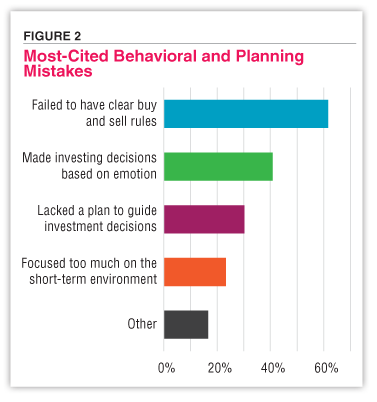
Behavioral and planning mistakes are a common source of investors not realizing the returns they might otherwise expect. Slightly more than three out of five respondents (62%) cited the mistake of failing to have clear buy and sell rules (Figure 2). Slightly more than two out of five (41%) respondents said they regret making investment decisions based on emotion. We also saw that about 30% of respondents lacked a plan to guide their investing decisions. Respondents had the option of choosing more than one of the multiple-choice answers to this question.
“Being too impatient, being bothered by volatility (mostly falling stock prices) and panic selling when I should have been sitting tight,” was the behavioral investing mistake submitted by Dennis Clark. He has since “learned to stay steady with [his] plan and not alter it based on emotions while watching the market tank or soar.”
Guidance From Survey Respondents: Do Your Own Research
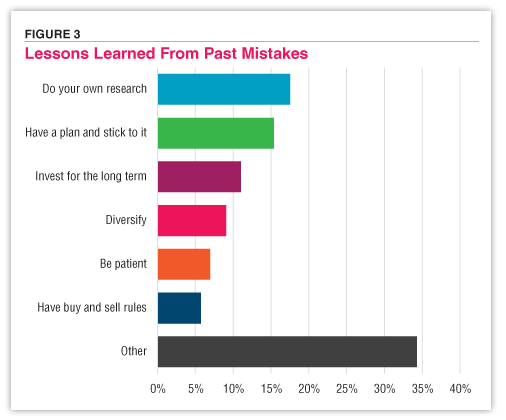
Finally, we asked respondents what lessons they have learned about avoiding investing mistakes that they think would be helpful to other individual investors. The most common type of guidance fell in the category of doing your own research and not putting all your trust in recommendations from others. This was suggested by 18% of respondents (Figure 3). Having a plan and sticking to it was listed by 15%. Another 11% suggested that individual investors invest for the long term.
“Never make an investment based on trusting someone else without understanding the investment yourself,” said David Cook.
Sven Goldbach suggested investors should “have a good strategy that has been tried and tested through many market cycles and consistently implement it—even in long and difficult phases.”
Jim Perschbacher summed up the suggestions of many others with his guidance: “Be diversified in stocks. Save and invest as much as you can when young. Maximize your retirement account contributions, if possible. Don’t pay too much for money management. Don’t listen to get-rich-quick ideas. You don’t need them to retire well.” In a follow-up email he suggested adding, “not trading too much because you will likely sell low and buy high.”
Investors’ Biggest Mistakes Often Involve Selling Video
We think you’d like this related webinar! Individual Investor Show: How the Famous Think, Members’ Mistakes and Investing Preferences

Related

AAII InvestoGraphic
The Cost of Panicking
Related

Discussion
FREE REPORT

Get your free copy of our special
report analyzing the tech stocks
most likely to outperform the
market.
O from MD posted over 5 years ago:
LARRY H from IA posted over 5 years ago:
MAYER L from FL posted over 5 years ago:
DAVID F from TX posted over 5 years ago:
You need to log in as a registered AAII user before commenting.
Log InCreate an account