


Related

Mutual Funds
Target-date funds are designed to allow you to choose one with the year closest to your expected retirement date. However, there are reasons why you may want to opt for a shorter- or longer-dated fund.
by Charles Rotblut | May 2021

Charles Rotblut leads a class in AAII's new Essential Investing Video Course. Go to https://www.aaii.com/ves for more information and to subscribe.
Target-date funds are designed to provide a one-stop solution for investors seeking to save for retirement. These funds hold diversified portfolios whose allocations evolve as the expected retirement date grows closer.
A starting point for selecting a target-date fund is the year listed in its name. The T. Rowe Price Retirement 2050  (TRRMX) is intended for those who plan on retiring near the year 2050. The T. Rowe Price Retirement 2040 (TRRDX) is intended for those who plan on retiring near the year 2040. The T. Rowe Price Retirement 2030 (TRRCX) is intended for those who plan on retiring near the year 2030. Some companies offer their target-date funds in five-year instead of 10-year increments.
A simple way to understand how target-date funds evolve over time is to look at their allocations. As of March 31, 2021, T. Rowe Price’s 2050 fund had 94% of its portfolio allocated to stocks. The 2040 fund had nearly a 90% allocation to stocks. The 2030 fund had nearly 78% of its portfolio allocated to stocks. As the expected retirement date moves closer, target-date funds reduce their exposure to stocks and increase their exposure to bonds. This shift occurs because target-date funds are designed to become more conservative over time. The change toward a more conservative allocation reflects the likelihood of portfolio withdrawals being made in retirement as well as the lower tolerance for risk many retirees have.
The big advantage of target-date funds is their evolving allocations, known as a glide path. These funds are designed to work either as the sole holding in a retirement portfolio or the primary holding. Because of this, target-date funds are frequently found in workplace retirement plans such as 401(k) plans. When a default investment option is offered in a 401(k) plan, it is frequently a target-date fund.
Investors do not have to participate in a 401(k) plan to access these funds. Many mutual fund companies make versions or certain share classes of their target-date funds available for individual investors to purchase directly or through their broker.
Target-date funds are included in AAII’s Mutual Fund Guide. Available to all AAII members, this guide is updated monthly.
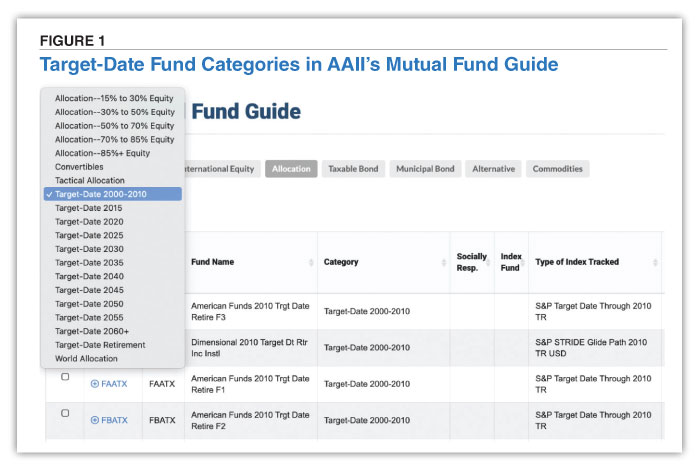
To see the list, click on the Allocation from the Expanded Fund Listings section of the online guide and then click on the Select Category drop-down menu (Figure 1). You can then narrow down the list by choosing one of the target years (displayed in five-year increments). If desired, you can choose to view all funds or just no-load funds. The table can be sorted by clicking on any of the column headings. Clicking on the Excel button on the right-hand side, at the top of the table, allows you to download a spreadsheet with the funds.
Checking the square located to the left of each ticker symbol allows you to do side-by-side comparisons of two or more funds. When comparing returns, take each fund’s glide path into consideration. One target-date fund may have higher or lower returns than a competitor simply because its allocation is more or less aggressive.
The risk indexes provide insight into the comparative allocation. Lower category and total risk indexes often reflect a more conservative allocation.
Of course, if you want to look at a specific target-date fund—such as one offered in your 401(k) plan—you can simply type the ticker symbol or name into the search box located at the top of any page on AAII.com. Choosing the fund from the search drop-down list will call up the Fund Evaluator page.
A+ Investor subscribers can use the Mutual Fund Screener to do a more specific search. Screens can be limited to a specific fund family. A cap on minimum purchase requirements can be set. Funds with lower-than-average expense ratios can be screened for, etc. A+ Investors can also save their screens.
Target-date funds are typically funds of funds. They hold shares in other mutual funds—most commonly offered by the same fund family—instead of individual securities. A T. Rowe Price target-date fund is generally composed of other T. Rowe Price mutual funds. A Vanguard target-date fund invests in other Vanguard mutual funds, and so on.
Because of this, target-date fund portfolios appear to be more concentrated than other mutual funds. Target-date funds have fewer holdings overall. They also have a large percentage allocated to the top 10 holdings.
Once you scratch below the surface, a different story emerges. Each of the individual holdings invests in a variety of securities. So while a target-date fund lists a relatively small number of holdings, those underlying funds hold a much larger number of stocks, bonds and other securities.
Information on fund allocations is provided in both the Mutual Fund Guide and in the results page for the Mutual Fund Screener. By scrolling right in either, you can see how a target-date fund allocates among stocks, bonds, cash and other assets. You can also see the number of holdings.
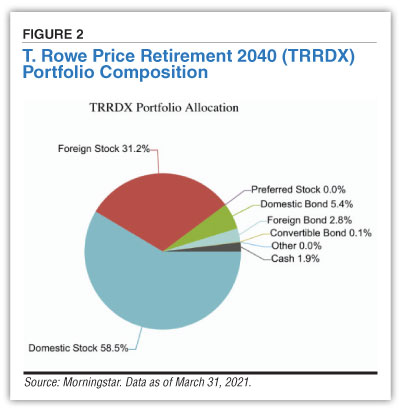
A more detailed breakdown of the allocation is provided on the Fund Evaluator page. Scroll down to see both a pie chart and a listing of the asset class groups. As Figure 2 shows, the T. Rowe Price Retirement 2040 fund has nearly 58.5% of its portfolio allocated to domestic stocks and an additional 31.2% allocated to foreign stocks. This aggressive allocation reflects the desire to grow wealth given the lengthy period of time before the target date is reached.
Those who wish to see the specific holdings should visit the fund family’s website. A link to each fund family’s website is listed in the purchase information section of the Fund Evaluator, available to all members. If you wish to dig deeper, you can then look at the individual holdings for each specific fund a target-date fund invests in.
The most straightforward way to decide which target-date funds to consider is to use the year closest to your expected retirement date. This is how target-date funds are designed. However, there are reasons why you may want to opt for a shorter- or longer-dated fund.
First is your tolerance for risk. If you can withstand greater volatility in exchange for the prospect of greater long-term wealth creation, opt for a longer-dated fund. If you are more risk-averse, opt for a shorter-dated fund. An example would be an investor with a planned retirement date of 2040. They would opt for a 2045 or a 2050 target-date fund to emphasize stronger expected growth. They would opt for a 2035 or a 2030 fund if they instead preferred less volatility.
The second reason is a fund family’s glide path. This is an important consideration for those choosing a target-date fund within a workplace retirement plan. Look at the prospectus to determine what the fund will do at and after retirement.
The T. Rowe Price Retirement 2040 fund has a lengthy “through” glide path, meaning it will gradually reduce its exposure to stocks over a 30-year period. The Vanguard Target Retirement 2040 Fund (VFORX), in contrast, will reduce its equity exposure over a period of seven years after retirement. Its glide path is therefore shorter.
A longer glide path, such as followed by T. Rowe Price, can provide greater long-term wealth. A shorter glide path, such as used by Vanguard, can lead to a more conservative allocation as retirement approaches. Some fund families may even use a “to” glide path with the final (conservative) allocation being reached at retirement. Depending on your tolerance for risk, you again may wish to opt for a longer- or shorter-dated fund than your planned retirement date would suggest.
Mutual Funds



Walter D from UT posted over 5 years ago:
JOHN L from NJ posted over 5 years ago:
JOHN J M from WA posted over 5 years ago:
ROBERT A from NC posted over 4 years ago:
You need to log in as a registered AAII user before commenting.
Log InCreate an account