


Related

PRISM Wealth-Building Process
Simple guidelines to follow, plus AAII tools and resources at your disposal that make finding the right ETFs or mutual funds for you a cinch.

Charles Rotblut leads a class in AAII's new Essential Investing Video Course. Go to https://www.aaii.com/ves for more information and to subscribe.
Choosing an exchange-traded fund (ETF) or a mutual fund involves some analysis, even though the amount of work is less time-consuming than selecting and analyzing individual stocks. In this article, we provide suggestions for how to do so, explain key terms and show you tools you can use to make a more informed decision.
There are two broad starting points that will serve you well as rules to follow.
The first is to decide what your allocation needs are. AAII’s Asset Allocation Models provide sample allocation strategies for three types of investors: aggressive, moderate and conservative.
The models use varying combinations of large-cap, mid-cap, small-cap, international and emerging market stocks along with intermediate- and short-term bonds. Below the models are ideas for the types of mutual funds and ETFs an individual investor can use to implement such strategies in a real-world portfolio. Allocation (“balanced”) funds can also be used to match these allocations. Target-date funds are an option for investors who would prefer to have a fund manager make the allocation decisions.
The Individual Investor Wealth-Building Process can help you assess what your personal risk tolerance is. This five-step process will help to create a personalized investment policy statement to guide your investing decisions and achieve your goals. To access the full toolbox—along with helpful videos—go to www.aaii.com/learnandplan.
The second rule is to start with broad-based index funds. These mutual funds and ETFs are typically the biggest and the lowest-cost offerings within their respective categories. They tend to offer the benefits of having low expense ratios, being tax-efficient, holding highly diversified portfolios and having above-average long-term performance.
Not all index funds are the same, so it’s important to look at what index a fund is following. A large number of ETFs follow indexes specifically designed for them to track. If you are unfamiliar with a certain index, type the index’s name plus the word “methodology” into a search engine such as Google. This will typically lead you to a document explaining what the index is designed to track.
If you are comfortable with or have a preference for active management, you can expand the universe of which mutual funds or ETFs you consider. When doing so, be cognizant of the data showing how relatively few actively managed funds are successful at beating their broad-based index counterparts over longer periods of time.
Mutual funds and exchange-traded funds provide individual investors access to professionally managed portfolios. They offer investors access to diversified portfolios managed at a low cost.
However, there are structural differences separating the two types of investments.
ETFs trade like stocks on an intraday basis. Investors incur trading costs such as the bid/ask spread (the difference between what buyers are offering and sellers are asking). Plus, when selling an ETF, investors can immediately reinvest the proceeds.
ETFs are bought and sold from other investors. The purchase of an ETF on the open market does not add dollars to the fund’s portfolio, nor does the selling of an ETF lead to an outflow of dollars.
Rather, ETF sponsors issue and redeem shares based on interactions with authorized participants (APs). APs are typically large institutional investors. Based on demand, APs can either request creation units from the ETF sponsor or redeem them. A creation unit typically comprises 25,000 to 200,000 shares of the ETF. The actual transaction involves either a basket of securities matching the ETF’s portfolio, cash or a combination of the two. These transactions occur on an intraday basis and help to keep the market price of an ETF’s shares close to their underlying net asset value. (NAV is the value of the assets each fund’s share represents.)
There’s quite a bit of information in the previous paragraph. The big takeaway is that there are intermediaries between an ETF and the actual investors who are buying and selling shares of the fund on the open market.
Mutual funds are bought and sold only at the end of each trading day. The prices of mutual fund shares are also updated at the end the day. When an order to purchase or redeem shares is placed by an investor, the order is not executed until the end of the trading day. These purchase and sell orders are executed at a mutual fund’s end-of-day net asset value. Transaction costs—beyond any loads, redemptions or brokerage fees—are not incurred, but the dollars from such trades cannot be reinvested immediately, except into another mutual fund.
Dollars from purchases flow directly into the mutual fund. Sell orders pull money out of the mutual fund. This is why flows are often tracked. An increase in demand from investors gives a mutual fund’s manager more capital to invest. Redemptions reduce the amount of capital to invest. If redemption requests are high enough, a mutual fund manager may have to sell some of the portfolio’s holdings to free up cash to fulfill the requests.
The structure of mutual funds can also lead to capital gains distributions being passed onto shareholders. These are profits from the sale of securities realized by the mutual fund that were not offset by realized losses. Investors have no control over the timing of such distributions, and there are years when mutual funds can have both disappointing returns and capital gains distributions. ETFs can also pass along capital gains distributions, but because they often fulfill redemption requests by giving APs securities from their portfolio instead of selling them capital gains are realized less often.
So, given all of the above, how do you decide whether to use an ETF or a mutual fund?
Part of the decision rests on the type of account you are using. Participants in workplace retirement plans such as 401(k)s are generally limited to mutual funds. Most robo-advisers use ETFs. If you have an account with a mutual fund provider, then your options depend on whether the firm has a brokerage arm. (Fidelity and Vanguard are among those that allow purchase of stocks and ETFs in addition to mutual funds.)
Discount brokers do not charge any commissions on ETF trades. Most also offer transaction-free trading on many mutual funds. Check with your broker to determine if the mutual fund you are interested in is on their transaction-free list.
Mutual funds are purchased in dollar amounts. This makes dollar-cost averaging easier and avoids the problem of having odd amounts of cash sitting uninvested. Exchange-traded funds are generally bought and sold on a per-share basis. This may make it harder to fully invest all cash.
As previously noted, ETFs generally have the advantage when it comes to taxes. This is not universally the case. Mutual funds following broad indexes, such as the S&P 500, may also have low tax-cost ratios. The Vanguard 500 Index Admiral  (VFIAX) fund has a tax-cost ratio of just 0.5%, for instance. This means shareholders in the highest tax bracket saw their returns reduced by a half of a percentage point due to taxes.
If trading on an intraday basis is important, ETFs may be preferable. Reasons why this would matter include trading strategies and a desire to use ETFs as a placeholder in a portfolio until a new stock can be found.
A final consideration is the type of strategy preferred. Active management largely remains the domain of mutual funds. Morningstar classifies about 80% of ETFs as index funds. Factor strategies—such as those favoring value, momentum or low volatility—tend to be the domain of ETFs.
In many cases, mutual funds and ETFs can be interchanged. We at AAII think investors should focus more on finding the right fund for their allocation needs as opposed to worrying about whether it is an ETF or a mutual fund.
Regardless of the type of fund you choose, be cognizant of the influence that market conditions have on returns. The returns of any fund—or investment strategy for that matter—are significantly influenced by the performance of its asset class.
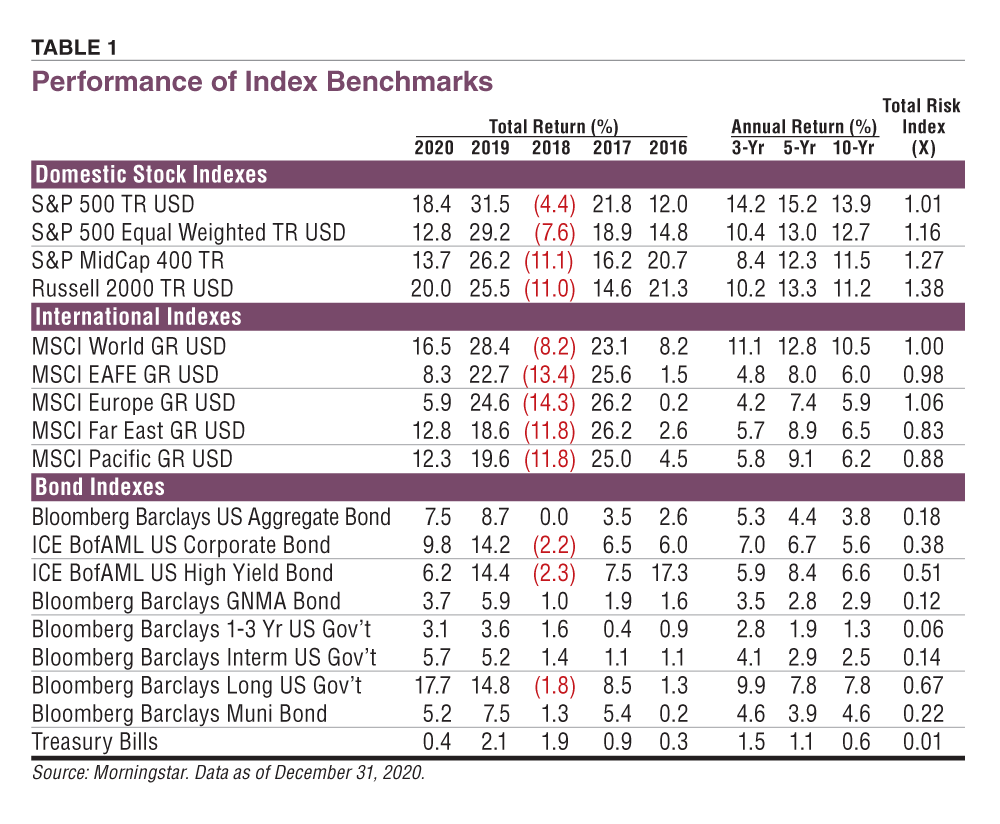
Table 1 shows the performance of major domestic stock, foreign stock and bond indexes. These provide a benchmark for setting expectations about how particular funds should have performed.
There are two things beyond performance for the most recent year to notice. First, the best-performing index changes by year. In 2020, the Russell 2000 index led all of the selected indexes with a gain of 20.0%. In 2018, Treasury bills were the best performers. European and Far Eastern country stocks led in 2017. The ever-changing leadership shows why diversifying across asset classes and fund groups is important.
The second thing to look at is the total risk index. Bonds are less volatile than stocks. Including bonds in a portfolio will dampen the volatility of returns. The trade-off is lower returns over the long term. Investors must balance their needs for the growth of wealth over the long term against their needs to preserve wealth for shorter-term goals and spending needs as well as their ability to withstand volatile market conditions.
The online versions of our guides provide information on more than 24,500 mutual funds and 2,400 exchange-traded funds. The universe of mutual funds covered includes institutional, adviser and retirement mutual funds. Both load and no-load mutual funds are covered as well. The ETF universe includes leveraged and inverse funds as well as exchange-traded notes (ETNs). You can access the mutual fund guide at www.aaii.com/guides/mfguide and the ETF guide at www.aaii.com/etf-guide.
The online guides provide more information. You can see how tax-friendly or unfriendly a fund is, whether it is more or less risky than its category peers, details about a fund’s portfolio composition and much more.
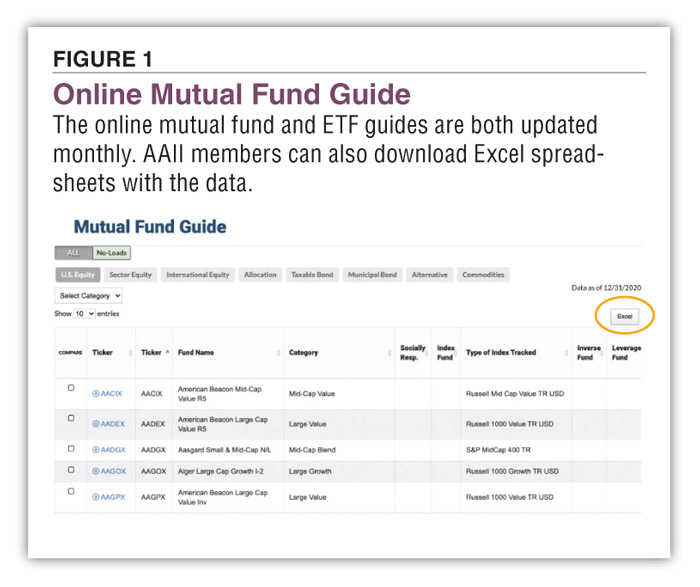
The online guides allow you to filter by asset classes and fund categories. Mutual funds can also be narrowed to no-load funds. Both the mutual fund and ETF guides provide the option to download the data in spreadsheet format via an Excel button on the right-hand side (Figure 1).
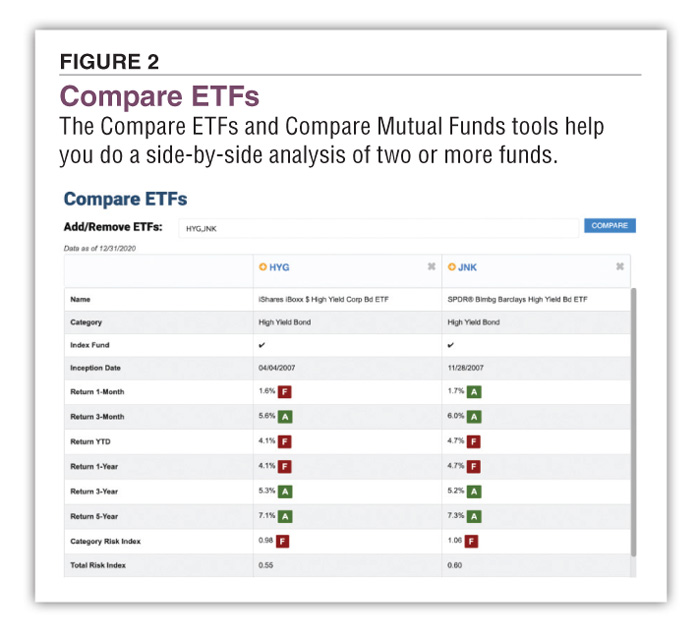
To compare one or more funds, just click on the boxes located on the left-hand side and then click on the “compare” button. This will call up our Compare Mutual Funds or Compare ETFs tool, respectively. As shown in Figure 2, the tools help you do side-by-side analysis of two or more funds. You’ll be able to compare returns, risk, portfolio turnover and expenses. You can also directly access either Compare tool by going to www.aaii.com/funds/compare and www.aaii.com/etfs/compare, respectively.
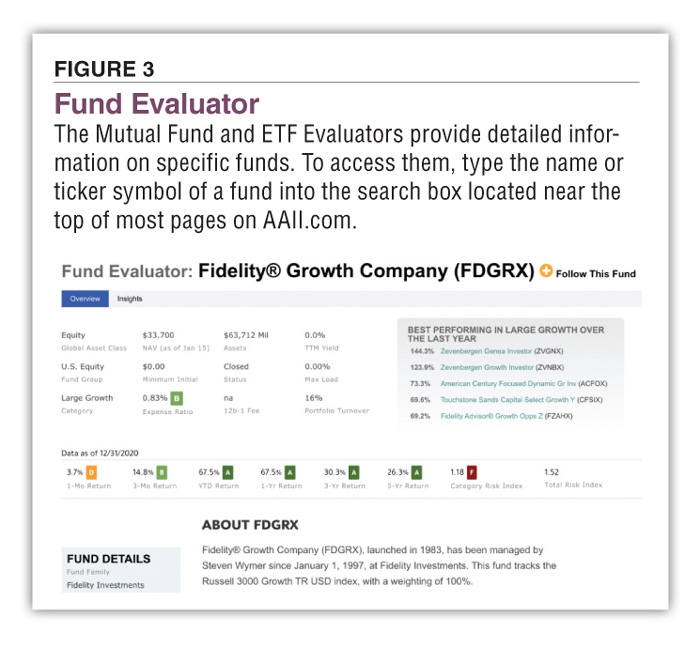
AAII members wishing to research a single fund can use our mutual fund and ETF evaluators. To access either, type the name or ticker in the search box at the top left of the AAII website; when the fund appears in the autofill drop-down box, click on its name.
The evaluators (Figure 3) give you information about the fund. Here, you will find important statistics such as the fund’s size, yield, expense ratio and—for mutual funds—the minimum initial purchase amount. You’ll also notice the fund’s grades. These grades measure a fund’s returns and risk against its peers. Grades of A or B signal that the fund is better than its category peers for a specific statistic, such as three-year return. Grades of D or F signal that the fund is worse than its category peers.
The letter grades are calculated by segmenting the funds in the respective mutual fund and ETF categories into quintiles (20% increments) and then assigning an A grade for mutual funds or ETFs that rank in the top 20% for any performance-related fields and in the bottom 20% for any risk and expense fields (for their overall categories).
The Fund and ETF Evaluators provide annual performance data for the last 10 years (if the fund has been in existence for that long), along with grades showing how the fund stacks up against other funds in its category on a year-by-year basis for performance. Standard deviation, total risk index, beta and category risk index and grade are displayed to give you insights about a fund’s risk profile. R-squared represents the percentage of a fund’s movement that can be explained by movements in the S&P 500. Higher readings imply that the fund is more closely tracking the large-cap index.
A+ Investor subscribers have access to our mutual fund and ETF screeners. Additionally, A+ Investor subscribers can access our growing library of Mutual Fund and ETF First Cut screens.
The fund screeners are a new addition to AAII.com for A+ Investor subscribers. The screeners are designed to help you identify funds that match your needs. This holds true when filtering for return, risk and cost.
These are brief definitions of some of the terms and statistics used. Complete field definitions can be found at the online Fund and ETF Guides.
Return (%): Total return percentages for each calendar year and average annualized returns for three-, five- and 10-year periods ending December 31, 2020. Returns are based on net asset value for both mutual funds and ETFs.
Risk Index: The Total Risk Index is the standard deviation of a fund’s return divided by the average standard deviation of return for all funds. Standard deviation is a measure of return volatility and is computed using monthly returns for the last three years. A value of 1.00 denotes average risk. Values above 1.00 indicate greater-than-average risk, while values below 1.00 indicate less-than-average risk. Risk numbers that are in the lowest 20% of all funds within the investment category are awarded a grade of A.
Expense Ratio (%): The sum of administrative fees plus, for mutual funds, adviser management fees and 12b-1 fees, divided by the average net asset value of the fund, stated as a percentage. Brokerage costs incurred by the fund are not included in the expense ratio but are instead reflected directly in net asset value. Front-end loads, back-end loads, redemption fees and account activity charges are not included in this ratio. Some funds are “funds of funds” and their expense ratios will not reflect the expenses of all funds held by the fund.
Portfolio Turnover Ratio (%): A measure of the trading activity of the fund, computed by dividing the lesser of purchases or sales for the year by the monthly average value of the securities owned by the fund during the year. Securities with maturities of less than one year are excluded from the calculation. The result is expressed as a percentage, with 100% implying a complete turnover within one year. ?
PRISM Wealth-Building Process

AAII How-To

Mutual Funds

THEODIS P from NC posted over 5 years ago:
GLEN D from IA posted over 5 years ago:
THOMAS P from TX posted over 5 years ago:
ERIC S from MI posted over 5 years ago:
BARRY J from TX posted over 5 years ago:
You need to log in as a registered AAII user before commenting.
Log InCreate an account