

Related

Behavioral Finance
When your investment goals change, so should your strategy.

Charles Rotblut leads a class in AAII's new Essential Investing Video Course. Go to https://www.aaii.com/ves for more information and to subscribe.
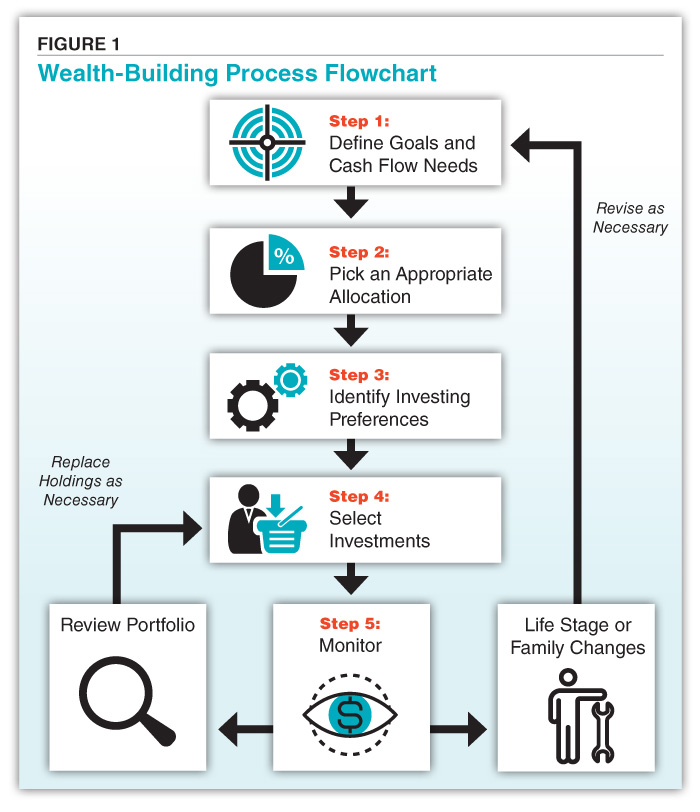
When we first launched the Individual Investor Wealth-Building Process (Figure 1), I asked AAII members to consider: Why is money important? Put a different way, what is the rationale for building or maintaining wealth?
The obvious answer is “money buys things.” But is the real reason you are investing to simply buy things? Chances are the real reasons go beyond what we consider material items such as a new Tesla or Mercedes.
You may want to ensure that you have a roof over your head and the ability to pay for food and medical care in retirement. You may be thinking about your children’s or grandchildren’s college educations. There may be a charity or other cause personal to you. Perhaps you want to leave a legacy for your heirs so they can live a better life.
Whatever your goals are, they should drive all of your investing decisions. How much you save, how much risk you take, what allocation you implement and when you start withdrawing money from your portfolio are determined by your goals. When your goals change, so should your strategy.
An analogy would be planning a trip. Say you intend to drive from Tampa Bay to Los Angeles and need to be there in a week. If this is your goal, you would start by focusing on the most direct route and where you might stay each night. You wouldn’t spend time considering whether it’s a good time to go to Niagara Falls because visiting it would interfere with reaching your goal.
Identifying and stating your goals brings clarity to the rest of the investment process. Once you’ve identified what you’re investing for, it becomes easier to make other portfolio decisions. Goals allow you to know what to say yes to and what to say no to.
Goals are personal decisions. No one can tell you what your goals are. They vary by person.
Just because someone you know is focused on leaving a large inheritance doesn’t mean you should be. Perhaps you don’t have kids. Maybe your children are financially independent. You could be concerned about high end-of-life expenses because Alzheimer’s disease runs in your family. You may wish to give it all away to charity or spend as much as you can on travel while you are healthy enough to do so.
If you’re a young adult, you could also have different goals than your friends. You may be fortunate enough to have financial help from your family. You could have a high level of college debt. You might be in a high-paying field and thinking about becoming part of the Financial Independence, Retire Early (FIRE) movement. Alternatively, you could be struggling to save.
There are obviously more scenarios we could give than would fit into this article. The big takeaway in this section is that goals are personal. Because goals are personal, your investment strategy should be as well.
Consider the large amount of investment advice given. Often, it’s focused on the short term. Strategists are asked how the financial markets will perform this year. Analysts are asked how a stock will perform over the next X number of months or what investors should expect from the upcoming earnings reports. Such information can give you ideas and help set expectations (rightfully or wrongfully), but the advice isn’t given with your unique goals in mind.
What about the fund managers you see being interviewed? What are their timelines? They may talk about investing for the long term, but two things should be kept in mind. First, fund managers are judged on short-term results. Underperforming over just a small number of years can cause investors in a given fund to leave. Second, most funds are intended to last into perpetuity. In reality, they have far shorter actual life-spans but, suffice it to say, the investment horizon of the typical fund is different than yours.
Even target-date funds may not match up with the timing of your goal. These funds are designed to evolve their portfolio allocations from being aggressive early in an investor’s career to being conservative as retirement approaches. Our research into these funds found that they differ from each other not only in their final allocations, but also in the length of time between the target (retirement) date and when they reach their final allocations. (See “A Second Look at How Target Date Funds Change Their Allocations” in the June 2016 AAII Journal for more information.)
None of this means you are on your own. Rather, it shows the importance of knowing what you will pull out of your investing toolbox to achieve your goals. Just as you wouldn’t use a hammer to insert a screw, you shouldn’t follow investment recommendations without first considering whether they are appropriate for your goals. The best strategy in the world isn’t right for you if it doesn’t keep you on the path to reach your goals.
When you are clear about your goals, you start viewing your investment choices through a different light. Your priorities become reaching those goals instead of trying to keep up with your neighbor or friend who likes to talk about the investments they are making. You begin to view new strategies through the lens of what you are trying to achieve. You ask, “How does this fit into my allocation?” and “Is it a good fit given what I’m trying to accomplish?” You start to worry less about what the market did today and focus more on whether you are on track given your timeline. You view your strategy in terms of the process needed to achieve your goals instead of what someone tells you it should be.
We made “Define Goals and Cash Flow Needs” the first of the five steps in the Wealth-Building Process because these decisions drive every other investing decision. When you are clear about your goals, executing the next four steps becomes easier. You have a clear purpose to consider every investing decision against.
Being clear about your goals can be empowering.
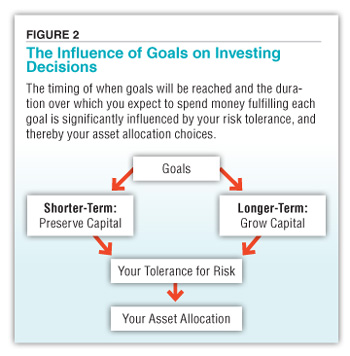
The reason we place such a high emphasis on goals is their timelines. The timing of goals can be broken into two parts. The first is the amount of time until the goal is expected to be reached. The second is the duration over which you expect to spend money fulfilling the goal.
Combined, these two parts have significant influence over how you will invest (Figure 2). Setting aside money for a large one-time expense expected to be incurred within a few years requires a very conservative allocation. Saving for a goal not expected to be reached for a period of 20 years or longer requires a very aggressive allocation, especially if the goal will have a long spending duration once reached.
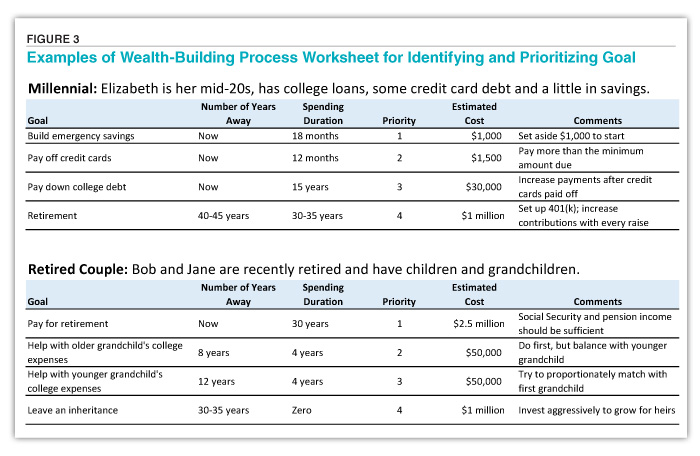
A way to think about this is the trade-off between the risk of losing capital and the risk of losing purchasing power. Consider a hypothetical millennial we used as an example when introducing our “Identify and Prioritize Your Financial Goals” worksheet (Figure 3). Elizabeth wants to both build emergency savings and start saving for retirement. Her emergency savings will cover things like deposits on a new apartment, replacing her phone or computer should they stop working and potential medical bills, among other things. This is money she should not put into the stock market because an ill-timed drop would prevent her from being able to pay for them.
The shorter the investment period, the greater the risk of a capital loss becomes. Since 1928, large-cap stocks have fallen in value once every four calendar years. The large-cap S&P 500 index has averaged a drop of at least 5% once every six months since the end of World War II. It has experienced a bear market—defined as a drop of 20% or more—approximately once every six years between 1946 and 2020.
Sequence of returns is a risk for anyone facing a short-term need for cash, like Elizabeth might with her emergency savings. Sequence of returns risk refers to the order in which returns occur. For a near-term goal with a short spending duration, a bad sequence of returns can force you to make unwanted choices. You may have to postpone your goal, cut back on your spending plans or completely abandon your goal. In the case of Elizabeth, she might have to rely on high-interest credit card debt.
The way to avoid incurring a bad sequence of returns is to invest conservatively. So-called safe assets such as savings accounts, certificates of deposit (CDs), money market funds and high-quality, short-term bond funds will protect your capital from the swings of the market.
Elizabeth’s contributions to retirement savings should be fully allocated to stocks (or at least close to it, depending on her psychological tolerance for risk). Not doing so will significantly harm her future purchasing power. (Purchasing power is the ability to buy goods and services with the money you have.) A dollar saved today is not worth a dollar 10 years into the future because of the eroding effects of inflation.
Longer investment periods smooth out sequence of returns risk. The bouts of downside volatility in stocks are offset by bigger, and longer periods of, upside returns. Longer periods of time also give you the ability to benefit from compounded returns or gains upon your gains. This compounded growth is necessary to preserve your purchasing power. The further out the goal is, the more you will need to be concerned about the eroding effect inflation has.
A helpful way to think about this is the rule of 72. Dividing 72 by the projected rate of return provides an estimate of how long it will take to double your money. It can also be used to measure the impact of inflation. Say you think inflation will average 3% for an extended period of time. Such a rate of inflation will cause prices to double in less than 25 years. To offset this risk, you will need to earn at least this much just to maintain your purchasing power. If you need additional wealth to fund your goal, you’ll have to earn a higher rate of return. A 7% annualized return will more than quintuple your savings over the same period.
You can change the assumptions as you please, but the big point does not change: the further out your goal is, the more important growth of capital becomes. The nearer your goal is, the more important preservation of capital becomes.
There is another timing aspect of goals: the spending duration. Spending duration is the length of time you expect to spend money on the goal. A large purchase has a very short spending duration. You may splurge on a once-in-a-lifetime vacation, like a world cruise. Retirement can have a long spending duration, especially if you are in good health and there is a history of longevity in your family. In between, there is a wide range of durations. College for a child or grandchild, for example, can be expected to last four years if graduate school isn’t a consideration.
The duration of spending impacts your investing strategy because as you approach your goal, you will have to consider the timing of withdrawals. Elizabeth may need to withdraw from emergency savings without much advance notice to cover a one-time expense. For her retirement, she will be making withdrawals over a period of potentially three decades.
Those of you intending to help children or grandchildren with college costs may be looking at a four-year spending duration. This is the case for our hypothetical retired couple, Bob and Jane. They also would like to leave an inheritance. While the transfer of the couple’s assets will occur on a single date (e.g., the settlement of the estate, the funding of a trust, etc.), their heirs may have a lengthy spending duration afterward. These differences influence the type of allocation needed.
A large one-time withdrawal or a series of withdrawals over a short period of time mandates reaching the goal with a conservative allocation. A lengthy duration of spending requires striking a balance between the short-term needed to preserve capital and the long-term need to grow capital.
Chances are you have more than one goal. Elizabeth wants to build her emergency savings, pay off credit card debt, pay down college debt and save for retirement. Bob and Jane need to ensure their retirement expenses are covered, would like to help out with their grandchildren’s college expenses and want to leave an inheritance.
Each goal has a different length of time before it is expected to be reached, as well as a different spending duration. A different sum of money will be required to fund each goal. In an ideal world, this wouldn’t be an issue. The real world isn’t so simple.
A good place to start is by prioritizing your goals. Which one of your goals is most important? What is second in terms of importance? What is third? Etc.
In the case of Elizabeth, building up emergency savings should take primary importance. Doing so will keep her from falling further into debt. Plus, she’ll need the cash to cover things like the deposit on a new apartment.
Prioritizing one goal doesn’t necessarily mean the other goals should be ignored. Elizabeth will need to pay down her credit card debt as quickly as her budget allows while also staying current with her student loan payments. It would also be wise to start saving for retirement—especially if there is an employer match—given her young age.
For Bob and Jane, ensuring their retirement expenses are covered is their top priority. While helping their grandchildren may be desired, it’s more important for them to ensure their own financial security. Their secondary goals can be covered by assets not needed. If the couple’s expenses are covered by Social Security and pension benefits, they may be able to use their accumulated wealth to pay for their secondary goals.
When it is realistic to save for—and potentially fulfill—several goals, some complexity is added to the investment process. The approach followed will need to account for the different timelines of each goal.
A simple place to start is to use the goals worksheet to list out each goal, how far away it is, the spending duration and the estimated cost of the goal. (We’ve added the estimated cost of the goal to the original worksheet.) You then have two options.
The first is to allocate your overall portfolio based on the timing and duration of each goal. The larger the sum of money needed within the next few years, the more conservative your overall allocation should be. The less money needed over the next few years, the more aggressive your overall allocation can be.
The second is to use more of a bucket approach. Each goal would be assigned its own account. While this adds complexity in terms of managing accounts, it may mentally help you better manage each priority. It is akin to the envelopes approach some of you may have used for budgeting and saving.
As you can see, the timing of when goals will be reached and their spending durations have implications for how you will invest. Short-term goals require different allocations than long-term goals. Knowing this allows you to narrow your investment focus. Advice from pundits and friends can be filtered through the lens of “Does this fit with the decisions I need to make to achieve my goals?”
We’ll come back to this inward-focusing concept as we move through each step of the Individual Investor Wealth-Building Process. It will help you to think about what your personalized investing plan should be. ?
 |
Go to the Learn & Plan section of AAII.com to walk through the entire five-step Individual Investor Wealth-Building Process. To aid in building your plan, there are short videos to watch and fun challenges to work through. |
Behavioral Finance

Portfolio Strategies
Portfolio Strategies

Michael A from MN posted over 5 years ago:
Peter N from TN posted over 5 years ago:
Charles L from TX posted over 5 years ago:
You need to log in as a registered AAII user before commenting.
Log InCreate an account