


When it comes to investment strategies for retirement (and almost any other application), most individual and professional practitioners have adopted an approach based on total-return investing and modern portfolio theory (MPT). So, the natural income from the portfolio (e.g., dividends and interest) is typically reinvested and income required for spending is chiseled off from the portfolio as needed.
Portfolio volatility presents a risk, as it can jeopardize one’s financial security in retirement by increasing the probability of running out of money (i.e., potentially less money to chisel from). For example, retirees may still need to withdraw from their portfolios during market declines, and this would result in forced selling at depressed prices. Of course, conservative financial planning should allow for such situations and be able to withstand such scenarios.
This typically results in constructing a diversified portfolio that will offer an attractive balance of growth potential and risk. If we confine ourselves to a world with just stocks and bonds (for the sake of simplicity), then the idea would be for stocks to generate sufficient long-term growth to help combat inflation or generate real returns (returns above and beyond the rate of inflation), while bonds might be regarded as a diversifying asset. As long as the bond allocation keeps up with inflation and tends to zig when stocks zag, many investors are content to maintain significant bond allocations in order to balance the risk in their portfolios.
The bottom line is that market risk is critical in the context of retirement planning. So, the lower volatility and low to negative correlations with stocks can make bonds useful in maintaining a diversified portfolio. However, viewing bonds only through the lens of market prices ignores the inherent stability they can provide in terms of generating specific cash flows with little to no uncertainty (i.e., the same attribute that likely makes them less volatile—S&P reports the one-year default rate for AAA-rated bonds has been precisely 0% historically).
Let us take a step back and look at the bigger picture. Consider a retiree who wants to ensure their portfolio will provide adequate income as long as they may live. A portion of this income will likely come from their fixed-income allocation. So, they purchase bonds or bond funds, but only to observe them as squiggly lines on charts that may later be converted to cash. In other words, they purchase future streams of cash that could be used for retirement spending, but ignore those stable cash flows, reinvest them, and end up at the mercy of the market when they want to extract those funds down the road.
This seems a rather roundabout way of using bonds when the ultimate goal is income (Figure 1). Bonds and, more generally, fixed-income investments already generate specific cash flows that are independent of market risk when held to maturity. In my view, this is the real sanctity of fixed-income investing. However, this notion seems to have been lost with many of the contemporary investment strategies that do not specifically align assets with liabilities comprising future outgoing cash flows.
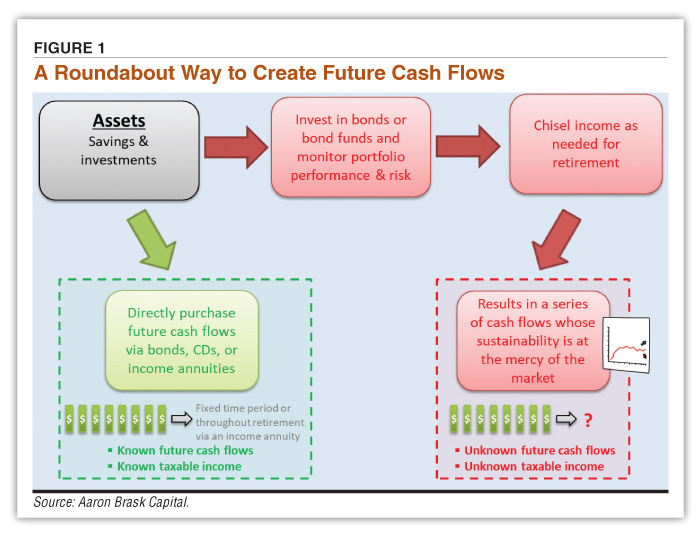
While the term fixed income is still widely used to describe various investments, it has lost the essence of its literal meaning. Hence this article and my goal to restore this sanctity of fixed income. The following sections discuss two specific tools investors can use to generate fixed cash flows and manage relevant risks: bond ladders and income annuities. While I touch on some of the potential cost and tax savings, I believe the greatest benefit is simplicity. In my experience working with many investors over the years, I find a greater understanding of one’s financial plan often facilitates the most peace of mind—regardless of the potential monetary benefits.
Bond Ladders
A bond ladder is basically a series of bonds spaced out over a specified time period (e.g., five, 10 or 20 years) and held to maturity. As time passes, each bond’s time to maturity decreases. In particular, the proceeds from each maturing bond are used to purchase a longer-term bond to restore the original length of the ladder.
For example, let us consider a 10-year bond ladder composed of 10 bonds—one for each year. After one year passes, the first one-year bond matures and the 10-year bond ladder is now a nine-year bond ladder. So, the proceeds from the maturing bond are used to purchase another 10-year bond and we are back to a 10-year bond ladder again.
I may have brushed some of the details under the rug (e.g., callable bonds and defaults), but this describes the general approach. The process is simple and eliminates unnecessary turnover from any jockeying around. There are basically two moving parts: how long of a time period to use and how far to space bond maturities within the ladder. So let us consider how to structure a bond ladder.
I find the main decision is how long to structure a ladder. Several factors are relevant here. In an environment with a typical upward-sloping yield curve, longer ladders will naturally increase the yield. At the same time, this will also likely increase the volatility of the ladder’s market value and its vulnerability to inflation. While many people consider volatility synonymous with risk, this could actually improve a ladder’s ability to diversify other positions (e.g., allocations to stocks).
Shorter bond ladders basically exhibit the opposite attributes. They generally have lower yields, are less volatile and are less susceptible to inflation. Indeed, as each year passes, shorter ladders would reinvest a larger proportion of their total capital (one out of the number of bonds held) and more quickly benefit from the presumably higher rates.
We could take this example to the extreme by considering a bond ladder with zero length. That is, the capital would simply be invested at overnight rates (like a savings account). On the one hand, it would not earn any term premium. (Term premium is a theoretical concept whereby investors are generally rewarded with higher yields for investing in longer maturity bonds.) On the other hand, it could instantly benefit from any higher rates due to inflation. This train of thought could be useful for retirees where inflation is a critical risk.
Of course, one could use different types of bond funds (long- versus short-term) to manage these risks. However, I find the simplicity and passive nature of bond ladders attractive—especially when focusing on the income profile and its relationship with inflation. In my experience, both active and passive bond funds tend to have excessively high turnover. This jockeying around from one bond to another does not necessarily lead to any reliable benefits but can impose additional fees and trigger sporadic capital gains.
Another application for bond ladders is one in which the actual bond principal is used for consumption. For example, consider a couple with one child entering college now and another starting four years down the road. In this case, they may wish to set aside funds to cover tuitions for the next, say, eight years. In this case, it is not just the bond income that is relevant since the principal will be spent as well. One might even use certificates of deposit (CDs) or fixed annuities that accrue but do not pay interest along the way. (Multi-year guaranteed annuities, or MYGAs, are similar to CDs, but the accrued interest is not taxed until withdrawal.)
Retirees may also set up bond ladders with the intention of spending the principal as bonds and CDs mature. The obvious challenge in this scenario is not knowing how long they will need income. If they build a bond ladder out to their (actuarial) life expectancy, they may live longer than average and have no more bonds maturing to fund their retirement. One solution is to plan for a reasonably long life-span. However, this requires one of two things:
- More money to provide for those potential additional years of spending, or
- Reducing the amount invested in each bond or CD, which means less money for spending each year.
On an individual basis, each retiree may effectively be forced to plan for the ‘worst-case’ scenario—living longer. For the lucky few that live like cockroaches, they will be happy they planned conservatively. For the majority who live shorter, average or slightly above-average life-spans, this conservative approach will result in their retirements being overfunded (which is only known in hindsight). Accordingly, this approach results in significant overfunding at the aggregate level—a natural byproduct of the desire to avoid running out of money. The income annuity products in the next section directly address this issue.
Income Annuities
Simply put, an income annuity is a product offered by insurance companies whereby they allow individuals (or couples) to purchase income that is guaranteed to last as long as they live (e.g., throughout retirement). The amount of income relative to the purchase price is determined by a combination of actuarial (i.e., life expectancy) and market factors (i.e., interest rates). As of this writing, for example, a 70-year-old man can purchase $1,443 in guaranteed monthly income for the rest of his life for $250,000. On an annual basis, this represents a payout of approximately 7%. (Please note that this 7% figure comprises both interest and principal. It is not comparable to yields on other investments.)
As I highlighted in the previous section, individual investors generally cannot afford to run the risk of assuming they will only live to their actuarial life expectancy. Accordingly, they often play it safe by allocating enough money to fund retirement for a period that is significantly longer than their true life expectancy. So, this results in overfunding at the aggregate level. This is where insurance companies can be helpful.
Unlike market volatility, actuarial risks such as life-spans are very predictable when averaged across large groups of people. By pooling risks across many annuity customers, insurance companies can effectively net out the longevity risks and price guaranteed lifetime income based on the average life expectancy. For individuals who would otherwise have to plan well beyond their life expectancy to be safe, pooling risk via an income annuity could allow them to free up capital or purchase a higher level of income per year.
For example, consider a 65-year-old man with a life expectancy of 18 years (i.e., expected to live to 83 years old) deciding between a bond ladder and an annuity. Assuming the same level of annual cash flows, constructing a bond ladder out to age 90 would cost significantly more than an annuity based on a life expectancy of 83. Indeed, the bond ladder would require funding 25 years (90 minus 65) of cash flows, whereas the annuity price would only reflect the average of 18 years. Ignoring the time value of money, the bond ladder would require approximately 39% [(25 ÷ 18) – 1] more capital for the same level of cash flows.
Figure 2 illustrates the expected mortality rates for 65-year-old men and women. As one might expect, very few people are expected to die early on, most will likely live to right around their actuarial life expectancy and increasingly fewer will be expected to live each year further out. With a large enough group of income annuity purchasers, the shapes of these curves would directly reflect the actual outgoing cash flows. So, an insurance company could purchase fixed-income investments to provide for those cash flows. (In practice, the assets used to back income annuities are invested in a general account that does not necessarily hedge those specific cash flows. However, the economics and pricing should directly reflect these hedging costs.)
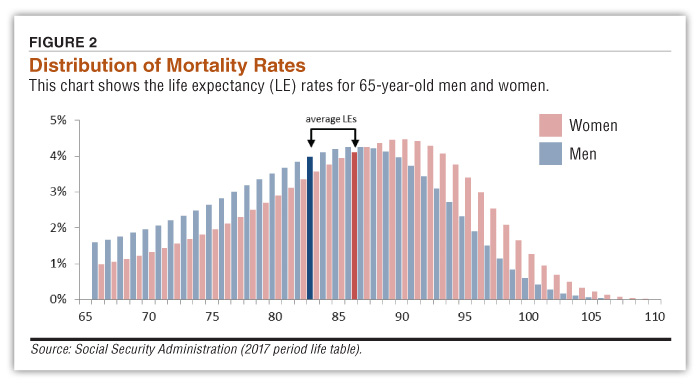
While insurance companies are in business to earn a profit, any additional expense (above and beyond the actuarial fair price) paid by income annuity purchasers would likely be significantly less than what it would cost for them to secure their own income through age 90, 100 or beyond—whatever age is required to ensure that the likelihood of running out of money was de minimis. The market jargon used to describe this averaging phenomenon is mortality credits. That is, income annuity clients who live longer effectively receive credits from those who live shorter life-spans.
Mortality credits alone can make income annuities an attractive tool for many retirees. However, I also like to present income annuities from another perspective. Given the current market environment where both interest rates and dividend yields are so low, most retirees will not be able to live off the natural income from their portfolios (i.e., dividends and interest). Accordingly, they will have to dip into principal to fund their retirement.
Once a retiree acknowledges that principal will be sold over the course of their retirement, they have a choice. On the one hand they can wait and chisel as needed down the road. Of course, this leaves future income at the mercy of the market. Moreover, each time they chisel away from their portfolio, it will naturally reduce the dividend and/or interest income paid out in subsequent years. With less income, the shortfall could increase and require chiseling away even more principal. This can be a slippery slope.
On the other hand, one way to mitigate this risk could be to allocate a portion of fixed-income investments to a bond ladder or income annuity. Rather than being at the mercy of the bond market when chiseling off money for spending, an income annuity allows the retiree to chisel income in advance—effectively eliminating the market risk for this stream of income.
Annuities Are Bad, Aren’t They?
Annuities have rightfully earned a negative stigma from the agents pushing more expensive products with higher commissions. While I have written extensively on the drawbacks of variable annuities (including excessive fees and potential tax issues: www.aaronbraskcapital.com/optimizing-fixed-annuity-tax-deferral), I find income annuities to be a very efficient tool for retirement planning. Unlike their complicated variable cousins, income annuities are very simple. This simplicity makes it easier for insurance companies to manage their risk. In theory, this should help to reduce their costs. Moreover, simplicity also makes it much easier for investors and independent agents (like myself) to compare apples with apples, shop around and get the best rate. This comparison shopping imposes additional gravity on income annuity prices from competition.
In my experience, income annuities have become more competitively priced in recent years, and this makes them an attractive option for many retirees. I built my own calculator to assess the implied costs embedded in income annuities for my clients, but online calculators are also available for those who know what they are doing (one free example can be found at www.aacalc.com/calculators/spia). David Blanchett of Morningstar Investment Management, Michael S. Finke of The American College and Branislav Nikolic of York University Department of Mathematics and Statistics found that when normalizing for interest rates, the trend for income annuity prices was lower over the seven-year period ending in August 2020 (“How Competitive Are Income Annuity Providers Over Time?,” SSRN, April 2021).
Some Other Considerations With Income Annuities
In addition to fees, another concern that periodically comes up is what would happen if you purchased an income annuity, but only ended up living a short period. If a significant sum was paid upfront for an income annuity, but only a few payments were received in return, it would undoubtedly be a negative economic outcome (and a personal tragedy). However, most insurance companies will guarantee a 100% return of premium in exchange for reduction in payout. This is effectively a money-back guarantee—something most conservative bond funds cannot even offer. Given the low-interest-rate environment we are currently in, I find that this option provides additional peace of mind—especially if children or other legacy concerns are present.
One approach many people choose is to allocate just enough to an income annuity to cover their basic necessities. More generally, I like to integrate income annuities into a broader plan for retirement income that complements the use of other assets and sources of income while tending to the potential risks that could jeopardize retirement security (inflation, health care needs, etc.). In addition to being able to provide guaranteed income, options like the cash refund feature described previously, the ability to structure income via joint and survivor payouts for couples and other features can make income annuities a versatile tool for retirement planning.
This versatility can be especially useful for minimizing the tax impact with retirement. I do not elaborate on the taxes here, but I do discuss it on my website: www.aaronbraskcapital.com/optimizing-fixed-annuity-tax-deferral.

Related

Portfolio Strategies
Quantifying the Value of Retirement Accounts
Related

Portfolio Strategies
How to Create Your Own Pension: A Closer Look at Immediate Annuities
Discussion
FREE REPORT

Get your free copy of our special
report analyzing the tech stocks
most likely to outperform the
market.
DONALD G from CA posted over 5 years ago:
CHARLES S from NM posted over 5 years ago:
AARON B from FL posted over 5 years ago:
AARON B from FL posted over 5 years ago:
AL H from FL posted over 5 years ago:
AARON B from FL posted over 5 years ago:
THAD A from ME posted over 1 year ago:
AARON B from FL posted over 1 year ago:
You need to log in as a registered AAII user before commenting.
Log InCreate an account