


Related

Investor Professor
The novel properties and unique intrinsic values of bitcoin and other digital assets are arguments for their inclusion within a modern diversified portfolio.
by Steven Ehrlich | July 2021
Bitcoin and other digital assets have emerged as a new asset class. Interested investors should approach cryptocurrencies with a goal of maximizing risk-adjusted returns and incorporating hedging strategies.
It is impossible to provide definitive insights on the broad cryptocurrency sector within a single article, but I provide food for thought and frameworks for analysis. My goal is to help you be able to ask more specific questions and explore the space more deeply in the future.
This question might seem self-explanatory, but cryptocurrency (crypto) assets have a very precise definition. It’s important to understand what makes bitcoin and other cryptocurrencies unique in order to grasp their intrinsic values.
Bitcoin is a decentralized cryptocurrency. It is decentralized because there is no single individual or company that owns or issues new coins, as compared to airline miles or rewards points from your favorite restaurant or retail store.
If Congress, the U.S. Securities and Exchange Commission (SEC) or the Treasury Department wanted to contact Bitcoin, there is no number to call or door to knock on. Bitcoin has a pseudonymous founder, Satoshi Nakomoto, but nobody knows who the person (or group) is, and this individual or team has not been involved in bitcoin development for many years.
Bitcoin is a crypto asset because it relies on the novel use of encryption algorithms to keep the network secure, process transactions and help participants authenticate themselves on the network.
Bitcoin’s intrinsic value exists even though it is not backed by anything tangible. Though this may seem unusual, the U.S. has been off the gold standard for 50 years; the U.S. dollar is simply backed by the “full faith and credit” of the U.S. government. Secondly, although bitcoin was originally designed as a novel payment system, it has now settled into a narrative as a form of digital gold.
Why does this analogy fit? First, bitcoin has a hard limit of 21 million units, which makes it a scarce asset. Secondly, its digital nature makes it far more transportable and divisible than gold. Finally, the network is highly secure. In the 10+ years of its existence, it has never been hacked at the network level. [Editor’s note: The FBI accessed crypto wallets in June 2021 to recover part of the ransom paid by Colonial Pipeline to DarkSide.]
Bitcoin is the original blockchain and crypto asset and center of the cryptocurrency universe, but it is hardly alone. In fact, an entire galaxy of crypto assets has been created to support a wide range of use cases and applications focused on vertical markets such as identity management, data storage, gaming, banking, lending, social media and streaming.
Because bitcoin started the industry, virtually every other crypto asset is called an altcoin. Altcoins can be categorized in a few different ways.
Protocol tokens, also referred to as level 1 or base layer tokens, are native to a blockchain and are necessary for the operation of a given platform. Bitcoin is a protocol token, not only because it is what users send and receive over the network, but because it is also how miners (payment processors), get compensated for supplying their computer power.
Ethereum is by far the most prominent and popular altcoin. It has the second-largest market capitalization, $274 billion, behind only bitcoin ($594 billion). It was created in 2015 by Vitalik Buterin, who was looking to build a blockchain platform that could run and execute any type of software program or application. Bitcoin is relatively rigid in its composition, which is by design, as more functionality offered by a blockchain can also create additional security vulnerabilities.
Ethereum operates in a similar manner to bitcoin, where miners expend substantial amounts of computer power to add transactions to the network. There are also many other prominent blockchains with their own protocol tokens. Some of the largest are Algorand, Cardano, Binance Smart Chain, Tron, EOS and Polkadot.
If the base layer of a blockchain is the operating system, then decentralized applications (dapps) are the programs that run on top of them. Many of these applications have their own tokens (known as dapp tokens) that are also freely traded on many exchanges. Dapp tokens first came to prominence in 2017 and 2018 during the initial coin offering (ICO) craze. It is worth noting that the vast majority of these ICO projects failed, and the value of their assets went to zero, which was a reflection of the novelty, hyperbole and excitement of the space.
Nonetheless, today there are still dozens of dapp tokens in existence with market capitalizations in the hundreds of millions or even billions of dollars that underpin applications with real utility and actual business operations that make money. They are headlined by decentralized finance (DeFi) tokens. Some of the most prominent include Compound, Aave, Uniswap, SushiSwap, Curve, PancakeSwap and Maker.
DeFi is an umbrella term used to capture traditional financial applications (such as banking or lending) that are replicated on a blockchain through dapps and smart contracts, which are automatically executable pieces of code that activate when certain conditions are met. Think of smart contracts as if/then statements built into blockchains. Today, there is more than $56 billion locked up in blockchain applications and DeFi tokens.
Finally, it is important to highlight the latest development in crypto, nonfungible tokens (NFTs). A core component of money, or cryptocurrency, is for every asset to be valued the same by every investor. They must be fungible. NFTs are the exact opposite of this. While they operate on top of blockchains just like any protocol or dapp token, they have a set of properties or characteristics that make them unique. If bitcoin is the first iteration of scarce digital value, then NFTs are the next evolution.
NFTs exploded in the early part of this year, with everything from online video game assets to baseball cards and digital works of art being replicated on the blockchain via NFTs. The space has cooled down some since the winter but is still highly elevated from a historical perspective. Much like DeFi was a more responsible successor to the boom and bust of the ICO craze, I expect that the NFT sector will settle on more focused use cases as an opportunity to grow.
Although cryptocurrency bottomed out in March 2020, along with the rest of the market, it rebounded quickly and hit unprecedented highs during the latter half of 2020 and early 2021. There are a few reasons for this, the most important being:
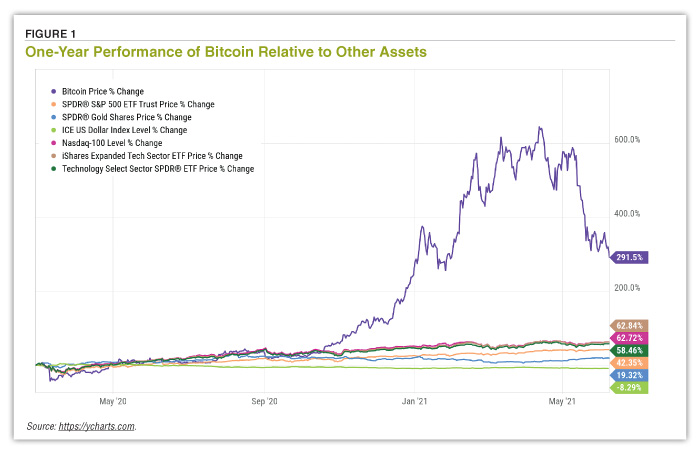
Figure 1 shows how cryptocurrency dramatically outperformed the S&P 500 index, gold, the U.S. dollar and even leading tech sector exchange-traded funds (ETFs) that were darling stocks over the last 12 months.
That said, as I write this in early June, virtually every crypto asset is down substantially from its highs earlier this year. There are a few reasons why.
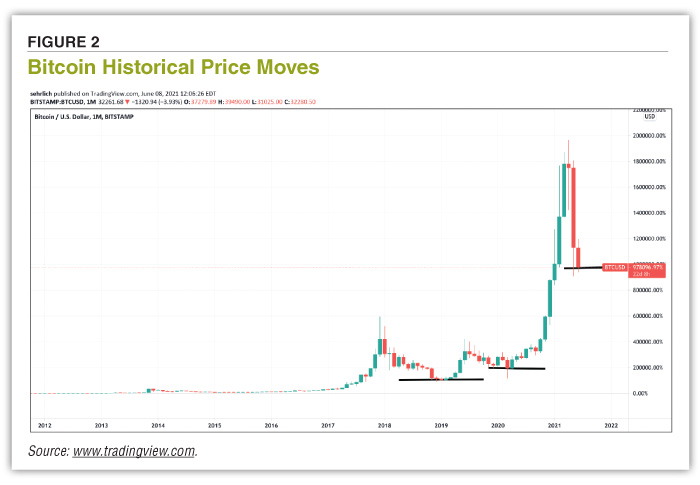
There are a few things to keep in mind. First, cryptocurrency is a novel and volatile asset class, so volatility should be expected. These types of reversals have been common throughout bitcoin’s history as can be seen in Figure 2.
Second, all the major characteristics that play a role in bitcoin’s intrinsic value (along with that of the respective altcoins) remain in place. This has not changed, and we are still in the very early days of cryptocurrency.
For many investors, exposure to spot market prices has been risky and/or lucrative enough for their first forays into crypto assets. However, as the industry matures, we are starting to see ways that investors can earn passive income on their holdings. This strategy can help top up gains or hedge against price risk.
The top two strategies are staking and yield farming.
Staking is the act of posting certain crypto assets as collateral to participate in the operation of a blockchain. As compensation for locking up holdings, users receive regular rewards in a manner similar to interest payments. Staking is useful for blockchains that operate a proof-of-stake (POS) consensus mechanism. This is a different approach than proof-of-work (POW), which is the computationally intensive and expensive mechanism employed by bitcoin, litecoin, bitcoin cash and many other tangents of the original blockchain.
Although POW has proven itself to be highly secure and effective, there are growing concerns about its energy usage and associated carbon footprint. In addition, POW blockchains have scalability and throughput issues such that the Bitcoin system can only process a handful of transactions per second, while POS platforms can handle hundreds of thousands per second.
Prominent stakeable assets include algorand, cardano, polkadot and tezos.
Additionally, while Ethereum remains a POW blockchain, it is possible to stake its native asset, ether. This is because Ethereum is currently undergoing a multi-year transition from a POW to a POS consensus mechanism so that it can support the high demand for its computational resources.
Please note that POS consensus mechanisms are not homogenous and each blockchain network may use a different way of calculating staking rewards, taking into account various factors such as:
Aside from purchasing DeFi tokens, it is also possible to earn them through a process known as yield farming. Yield farming can be thought of as DeFi 2.0. Before, when you would provide liquidity to a decentralized exchange or lending protocol, you’d simply earn a fee or earn some interest. However, this summer Compound kickstarted a new trend that rewarded users with governance tokens—COMP in this case—as an incentive program.
Consistent with the decentralized ethos of the space, governance tokens are mechanisms for each protocol’s respective founders to cede control of the platform and turn it over to the users. In turn, token holders can use their ownership shares for additional rewards or to vote on governance decisions that vary between protocols.
In fact, so many governance tokens and yield farming opportunities were created that a group of DeFi portfolio managers were built to help shift user funds between opportunities so that they could maximize rewards and reduce transaction fees. Think Betterment or Wealthfront robos for crypto assets. The most prominent of these is yearn.finance, whose governance token (valued at $37,622) is more valuable than bitcoin.
Yield farming comes with some fine print as well. Here are a few important points for consideration.
Security: Many DeFi projects are launched without going through proper security audits, and, even then, the risk does not disappear entirely.
Scams: Oftentimes you need to deposit tokens into these protocols to earn rewards, which can be locked for a certain amount of time. However, these smart contracts could give founders backdoor control over locked funds, presenting the risk that they abscond with them.
Bubbles: Much of the activity on these DeFi protocols has been driven by speculators looking to collect governance tokens. In fact, responses to a 2020 survey posed to representatives of DeFi platforms demonstrated that 37.5% feel that 90% or more of the activity is driven by speculators; the other 62.5% of respondents believe that real usage is somewhere between 10% and 30%. Speculation is not necessarily a bad thing, but more crossover between DeFi and the traditional financial sector would be preferred.
When Coinbase Global Inc.  (COIN) went public in April 2021, many investors falsely believed that it was their first opportunity to gain cryptocurrency exposure through brokerage accounts. However, there are many publicly traded securities that have offered exposure to the crypto space for some time. I cannot mention them all here, but there are two primary categories to keep in mind.
An exchange-traded product (ETP) can be thought of as a packaging layer around an asset or group of assets—such as bitcoin and cryptocurrencies—that trades on an exchange like a security.
The biggest ETP provider is Grayscale. Grayscale’s Bitcoin Trust (GBTC) is by far the industry’s largest fund available to investors, with assets under management (AUM) totaling $24.4 billion as of this writing. Grayscale also offers other similarly structured products tracking other assets including ether, litecoin and ethereum classic. The company’s lineup also includes Chainlink, a data provider for smart contracts.
There are competitors to Grayscale. Several can be found on Switzerland’s SIX Swiss Exchange and Canada’s Toronto Stock Exchange.
Some exchange-listed stocks are seen as a proxy for bitcoin. Business analytics firm MicroStrategy Inc. (MSTR) is seen as a leader in the space, given its status as the largest corporate holder of bitcoin in the world. There are also many publicly traded bitcoin mining firms (companies that run complex computers used to add transactions to the Bitcoin network) including Marathon Digital Holdings Inc. (MARA) and Riot Blockchain Inc. (RIOT).
Exchanges like Coinbase make 90% or more of their revenue from transaction flows, which come in whether the market is going up or down. Coinbase also offers dozens of assets for trading beyond bitcoin.
How much should one invest in a risky and volatile growth asset such as cryptocurrency? A common target for allocating to alternative assets is in the range of 1% to 15% of a portfolio, based on investor risk profile, age and objectives.
Although crypto assets are somewhat correlated to each other and are not quite the non-correlated asset that some purport them to be, their novel properties and unique intrinsic values are an argument for inclusion within a modern diversified portfolio.
Aside from making investment decisions, I often receive questions about the specific mechanics of crypto investing. This is somewhat novel to the industry because there are few options to buy crypto assets from traditional brokerage or wealth management accounts.
In the U.S. alone, there is a wide variety of secure and regulated exchanges that offer simple onboarding procedures. Some of the biggest and most widely used include Coinbase, Kraken and Gemini. They each have easy-to-use websites and mobile applications.
Additionally, as the space has grown, many non-crypto native platforms and financial applications such as Square, Robinhood, Revolut and PayPal have enabled crypto trading. The added benefit of these platforms is that you do not need to do any additional onboarding if you are already a client.
Once you’ve bought cryptocurrency, you need to keep it safe. Virtually all the regulated platforms suggested for first-time buyers will provide software wallets (similar to mobile banking applications) that are reasonably secure. The security of these applications can be further enhanced by taking a few basic steps:
We think you’d like this related webinar! Individual Investor Show: Cryptocurrency, First Cut Stock MVPs and Shadow Stock Changes
Investor Professor
Investor Professor

Portfolio Strategies

CARLOS G from FL posted over 5 years ago:
CRAIG & NANCY B from CA posted over 5 years ago:
RAJIV C from OR posted over 5 years ago:
GREGORY M from CA posted over 5 years ago:
HAROLD R from MN posted over 5 years ago:
Gregory E from TN posted over 5 years ago:
DAVID W from AZ posted over 5 years ago:
BRIAN R from MI posted over 5 years ago:
EDWARD K from NC posted over 5 years ago:
C J from NC posted over 5 years ago:
DAVID R from WI posted over 5 years ago:
Stephen C from NJ posted over 2 years ago:
You need to log in as a registered AAII user before commenting.
Log InCreate an account