



Featured Tickers:
- Small-cap stocks remain attractively priced relative to large-cap stocks
- Two stocks exceeded the size maximum and were removed from the model portfolio
- From the list of 18 stocks passing the portfolio’s initial criteria, three new stocks were added
A broad market rally is helping to pull most market segments into positive territory for 2023 as we go to press in mid-December. While the Magnificent Seven stocks have helped the S&P 500 index and Nasdaq composite shine during 2023, many market segments have struggled during much of the year.
The S&P 500 as measured by the performance of the Vanguard 500 Index fund  (VFINX) is up 20.6% for 2023 through November. The S&P 500’s impressive performance is largely attributed to the Magnificent Seven; since it is a market-capitalization-weighted index, larger companies have a greater impact on its performance. The seven stocks together—Apple Inc. (AAPL), Amazon.com Inc. (AMZN), Alphabet Inc. (GOOGL), Nvidia Corp. (NVDA), Meta Platforms Inc. (META), Microsoft Corp. (MSFT) and Tesla Inc. (TSLA)—are up 102.3% on average through the end of November and make up 27.8% of the Vanguard 500 Index fund. In comparison, the equally weighted index of the S&P 500 companies is up 6.4% through the end of November, as measured by the Invesco S&P 500 Equal Weight ETF (RSP).
The recent broad market rally has been christened the “everything rally,” as we are seeing gains in stocks, bonds, gold, cryptocurrency and home prices. Declining interest rates seem to be the greatest catalyst for the everything rally, and interest-sensitive sectors such as real estate have benefited the most.
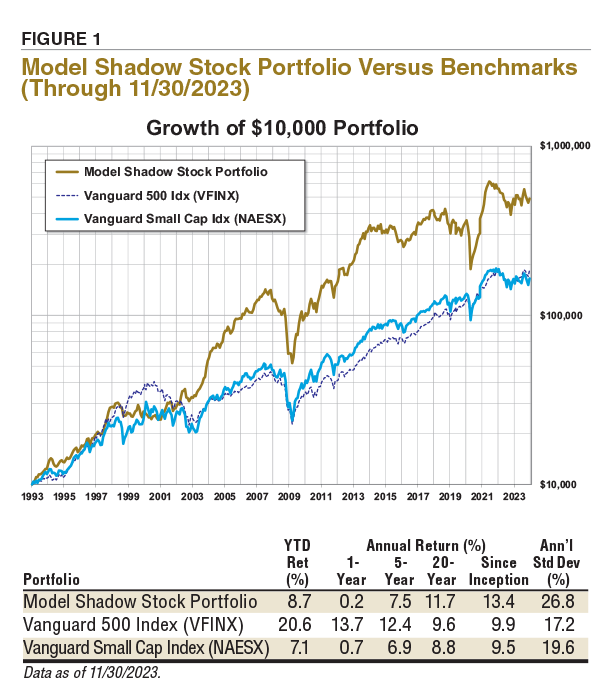
The Model Shadow Stock Portfolio is now up 8.7% for the year through the end of November. This compares to 20.6% for the Vanguard 500 Index fund and 7.1% for the Vanguard Small Cap Index fund (NAESX) year to date.
Small-cap stocks remain attractively priced relative to large-cap stocks. The median price-to-book-value (P/B) ratio of the companies in the S&P SmallCap 600 index is 1.69, well below the 3.25 median ratio for the companies in the S&P 500. The S&P SmallCap 600 normally trades at a discounted multiple relative to the S&P 500. The discount has averaged 0.67 since 1998 and is currently 0.52.
Since its inception in 1993, the AAII Model Shadow Stock Portfolio has a compound annual average return of 13.4%, versus the Vanguard 500 Index fund’s gain of 9.9% per year on average over the same period. Over the same period, the Vanguard Small Cap Index fund posted an average annual gain of 9.5%. Figure 1 shows performance over various time periods.
Quarterly Portfolio Review
The Model Shadow Stock Portfolio was designed to test the strategy of investing in the 1% intersection of the smallest and cheapest publicly traded stocks. Research conducted by Eugene Fama and Kenneth French (Journal of Finance, June 1992) showed that the smaller the market cap of a company, the higher its stock returns. In addition, the lower the ratio of market price to book value, the higher the returns. The highest returns came from those stocks that were in the lowest market-cap decile and the lowest price-to-book decile.
The primary Model Shadow Stock Portfolio selection criteria target the intersection of the smallest 10% of domestic stocks as measured by market cap, along with the “cheapest” 10% of domestic stocks as measured by the price-to-book ratio. These decile breakpoints are determined by examining domestic companies that are listed on the New York Stock Exchange (NYSE) and then applying the size and value breakpoints for stocks listed on all domestic exchanges. The intersection of 10% constitutes the primary initial selection universe.
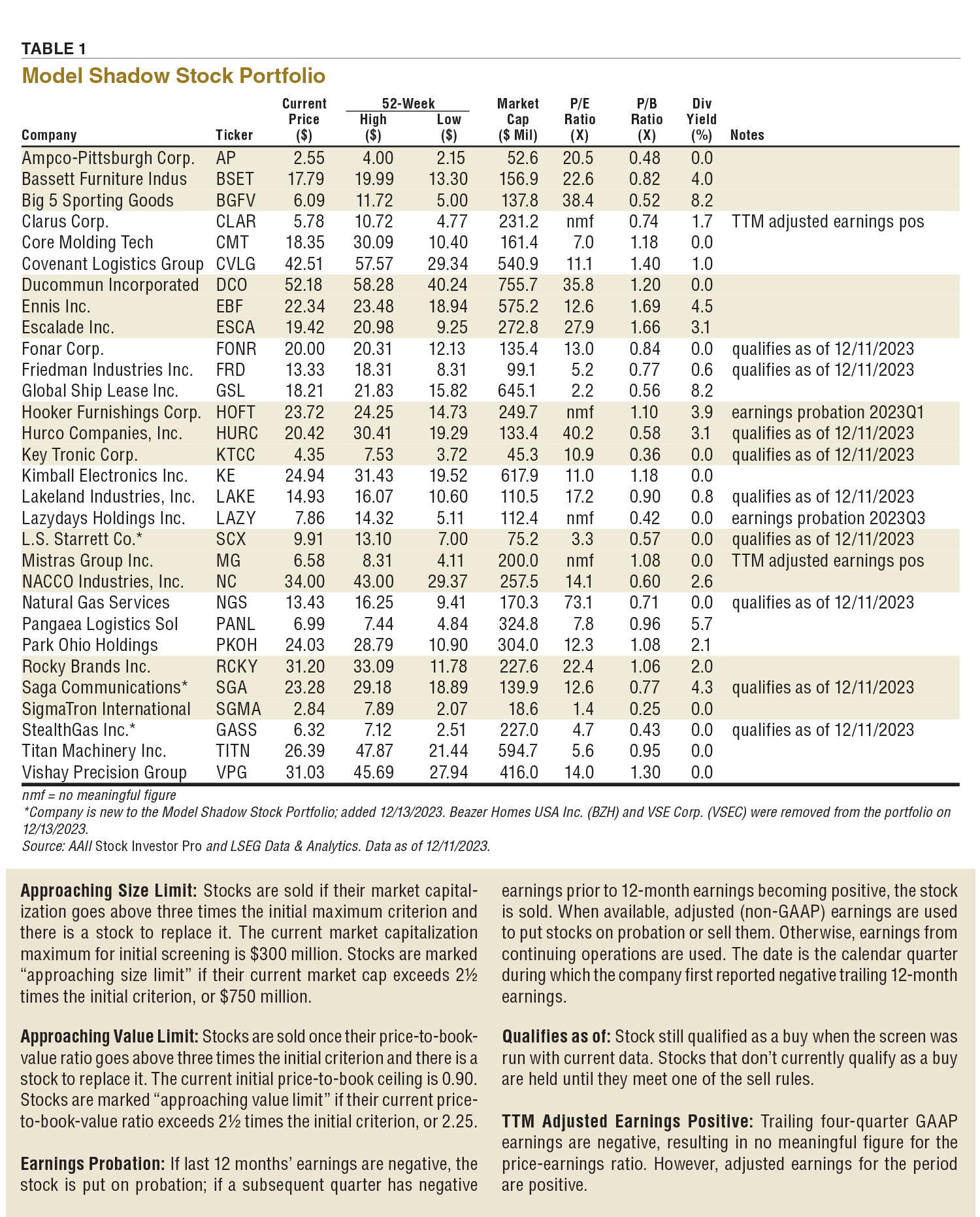
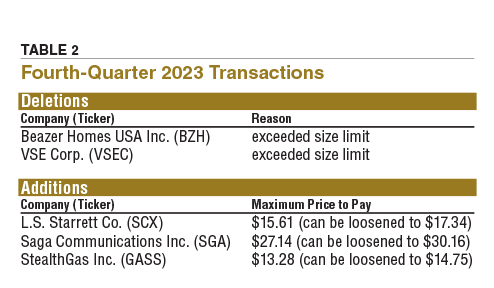
The Model Shadow Stock Portfolio is reviewed quarterly to determine portfolio deletions and additions. The quarterly review cycle is tied to the reporting cycle of most firms and limits costly portfolio turnover. AAII’s stock analysis and screening service Stock Investor Pro, with data as of December 11, 2023, was used for the quarterly review. Table 1 shows the stocks currently held in the model portfolio. Two stocks were deleted and three stocks were added. Table 2 summarizes the changes.
Value Factor
The price-to-book cutoff has decreased slightly from 0.85 in September to 0.81. The current initial qualifying maximum price-to-book ratio is 0.90, and we left it unchanged. There are currently 1,314 exchange-listed securities with a price-to-book ratio less than or equal to 0.90.
Stocks in the model portfolio are removed for valuation if they exceed three times the initial maximum price-to-book ratio at the time of a quarterly portfolio review. No stocks in the model portfolio exceeded the maximum price-to-book ratio at the time of review.
Size Factor
We examined the market-cap levels of domestic companies listed on the NYSE to determine the size cutoff for the lowest decile when adding stocks to the model portfolio. The lowest decile market-cap level declined from $270 million in September to $267 million using data in Stock Investor Pro. We are leaving the maximum initial qualifying market-cap value unchanged at $300 million. There are currently 1,545 exchange-listed securities with a market cap between $30 million and $300 million.
Holdings are removed if their market cap goes above three times the initial criterion at the time of the quarterly review. There were two holdings in the model portfolio that exceeded the $900 million market-cap maximum at the time of review: Beazer Homes USA Inc. (BZH) and VSE Corp. (VSEC).
Size Deletion: Beazer Homes USA Inc.
Beazer Homes USA exceeded the market-cap deletion cutoff of $900 million with a market cap of $935.9 million and was removed from the portfolio. Beazer Homes was added to the Model Shadow Stock Portfolio on September 1, 2016, at a price of $11.15 per share. It was removed on December 13, 2023, at $28.728 per share, for a gain of 157.7%.
Size Deletion: VSE Corp.
VSE Corp. exceeded the market-cap deletion cutoff of $900 million with a market cap of $961.1 million and was removed from the portfolio. VSE Corp. was added to the Model Shadow Stock Portfolio on December 4, 2018, at a price of $29.55 per share. It was removed on December 13, 2023, at $60.76 per share, for a gain of 105.5%.
Negative Earnings Rule
If a company has trailing 12-month earnings from continuing operations that are negative, the stock is placed on probation; if a subsequent quarter has negative earnings prior to trailing 12-month earnings becoming positive, the stock is deleted. When available, adjusted (non-GAAP) earnings are used to put stocks on probation or remove them. No holdings were removed during the quarterly review because of negative earnings.
Hooker Furnishings Corp. (HOFT) has been on earnings probation since the first quarter of 2023. While it reported positive quarterly earnings in July and December, its trailing 12-month earnings are still in the red and the company remains on earnings probation.
Lazydays Holdings Inc. (LAZY) went on earnings probation this quarter when it reported a third-quarter loss of $0.48 per share. This also pushed trailing 12-month earnings into the red.
Holding Period Rule
We also examine the portfolio for stocks that have been held for at least four years and have not had strong price appreciation and no longer meet the initial qualifications. Holdings that no longer qualify and have not gained at least 10% annually are usually removed. However, with the bear market environment for small-cap companies and the relatively low number of qualifying candidates, no holdings were removed this quarter for tenure.
Quarterly Additions
As of December 11, 24 stocks met the initial selection criteria for the Model Shadow Stock Portfolio. AAII members can see and research which companies are currently passing the initial selection criteria in the Shadow Stock Ideas table on AAII.com. The list of new Shadow Stock Ideas is updated daily—Tuesday through Saturday.
Six qualifying stocks were already in the Model Shadow Stock Portfolio at the time of the review. The remaining 18 stocks were examined to ensure adequate liquidity, timely financial filings and appropriate industry and foreign considerations. The Shadow Stock Portfolio Rules on AAII.com provide guidance on factors to consider when selecting stocks for your portfolio.
With the proceeds from the deletions, as well as the cash held in the portfolio, positions in three companies were able to be taken at roughly the average position size for the existing holdings in the tracking portfolio.
L.S. Starrett Co. (SCX)
L.S. Starrett is engaged in the business of manufacturing various products for industrial, professional and consumer markets. It principally serves the global manufacturing industry, including metalworking, construction, machinery, equipment, aerospace and automotive markets.
L.S. Starrett has a book value per share of $17.34 as of September 30. If you wish to stay within the 0.90 price-to-book maximum, you should pay no more than $15.61 per share ($17.34 (AAPL) 0.90). However, if the stock price has moved up after being added to the portfolio, you can still purchase the stock unless the price-to-book ratio goes above 1.00, which equates to a price of $17.34 per share. To calculate the maximum purchase price based on the maximum desired price-to-book ratio, multiply the current book value per share ($17.34 for L.S. Starrett) by the maximum price-to-book ratio to be considered for the Model Shadow Stock Portfolio (currently 0.90, or 1.00 for loosened consideration).
Saga Communications Inc. (SGA)
Saga Communications is a broadcast company engaged in acquiring, developing and operating broadcast properties. It owns approximately 79 FM radio stations, 34 AM radio stations and 80 metro signals serving over 27 markets.
Saga Communications has a book value per share of $30.16 as of September 30. If you wish to stay within the 0.90 price-to-book maximum, you should pay no more than $27.14 per share ($30.16 (AAPL) 0.90). However, if the stock price has moved up after being added to the portfolio, you can still purchase the stock unless the price-to-book ratio goes above 1.00, which equates to a price of $30.16 per share.
StealthGas Inc. (GASS)
StealthGas is a provider of international seaborne transportation services to liquefied petroleum gas (LPG) producers and users, as well as crude oil and product carriers to oil producers, refineries and commodities traders.
StealthGas has a book value per share of $14.75 as of September 30. If you wish to stay within the 0.90 price-to-book maximum, you should pay no more than $13.28 per share ($14.75 (AAPL) 0.90). However, if the stock price has moved up after being added to the portfolio, you can still purchase the stock unless the price-to-book ratio goes above 1.00, which equates to a price of $14.75 per share.
Next Portfolio Review
The next quarterly review of the Model Shadow Stock Portfolio will take place in March 2024. Any changes to the portfolio will be announced at the time they are made in our Model Shadow Stock Portfolio Update emails (sign up at www.aaii.com/email).

Related

Discussion
FREE REPORT

Get your free copy of our special
report analyzing the tech stocks
most likely to outperform the
market.
JOHN L from NJ posted over 2 years ago:
MIKE C from SC posted over 2 years ago:
You need to log in as a registered AAII user before commenting.
Log InCreate an account