

Related

Mutual Funds
You shouldn’t immediately switch from a fund when it changes manager(s), but you should pay closer attention to investment style, portfolio turnover, fees and performance after a change.

Wayne Thorp leads a class in AAII's new Essential Investing Video Course. Go to https://www.aaii.com/ves for more information and to subscribe.
Mutual fund managers often move on to better opportunities or are replaced for poor performance, many times over too short of a time horizon. What does it mean to investors in a fund when there is a turnover in manager(s)?
For index funds, the impact is all but nil, since the manager is buying and selling to keep the holdings in line with the target index, such as the S&P 500 index or Russell 2000 index.
For actively managed funds, however, the impact could be more pronounced. For starters, even if there is a prescribed investment style for the fund, the new manager may have a different approach to achieve that style. This could lead to a change in the types of securities held by the fund, the fund’s turnover, etc.
However, the change of a portfolio manager is not reason, in and of itself, to leave a fund. Instead, monitor the mutual fund closely to make sure the new manager is continuing the old manager’s style, and that any changes won’t significantly affect your investment.
New portfolio managers have been known to take command of a mutual fund and sell off securities, reflecting a change in style. A significant portfolio realignment might mean greater capital gains distributions, and therefore taxes, unless you hold the mutual fund in a tax-sheltered account.
On the other hand, if the mutual fund is an index fund or less actively managed, the portfolio manager may not be all that important. Or the new portfolio manager may continue with the old style and perform just fine.
You should switch to another fund with a similar investment objective only when the performance of your fund falls off against other funds with the same investment objective, or if your existing fund changes objectives so that it no longer reflects the objective you are seeking.
High-profile fund manager changes tend to make headlines that lead to significant outflow. But what impact do these changes have on future returns of a fund?
In 2017, Morningstar did a study to answer this exact question. The key takeaways from this study are discussed below. Note that when the study uses the term “investors,” it is primarily referring to the network of intermediaries that oversee the vast majority of fund inflows and outflows—advisers, institutions and platforms.
The Morningstar study found zero relationship between a management change—adding or removing a single manager or an entire team—and future fund returns over the next month up to the next three years.
It would seem, based on the findings, that running a mutual fund is much more of a team-driven endeavor than it has ever been. In fact, Morningstar analysis shows that the percentage of actively managed mutual funds run by a single manager has fallen from just over 50% in 1990 to around 25% as of the start of 2015.
The data also shows that there is no evidence that management change has a delayed impact on future performance.
Not only do investors overreact to fund management changes, but this reaction actually strengthens, persisting up to 36 months after the change is made.
This creates an investor behavior gap, the difference between an investment’s returns and the returns of an investor. Investors react to an event that, research now shows, does not have an impact on fund performance. This reinforces the argument that, as long as the fundamental reason holds for investing in a fund in the first place (and expenses don’t become disproportionately high), investors shouldn’t move their investment.
Although the study points to management change as a signal for a fund closing, it notes that there are other common characteristics that are better indicators of whether a fund is nearing a close:
The Morningstar study found that, in general, investors are too quick to react to a change in fund management. For up to 36 months after a change, the study revealed that the average fund will see lower category percentile growth rates.
No matter what the time period, the data shows that funds with management changes see sustained periods of outflows. This may stem from investors’ aversion to change and the unknown. Switching from funds that have seen a management change may be investors exerting control over an unknown and seemingly negative situation. Underperforming funds that change managers tend to remain underperformers, and a high-flying fund will most likely continue that trajectory.
The bottom line, all else equal, is that individual investors need to be patient when a fund changes managers.
While we discussed previously that investors, in general, punish funds that change managers by withdrawing their money, this isn’t the case with high-alpha funds. Funds achieving high alpha (excess return above that of the market) tend to experience less outflows than a fund with low alpha. The data indicates that investors are willing to give new managers a chance when the fund has been performing well.
While the Morningstar research indicates that large funds do not see any difference in performance when there is a manager change compared to small funds, large mutual funds see larger outflows than small funds.
This could be due to the disproportionate attention larger funds receive than smaller funds. With only so many words to use or column space to fill, the more well-known funds are going to receive the coverage. As a result, the potential for negative attention is lower with small funds, which could account for the smaller outflows.
Lastly, the Morningstar analysis found that there is virtually no relationship between industry tenure, management change and subsequent inflows or outflows. Also, removing a manager with lengthy industry experience results in a similarly small change in outflows.
This again highlights the fact that funds are rarely run by one person anymore. Instead, there is a team of portfolio managers, research analysts and risk-management professionals overseeing a fund. Replacing even the most senior manager will not stop or change the investing process. In addition, fund companies tend to set narrow mandates for funds. Given a fund’s stated objective, there is a stated and restrictive range of capital deployment strategies that managers must follow.
While the research indicates that you shouldn’t immediately switch from a fund when it changes manager(s), this is information worth knowing so you can pay closer attention to investment style, portfolio turnover, fees and performance. To help you in this process, the Funds page at www.aaii.com/funds includes a table that reports recent fund portfolio manager changes (Figure 1).

The table has separate tabs for funds that have added and dropped managers as of the latest month-end. It also includes a tab called My Funds that is populated by any funds that you are tracking in our My Portfolio tool that have had a recent manager change.
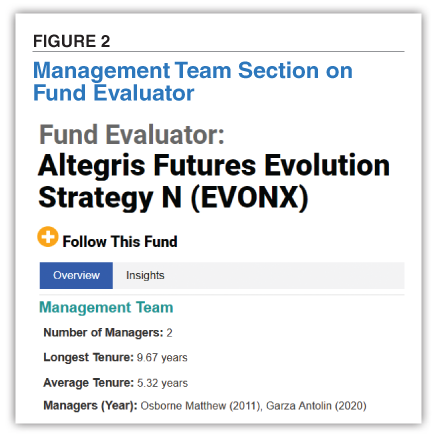
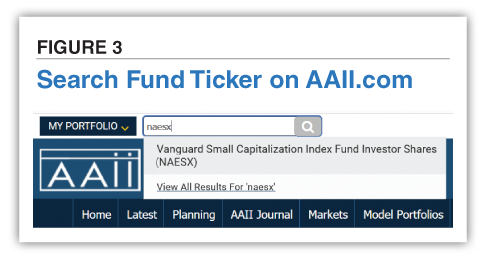
In addition, go to any fund’s Evaluator page to find out the number of portfolio managers, the average tenure of the fund’s managers, the longest tenure and the names of each manager with the year they joined the fund (Figure 2). Simply type the fund name or ticker in the search box at the top of our webpages and click on the fund name when it appears in the drop-down box (Figure 3).
Mutual Funds

Mutual Funds


T F from NJ posted over 5 years ago:
You need to log in as a registered AAII user before commenting.
Log InCreate an account