


Derek Hageman leads a class in AAII's new Essential Investing Video Course. Go to https://www.aaii.com/ves for more information and to subscribe.

Featured Tickers:

AAII’s Buffett Hagstrom screen is based on portfolio manager Robert Hagstrom’s extensive writings about the stock-picking strategy of Warren Buffett. Possibly no other investor today is associated as strongly with the basic principles of fundamental investing as Buffett.
Buffett attracts attention, and a cottage industry has sprung up to pass on and interpret his fundamental teachings. While some critics feel that Buffett’s strategy cannot be duplicated, Hagstrom disagrees. He has authored a number of popular books that highlight Buffett’s core investment principles. In “The Essential Buffett: Timeless Principles for the New Economy” (Wiley, 2002), Hagstrom argues that it is possible to duplicate Buffett’s approach within your personal area of expertise. He presents the approach through an accessible series of questions that should be explored with any potential investment. The approach requires that you:
- Analyze a stock as a business,
- Demand a margin of safety for each purchase,
- Manage a focused portfolio and
- Protect yourself from the speculative and emotional forces of the market.
Developing an Approach That Invests for the Long Term
Buffett’s most recent annual letter to Berkshire Hathaway Inc. shareholders came out on February 27, 2021. It is a must-read for investors as there are plenty of good insights to learn from over the years.
One section from last year’s letter stood out: “Anything can happen to stock prices tomorrow. Occasionally, there will be major drops in the market, perhaps of 50% magnitude or even greater. But the combination of The American Tailwind … and the compounding wonders [from the power of retained earnings], will make equities the much better long-term choice for the individual who does not use borrowed money and who can control his or her emotions.” What Buffett is ultimately saying is “keep calm and invest for the long term.”
One of the enduring themes again in this year’s letter included Buffett saying that most owners of productive assets will be rewarded. “All that’s required is the passage of time, an inner calm, ample diversification and a minimization of transactions and fees,” wrote Buffett. What he is saying here again is that investors should stick with holdings over the long term.
Buffett feels that speculators are primarily concerned with a company’s stock price, while investors first focus on how the business is doing. Buffett is a firm believer that knowledge helps to increase investment return and reduce risk.
It is also important to keep one’s emotions in check. We should not let our emotions override our good judgment. Every person must take their own psychology into account. Some losses are inevitable when it comes to investing, so if you cannot emotionally handle the volatility then you should consider a more conservative investing style.
What It Takes: Buffett Hagstrom Criteria
- Market capitalization is greater than or equal to $1 billion;
- Positive operating income for the trailing 12 months (sum of the last four quarters) and each of the last seven fiscal years;
- Return on equity is greater than 15% over the last four quarters and for each of the last three fiscal years;
- Current debt-to-equity ratio is better than the industry’s current median debt-to-equity ratio;
- Current operating margin is greater than the industry’s current median operating margin;
- Current operating margin and net profit margin are greater than their industry’s current median operating margin and net profit margin;
- Price change is greater than book value change over the last five years;
- Low price-to-free-cash-flow ratio;
- Price to free cash flow relative to free cash flow growth is greater than zero and less than or equal to 2.
Buffett’s Tenets
Hagstrom identifies 12 basic Buffett principles from business, management, financial and valuation tenets that a company should possess to be considered for purchase. Not all of Buffett’s purchases displayed all of these tenets, but as a group the principles help to establish a reasonable approach to selecting stocks. The tenets cover both qualitative and quantitative business elements. We focus here on the main ones used to create the Buffett Hagstrom screen.
Business Tenets
Is the business simple and understandable?
Knowledge helps to increase investment return and decrease risk. Buffett warns that if you buy a company for superficial reasons, then there is a tendency to dump the stock at the first sign of weakness. Investors need to be able to understand company factors such as cash flow, labor issues, pricing flexibility, capital needs, revenue growth and cost control.
Does the business have a consistent operating history?
Buffett avoids companies that are either solving difficult business problems or fundamentally changing their direction because previous plans were unsuccessful. Turnarounds rarely succeed in their turn. Buffett feels that the best returns come from companies that have been producing the same product or service for years.
While this tenet is primarily a qualitative element, the screen looks for positive operating profit over each of the last seven years as a basic test for consistent performance.
Management Tenets
When considering a company, Buffett evaluates managers for their rationality, candor and independent thinking, among other characteristics.
Is management rational?
Buffett looks for companies whose managers behave like business owners and act in a rational way, especially in the treatment of retained earnings and the investment of company profits. Hagstrom feels that the most important action of management is the allocation of a firm’s capital. Effective use and reinvestment of a company’s cash flow ultimately determines the growth of a firm and its long-term value. This issue becomes critical as a company matures and starts to generate excess cash flow that cannot be reinvested in the primary business line at a high rate of return.
Is management candid with its shareholders?
Buffett holds in high regard managers who fully disclose company performance, equally reporting mistakes and successes. He respects managers who report information beyond that required with generally accepted accounting principles (GAAP). Buffett looks for financial reports that enable the financially literate investor to determine the approximate value of a business, determine the likelihood that a firm can meet its financial obligations and gain an understanding of how well the managers are running the business.
Financial Tenets
Buffett does not take quarterly or yearly results too seriously when studying company financials. He finds it better to focus on three- to five-year averages to gain a feel for the financial strengths of a company.
While Wall Street typically measures company performance by studying earnings per share, Buffett looks for strong and consistent return on equity that is achieved without excess leverage or accounting gimmickry.
Focus on return on equity, not earnings per share.
The AAII Buffett Hagstrom screen looks for return on equity above 15% over the last four quarters and for each of the last three fiscal years.
Companies can increase return on equity by increasing asset turnover, widening profit margins or increasing financial leverage. Buffett is not against the use of debt—financial leverage—but warns against excessive use of debt. Acceptable levels of debt vary from industry to industry, so a filter was added that requires debt-to-equity ratios to be below the respective industry norm.
Look for companies with consistent and high profit margins.
Buffett seeks franchise companies selling goods or services in which there is no effective competitor, either due to a patent or brand name or similar intangible that makes the product unique. These companies typically have high profit margins because of their unique niche. Franchises have pricing flexibility to raise prices without the fear of losing market share or unit volume.
The Buffett Hagstrom screen looks for companies with operating margins and net profit margins above their industry norms. The operating margin concerns itself with the costs directly associated with production of the goods and services, while the net margin takes all of the company activities and actions into account. Follow-up examinations should include a detailed study of the firm’s position in the industry and how it might change over time.
For every dollar retained, make sure the company has created at least one dollar of market value.
The market recognizes companies that use retained earnings unproductively through weak price performance. Buffett feels that companies with good long-term prospects run by shareholder-oriented managers will gain market attention, which results in a higher market price. The AAII Buffett Hagstrom screen requires at least a dollar-for-dollar share price increase for each dollar added to retained earnings over the last five years.
Valuation Tenets
Even if you have identified a good company, it does not necessarily represent a good investment unless it can be purchased at a reasonable price.
Purchase stock if it can be acquired at a significant discount to its valuation.
Many investors turn to simple multiples, such as price-earnings ratios, to help establish a preliminary hurdle before an in-depth analysis is performed. Since Buffett likes to focus on free cash flow, the price-to-free-cash-flow (P/FCF) ratio is used in the screen.
The lower the price-to-free-cash-flow ratio, the better. However, a company with higher growth deserves to trade at a higher multiple than a slower-growing firm. To adjust for varying growth rates, the price-to-free-cash-flow ratio is divided by the free cash flow (FCF) growth rate to help equate value to growth.
Screen Performance
The Buffett Hagstrom screen is built into AAII’s Stock Investor Pro fundamental stock screening and research database. The companies meeting the criteria of this strategy each month are used to calculate hypothetical performance.
Figure 1 shows that the Buffett Hagstrom approach has outperformed the S&P 500 index since the beginning of 1998. It has generated a compound annual price gain of 14.2% over the period from January 1998 through September 30, 2021, while the S&P 500 is up 6.5% annually over the same period.
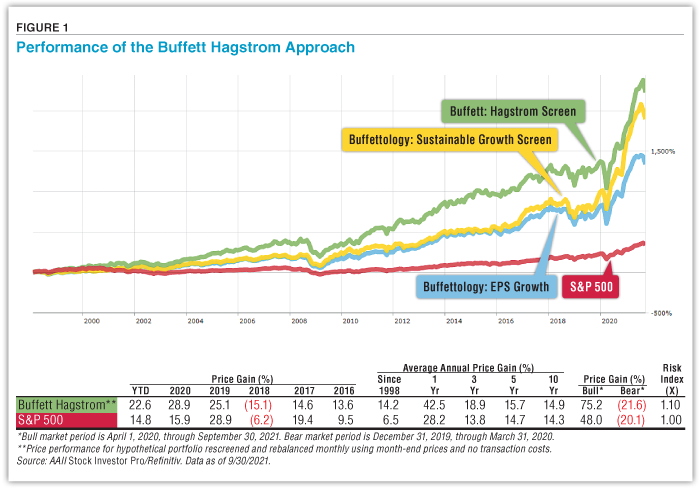
The Buffett Hagstrom strategy has been one of AAII’s most consistent screens over the long term. The approach has outperformed year-to-date through September 30, rising 22.6% versus a gain of 14.8% for the S&P 500. The strategy’s one-year, three-year, five-year and 10-year average annual price gain outperformed the S&P 500 over the same periods. The strategy has an average annual price gain of 18.9% a year over the last three years and 15.7% a year over the last five years, while the S&P 500 gained 13.8% and 14.7% on average over the same periods, respectively.
As an AAII member, you can follow the Buffett Hagstrom strategy’s performance, and see how it compares to the other stock approaches that AAII tracks, at the Screening area of AAII.com (choose Guru Screens from the dashboard). You can also see a monthly list of stocks passing the screen.
Profile of Passing Companies
Table 1 highlights the characteristics of stocks meeting the Buffett Hagstrom screening criteria as of October 11, 2021.
TABLE 1. Buffett Hagstrom Screen Portfolio Characteristics
Many of AAII’s screening approaches search for stocks that are attractively priced relative to some measure of intrinsic worth. These screens usually incorporate traditional valuation metrics such as the price-earnings ratio or price-to-book-value ratio as primary screening criteria.
For the stocks currently passing the Buffett Hagstrom approach presented in Table 1, the median value of the price-to-book ratio of 6.20 is significantly above the 2.17 median value for all exchange-listed stocks. The median values of the price-earnings ratio and price-to-sales ratio are also above the median values of these metrics for all exchange-listed stocks. The median value of the historical earnings per share growth rate for the Buffett Hagstrom screen of 25.5% is significantly above the 5.4% median value for all exchange-listed stocks.
Thirty companies that met the Buffett Hagstrom criteria as of October 11 are listed in Table 2 ranked by the ratio of price to free cash flow to free cash flow growth.
TABLE 2. 30 Companies Currently Passing the Buffett Hagstrom Screen
(Ranked by the ratio of price to free cash flow to free cash flow growth)
Go to AAII Guru Screens for an updated list of stocks passing this screen.
Final Thoughts
Buffett’s approach identifies “excellent” businesses based on the prospects for the industry and the ability of management to exploit opportunities for the ultimate benefit of shareholders. He then waits for the share price to reach a level that would provide him with a desired long-term rate of return.
Most investors have little trouble understanding Buffett’s philosophy. The approach encompasses many widely held investment principles. Its successful implementation is dependent upon the dedication of the investor to learn and follow the principles. It requires the ability to stick to the approach during times of market volatility. But for individual investors willing to do the considerable homework involved, the Buffett Hagstrom approach offers a promising path to investment value.
More Hagstrom on Buffett
Robert Hagstrom’s books include the New York Times bestseller “The Warren Buffett Way” (Wiley, third edition 2013) and “The Warren Buffett Portfolio: Mastering the Power of the Focus Investing Strategy” (Wiley, 2009). His latest book, published in March 2021 is “Warren Buffett: Inside the Ultimate Money Mind” (Wiley). Hagstrom spoke recently on the topic of this book at AAII’s virtual Investor Conference 360, where he explored the philosophical underpinnings of Warren Buffett’s investment approach and applied it to today’s markets. A complete set of video recordings from the conference are available for purchase; see https://conference.aaii.com for details.

Related

Related

Stock Strategies
Focus on the Value of a Business, Not the Stock's Valuation
Discussion
FREE REPORT

Get your free copy of our special
report analyzing the tech stocks
most likely to outperform the
market.
Sneha J from IND posted over 4 years ago:
You need to log in as a registered AAII user before commenting.
Log InCreate an account