




Related

Portfolio Strategies
As a hybrid security, preferreds have higher yields than bonds and offer an attractive risk/return tradeoff for investors searching for yield.

In the June 2021 AAII Journal, I discussed convertible bonds, which possess both fixed-income and equity characteristics (“Inside Convertible Bonds: An Attractive Risk/Return Tradeoff”). Preferred securities (aka preferred stocks, or preferreds) are a related type of hybrid. They share some features of bonds in that they offer scheduled payments on a fixed par amount and carry a credit rating. Their risk profile is closer to that of equity, however. As such, they have higher yields than bonds and offer an attractive risk/return tradeoff for investors searching for yield.
Like common stock, preferred securities represent an ownership interest in the firm, although generally without voting rights. (Some firms do assign preferred shareholders voting privileges in extraordinary circumstances.) Preferred shareholders do have a higher claim than common stockholders to the assets of a firm in the event of its bankruptcy, although their claim is subordinate to those of bondholders.
Dividends on preferreds are typically fixed, like bond coupons. Preferred dividends are larger than those on common shares, although the latter tend to increase over time as the firm’s fortunes improve. Dividends on participating preferreds may also increase, but typically only when a firm is being wound up. Furthermore, as with convertible bonds, convertible preferred shares can be converted into common stock, thereby allowing the investor to benefit from price appreciation. In contrast to bonds, whose coupons are typically paid semiannually, preferred dividends are paid quarterly and are not contractual. A firm’s failure to pay preferred shareholders a dividend is not an event of default.
The firm’s ability to defer dividends increases the risk of these securities relative to senior debt. However, dividends on preferred shares due in the current period—and also, in the case of cumulative preferred shares, any unpaid dividends from prior periods—must be paid before any dividends can be paid to common shareholders. Unlike coupons on most bonds, dividends on many preferred shares are qualified, and are taxed at an advantageous qualified dividend income (QDI) rate, rather than as income, to the benefit of investors who hold them in taxable accounts. (Preferred stocks must be held for a consecutive minimum of 90 days during a 181-day period beginning 90 days prior to the ex-dividend date to qualify for the reduced tax rate. This is a longer period than the one that applies to common stocks.)
Most preferreds are issued by financial firms, and carry a par value of $25, although some carry a par value of $1,000, like senior debt. The market consists of several types of securities, including:
As with bonds, purchasers of preferred securities must pay for any accrued interest, and it is usual for a “dirty price,” which includes accrued interest, to be quoted. The price will drop on the ex-dividend date to reflect the dividend payment just made, as the price of dividend-paying common stock also does.
Just as there are floating-rate bonds, floating-rate preferreds pay a variable dividend, typically with a floor, or minimum payment. Fixed-to-floating rate preferreds pay a fixed dividend for a specified number of years (typically five years) after issuance. After this period has passed, fixed-to-floating rate preferreds switch to paying a floating dividend (if not called by the issuer). Floating dividends are set at a spread to a reference rate such as three-month LIBOR (London Interbank Offered Rate), which is likely, in the next year or two, to be replaced by another rate such as the Secured Overnight Financing Rate (SOFR).
While bonds have a fixed maturity, preferred shares traditionally have had perpetual lives, although many nowadays may be redeemed after a specified number of years. Term preferreds have a mandatory redemption feature, which means that in practice they have a maturity date.
Most preferred securities have a feature that enables the issuer to call them on specified dates. Similar to a call option on stock, the option is likely to be exercised when the securities trade at a premium.
Since preferreds with fixed dividends tend to look increasingly attractive when interest rates decline, these will likely be called if rates remain low or decrease. The likelihood of a call depends also on the credit quality of the issuer, and the refinancing cost they would face, as well as the provisions of the specific issue.
Preferred shares that have fixed dividends tend to behave like bonds, with their prices moving in response to changes in interest rates. Just as bond price sensitivity to interest-rate changes is a function of maturity, term preferreds will tend to have relatively low price volatility in response to interest rate changes, since they act like short-term bonds.
Floating-rate preferreds, on the other hand, will have almost no rate sensitivity since their dividends adjust with changes in short-term interest rates. The Invesco Preferred ETF  (PGX), for instance, has a modified duration of close to 4.0, lower than the 4.8 of the current five-year U.S. Treasury note. A modified duration of 4.0 indicates that the ETF could be expected to decrease in price by about 4% in response to a 1% increase in interest rates.
When investing in preferred securities, either directly or via an exchange-traded fund (ETF), it is important to study and understand their credit risk. Most preferred securities are assigned a credit rating, which can range from AAA (the highest quality) down to D (currently in default). Ratings from AAA through BBB- are considered investment grade, while those with ratings below BBB- are non-investment grade and are substantially riskier. The majority of preferreds are rated BBB and below. According to the company’s website, for instance, the Invesco Preferred ETF has 54% of its assets in securities rated as investment grade by S&P, with the remainder either non-investment grade or not rated.
Since preferreds have a claim on assets that is lower than that of the issuing firm’s bonds, they are riskier, as shown in Figure 1.
For example, Citigroup Inc. senior debt is rated BBB+ by S&P. However, Citigroup also has several classes of preferred shares outstanding, including Series K, which are perpetual, non-cumulative preferred shares that are callable in November 2023. The Series K preferreds (ticker C-PK) are rated BB+. Since the preferreds are riskier, they should offer higher returns than senior bonds. They should offer lower returns than common stock, though, since they have lower risk due to their higher claim on assets.
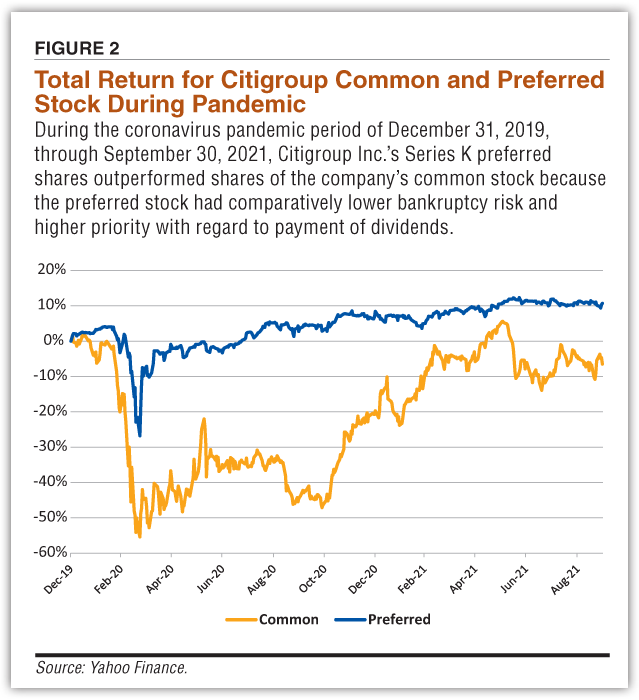
Figure 2 compares the performance of Citigroup securities during the period from December 31, 2019, until September 30, 2021, through the coronavirus pandemic. You can see that the common stock, shown in orange, suffered a precipitous decline of almost 55% in March 2020. The Series K preferred shares outperformed the common stock over this tumultuous period because of their comparatively lower bankruptcy risk and their priority with regard to payment of dividends.
It is interesting to compare the performance of preferreds against high-yield bonds and short-term bonds. Figure 3 illustrates the relative performance over a 10-year period ending September 30, 2021, of the iShares iBoxx $ High Yield Corporate Bond ETF (HYG), the Vanguard Short-Term Bond ETF (BSV) and the Invesco Preferred ETF. The preferred shares ETF outperformed, as one might expect, with an average annual return of 6.92%, while the high-yield ETF returned 6.17% and the short-term bond ETF returned 1.74% annually.
However, it is worth noting that during the sub-prime crisis, from January 31, 2008, through December 31, 2009, while the high-yield and short-term bond ETFs both had cumulative positive returns of close to 8%, the Invesco Preferred ETF underperformed, with a cumulative total return of –21%. This drop was even worse than the S&P 500 index’s total return of –15%. While we might expect preferreds to offer better returns in a bear market, they won’t always do so. During the sub-prime crisis, preferred performance was likely adversely impacted by their overexposure to the financial sector. Indeed, over the same period the S&P 500 Financials Index returned –47%.
Preferred shares combine some of the benefits of bonds (credit ratings and fairly predictable income) with the extended maturity and higher returns of equity-type investments. They can offer higher yields than bonds, tax advantages relative to bonds, and a means of diversification due to their low correlation with other asset classes.
However, there are some nuances that investors should note. Firms in high-growth sectors don’t tend to pay dividends, or issue preferred shares. An allocation to preferreds will, therefore, tilt your portfolio away from these sectors and toward financial and utility companies, which account for the majority of preferred issuance.
Liquidity, or trading volume, tends to be thin, so if you are buying shares in individual firms, you should make use of limit orders. Indeed, because of the security-specific call and other provisions, as well as the thin trading, an ETF or closed-end fund is the best vehicle through which to gain access to this sector for all but the most sophisticated investors.
Portfolio Strategies
Portfolio Strategies

ROBERT A from AL posted over 4 years ago:
BRIAN H from NY posted over 4 years ago:
STUART K from PA posted over 4 years ago:
You need to log in as a registered AAII user before commenting.
Log InCreate an account