

Currently we are in a low-interest-rate environment. This is wonderful for people buying houses because mortgage rates are so low. However, if you are a retiree or someone planning to retire, this is not good news. How can you generate enough income to support your lifestyle? The usual way for conservative investors to generate an income is to buy bonds. By maintaining low rates, the Federal Reserve is forcing investors to take more risk. If you are at or near retirement, it might not be advisable.
Bond investors have two major concerns when they invest in bonds. They ask:
- How likely am I to get my money back at maturity?
- How likely am I to get my interest payments on time?
The possible deterioration of the issuer’s ability to pay interest and return principal is called credit risk. This article addresses the evaluation of the credit risk of bonds and suggests that purchasing lower-rated bonds is not a good strategy, despite the potentially higher returns.
Credit Quality and the Rating Agencies
What is credit quality? This is a catch-all phrase referring to current financial strength. It also encompasses future financial strength. Depending on the time horizon of the investment, this can be interpreted differently. The issuer may be financially stable over the near term, but the long-term credit quality may be questionable.
One principal way that investors evaluate credit quality and credit risk is to focus on the bond rating of the issuer. The bond rating agencies were sanctioned as a result of the mistakes that they made during the financial crisis in 2007 and 2008. The rating agencies were overly generous in their ratings of mortgage-backed securities, banks and some financial institutions. As a result of these mistakes, a new registered nationally recognized statistical rating agency was licensed. Despite the limitations of the rating agencies, they currently still form an essential element in the assessment of risk, price and desirability of all kinds of bonds.
The “big three” bond rating agencies are Moody’s Investors Service (Moody’s), S&P Global Ratings (S&P) and Fitch Ratings (Fitch). These agencies have been rating bonds for more than a century. The newcomer to the block is Kroll Bond Rating Agency (KBRA), founded in 2010. Though the agencies all look at ratings over a range of scenarios, their interpretations and evaluations may differ.
Rating agencies rate sovereign governments, corporations, municipalities and agencies of those governments. They may also rate securities, insurance companies that insure securities, loans, structured financial instruments and preferred stock.
U.S. Treasury bonds are considered the safest bond investment, followed by other federally supported debt. Treasury bonds also have the best liquidity, meaning the bonds can be sold reasonably quickly at a fair price. For these reasons, Treasury bonds provide the lowest yield. Treasury bonds set a benchmark of safety against which all other bonds are measured. They are rated triple-A by Moody’s and Fitch—the best rating possible—and double-A plus by S&P after a downgrade in 2011. KBRA does not rate Treasury bonds.
Though ratings might be the same for a sovereign government or a small city or town, they are not equivalent. Houston, Texas, and Washington, D.C., are rated the same as Treasury bonds, but they would not carry equal weight to a sophisticated bond buyer.
Certain cities can carry the same ratings as Treasury bonds because the rating is conveying the (low) likelihood of default. Keep in mind that bond ratings are merely a current forward-looking evaluation of risk based on the ratings criteria the agencies establish. The bond ratings are generally designed to be a good faith evaluation of the issuer’s current credit quality. The larger the entity, the better the evaluation and the greater the likelihood of the staying power of that rating.
Factors Affecting Bond Ratings
There are many factors that are considered in creating a bond rating. First is the financial health of the issuer. Are the financial officers issuing the bonds committed to managing its finances so that the bond buyer will be repaid? What is the financial history of repayment? What were the circumstances of default, if they have occurred? Are there any new factors to be taken into consideration that might affect future ratings?
The rating criteria will differ based upon the type of entity being rated. Aside from financials, other factors that play a role are market share, socioeconomic influences, political framework, fluctuating currencies, tariffs and leadership. It should be pointed out that though corporate bonds and preferred stock may have the same ratings as municipal bonds, corporations may be subject to takeovers, which may double their debt overnight. While municipalities must deal with political and business issues in addition to climate-related fires, floods, mudslides, windstorms and other forces of nature, the governments will generally regroup and soldier on.
Climate change, which has been discussed for years, is finally becoming more of a factor in the ratings. For example, Moody’s purchased Four Twenty Seven Inc. in July 2019. According to the Moody’s press release announcing the merger, Four Twenty Seven evaluates physical climate risks. It quantifies information regarding environmental, social and governmental (ESG) risks and provides risk metrics to further enhance Moody’s rating evaluations. This signals a change in how climate risk will be incorporated into the ratings. The risks of climate change had been focused on reputational and ethical challenges. The physical and financial impacts of climate change are now being incorporated into Moody’s ratings, according to Bloomberg.
Frequent issuers have their ratings updated every time they come to market. Unlike stock market valuations, which tend to jump around, bond ratings on municipal bonds tend to shift glacially. Corporate bond ratings may be more subject to change than municipal ratings and may be updated after quarterly earnings reports.
If the credit quality of the issuer is declining, then the rating agencies will put the bond on negative credit watch (NEG). That can eventually result in an actual downgrade of a rating. The credit watch can also be positive (POS) for a potential upgrade in ratings, or removed from credit watch (STA), in the same way that a patient’s medical condition can deteriorate or improve or is developing (DEV).
In order to understand the rating business, keep in mind that all rating services are paid by the issuers, not the investors. One explanation of the difference in ratings is that each of the four rating agencies are competitors in one regard—on the basis of price. KBRA tried to change this model and have the users of the ratings pay for them, without success. The issuers often do what is called “forum shopping” to get the highest rating at the lowest price. The rating agencies must hold the line to maintain their credibility. In the municipal bond markets, issuers understand that investors value the ratings of Moody’s and S&P the most, with Fitch posting periodically as a third or alternate rater.
Inexperienced investors may be unaware that ratings are not forever. When the rating agencies see that an Aaa or Aa1 bond is deteriorating, they downgrade the issue well in advance of a possible default. Moody’s downgraded New York City (NYC) from Aa1 to Aa in October 2020. The 2021 budget in NYC was supposed to include productivity gains—but no such luck. The increase in the NYC payroll that took place during Mayor DeBlasio’s tenure resulted in 38,219 new jobs, but without significant productivity increases. NYC needed to issue new bonds in October 2020 because it had to maintain its payroll rather than stimulate the economic engine of the city. The impact of the coronavirus pandemic has decimated NYC businesses. Will state and local revenues recover? Will NYC need to restructure as it did in the 1970s? This remains to be seen as we write this.
There have been few defaults on double-A bonds because they are downgraded to junk prior to their default, their ratings having been generally gradually lowered. Overall, defaults are relatively infrequent in the municipal market.
There is a saying: “Don’t buy triple-A bonds because the ratings can only go down.” That may be the case, but if the issuer weakens, the ratings will likely decline at a slower pace because the triple-A issuer has shown that it is fiscally responsible, and the investors have a better chance of keeping their principal safe.
What Are Bond Ratings and Why Do They Change? Video
We think you’d like this related webinar! The Individual Investor Show: Financial Capability, Bond Ratings and Investing Community
Why the Ratings Matter
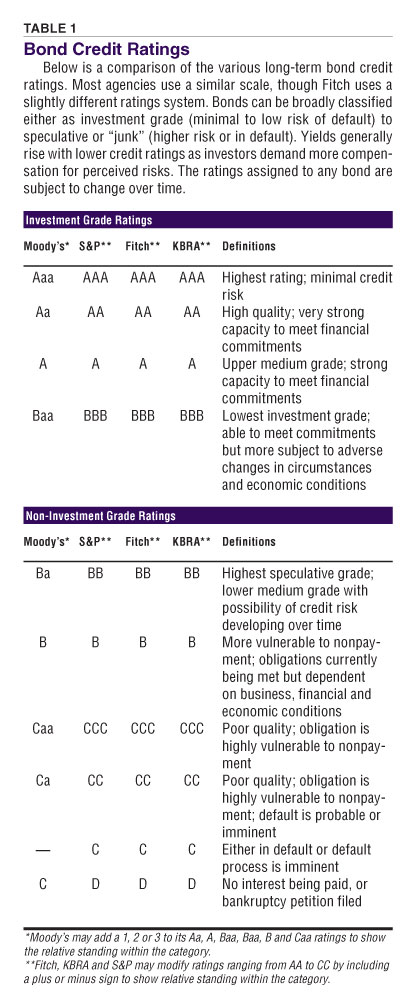
Ratings are divided into investment grade and non-investment grade ratings. The investment grade ratings range from a high of Aaa (Moody’s) and AAA (S&P) to a low of Baa– (Moody’s) and BBB– (S&P). The triple-A rating gives the issuer’s bonds an Excellent, double-A a Very Strong, A says Strong and triple-B is Adequate. The non-investment grade ratings are measures of vulnerability. Ba and BB is Less Vulnerable; Single-B is Vulnerable; C ratings indicate degrees of Currently Very Vulnerable. Pluses and minuses for S&P, Fitch and KBRA indicate gradations in each of the categories. Moody’s uses numbers for the same purpose. Moody’s uses upper- and lower-case letters, such as Aaa, Aa, while the other three rating agencies use capital letters, such as AAA and AA. A withdrawn rating is (WR) and a non-rated bond is indicated by (NR). Table 1 summarizes the range of possible ratings given by each agency and what they mean.
Moving past the line between investment grade and non-investment grade is more than a matter of degree. Mutual funds and exchange-traded funds (ETFs) that hold non-investment-grade-rated bonds may be limited to a percentage of their holdings for that kind of bond. It may mean that they have to divest the fund of those holdings if the bond rating falls below investment grade. A downgrade to below investment grade may result in a decline in price and bond liquidity.
There is more competition among the four rating agencies for rating distressed bonds. Here is a statement on the health of the New York City Metropolitan Transit Authority (MTA) on September 24, 2020: “The MTA faces an existential threat where enfeeblement is the short-term risk and extinction the worst-case scenario,” MTA chairman Patrick Foye was quoted by The Bond Buyer in September 2020 as saying after the issuance of a new MTA bond issue.
On September 15, 2020, the MTA came to market with the following ratings: Moody’s A3, S&P BBB+, Fitch A+ and KBRA AA+. The MTA sold $900 million Series 2020D transportation revenue climate bonds, certified as green bonds in three distinct issues. Looking at the data, an investor may ask why is there such a wide disparity in ratings? The rating agencies may evaluate data differently or choose different data to evaluate.
KBRA provided the highest rating, while the ratings from Fitch, Moody’s and S&P had lower investment grade ratings. Which entities that hold bonds benefit from an AA+ rating, even though all the other ratings are lower? On October 6, 2020, less than a month after the MTA came to market, KBRA downgraded MTA from AA+ to AA with a negative credit watch as a result of the expected continuing bad MTA financial news.
Material Events
If you purchase individual bonds, you know that “material events” are posted fairly regularly. Material events are notices of any changes or events that might affect the health of an issuer. Hopefully, your broker provides a link to material events if you are considering purchasing an individual bond. You can also find such information for municipal bonds on EMMA, a website run by the Municipal Securities Rulemaking Board.
Frequent posts state whether an issuer has filed their financial report in a timely manner. Less frequent postings are about rating changes. Many issuers are posting that there have been developments relating to a financial obligation as a result of the coronavirus pandemic. We may soon see material events regarding climate issues. States have resources to meet these challenges.
Conclusion
Credit quality is not something that should be taken lightly when purchasing municipal or any other kind of bonds. If bonds lose their investment grade rating—lower than BBB– or Baa3—then mutual funds, ETFs and other bond-consolidating entities may have to divest their portfolios of such high-yield (junk) bonds. If the bonds are in an index, they may be deleted. Liquidity may dry up, meaning you won’t be able to sell quickly at a fair price, if you want to sell.
If bonds are meant to add a sleep quotient to your feelings of well-being, seeing them descend into junk territory with the risk of losing principal will do the opposite. A temporary higher yield will not compensate for loss of principal.
High-quality bonds are more likely to hold their value. Well-managed municipalities have broad rate-paying abilities and expense management. There is political will to pay bondholders.
Related

Related

Discussion
FREE REPORT

Get your free copy of our special
report analyzing the tech stocks
most likely to outperform the
market.
ARTHUR F from NJ posted over 5 years ago:
You need to log in as a registered AAII user before commenting.
Log InCreate an account