

Related

PRISM Wealth-Building Process
Checking your portfolio at regular intervals tells you if you are on or off track to achieve your goals and whether they are still valid.

Charles Rotblut leads a class in AAII's new Essential Investing Video Course. Go to https://www.aaii.com/ves for more information and to subscribe.
In last month’s AAII Journal, I discussed the importance of monitoring your portfolio’s allocation along with suggestions about when to make adjustments (“Effectively Monitoring Your Portfolio,” October 2021). Monitoring your portfolio is just one of the components of Step 5 of the PRISM Wealth-Building Process. The other two components are monitoring your progress and life stages. I address monitoring both in this article.
Before doing so, let me explain why. Monitoring progress tells you if you are on track or off track to achieve your goals. Identifying whether you are ahead, you are where you should be or you are behind can alert you as to whether changes are needed. Monitoring your life stages provides a reminder to revisit your goals to determine whether they are still valid. A positive change (e.g., a new child or grandchild) or a negative change (e.g., an unexpected job loss, a deterioration in health, etc.) in your life may require a change in your goals—and thereby a revision to your wealth-building plan.
We created PRISM to be an ongoing process. The plan you create by using the PRISM process should evolve over time as your financial, personal and family situation changes. While much of the wealth-building process focuses on investing, factors outside the realm of portfolio management play an important role too. Just because your goals may require a certain amount of money doesn’t mean the goals themselves are financial in nature. Houses can be bought as investments; homes are made by the people living there.
Progress toward goals from a financial standpoint can be defined by asking, “How much do I have saved right now relative to what I should have saved?” It’s a simple question with what may appear to be a simple answer: yes or no.
The simplicity or complexity of getting to the “yes” or “no” answer can vary. A 55-year-old person with no pension who has just $10,000 set aside for retirement does not have enough saved. A 40-year-old with a six-year-old child for whom they’ve saved $10,000 toward college could find themselves being on track. This would be the case if they’ve just paid off their own student loans, are on a fast-track career path in a well-paying field or have received some other type of financial windfall (e.g., stock options, an inheritance, etc.).
There is also the timing component of goals. Goals with a short spending duration—such as a dream vacation—must be fully funded at the time the cost is incurred. Goals with a long spending duration—such as retirement—do not need to be fully funded at the time they start.
In either case, there is a certain amount of money that will be needed at the time the goal is first reached. This amount should be determined at the time the goals are prioritized. In the PRISM Wealth-Building Process Academy, we provide a spreadsheet to help estimate the cost of a goal based on your assumptions. There are also various calculators online. Once you arrive at an estimate, then it is a question of whether savings are increasing at a fast enough pace to reach the number.
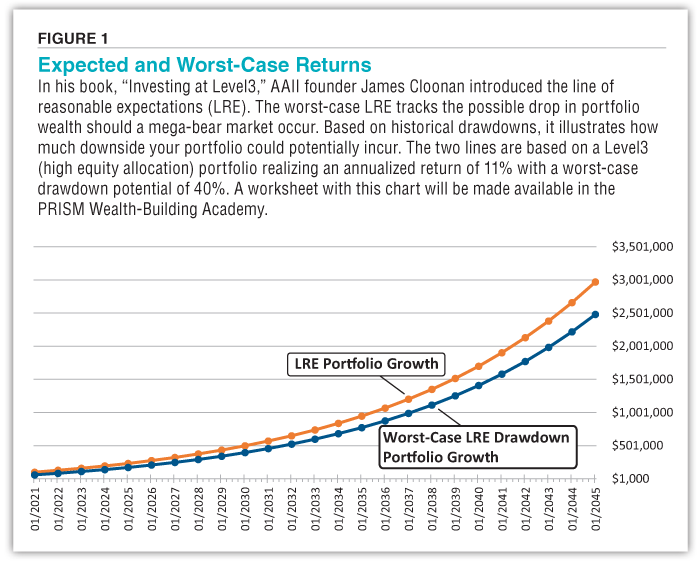
In his book, “Investing at Level3” (AAII, 2016), AAII founder James Cloonan introduced the line of reasonable expectations (LRE). The LRE shows how much your portfolio will grow given a certain annualized return. Contributions or withdrawals can be added so that the LRE shows how much your portfolio should be worth factoring them in.
The beauty of the LRE is that it can show you where you should be wealth-wise at any given point in time. Your portfolio will rarely be exactly on the line. At certain points in time, your portfolio’s value will be above the line as your wealth grows faster than the LRE’s projection. During other periods, your portfolio’s value will be below the line as returns are below expectations. Cloonan referred to these scenarios as the “you owe the market” (wealth above the LRE) and “the market owes you” (wealth below the line).
Investing is messy. A margin of acceptable error should be factored into your plan. This is where an understanding of the historical volatility of your asset allocation strategy comes into play. If the separation between the LRE and your portfolio is within the normal volatility, you may not need to make any adjustments. If it is outside of the range, you may need to make adjustments. These adjustments could include changing how much you save, how much you withdraw, the timing of your goal or the cost of the goal itself. If you find your portfolio is farther above the LRE than you anticipated, you could even consider allocating some of those excess dollars to funding lower-priority goals.
Cloonan also calculated a worst-case LRE. This line showed what a portfolio would be worth at a point in time if a mega-bear market occurred. Cloonan assumed a 40% drop in the market with a portfolio realizing an 11% annualized return (see Figure 1). The assumptions can be changed based on your allocation strategy and either historical or projected returns.
The timing of when your portfolio falls to the worst-case LRE matters significantly. It has taken, on average, slightly more than two years for the S&P 500 index to fully recover from a bear market according to data provided by Sam Stovall, the chief investment strategist at CFRA Research. Mega-meltdown drops of at least 40% have taken an average of nearly six years to fully recover.
The length of time it has historically taken for the stock market to recover is why shifting toward a comparatively more conservative allocation while nearing a goal is a prudent strategy. Reducing risk is not necessarily the same thing as dramatically de-risking. Retirees, for instance, can incorporate a bucket of safe assets alongside a significant allocation to equities. Under the Level3 withdrawal approach, the bucket of safe assets would be used to fund withdrawals whenever the market is more than 5% below its highs. The safe bucket’s role is to prevent the need to sell equities during a downturn.
If your portfolio falls to the worst-case LRE and there is enough time for the portfolio to recover before you need to sell equities to fund your goals, then you can maintain your allocation without shifting toward a more conservative allocation. If you can increase your savings rate when a bear market occurs, you will get an extra boost of wealth once the recovery occurs. This is particularly the case when the goal will not be reached for many years.
For goals with a one-time or a very short spending duration, reducing risk as the date of those goals nears is important. An ill-timed bear market that sends your portfolio down toward the worst-case LRE could cause you to miss your goals—especially if you are unable to postpone the timing of the goal. The risk questionnaire in Step 2 will help you determine when it makes sense to adopt a more conservative allocation.
As previously noted, portfolio withdrawals can be incorporated into the LRE. Projected withdrawals can be used at first, though those projections should be replaced with actual withdrawal amounts each year to provide better monitoring.
Doing so allows you to incorporate a floor-and-ceiling approach. If your portfolio is significantly above the LRE, you can take a larger withdrawal—but not so large that it drops your portfolio to or below the LRE. If your portfolio is below the LRE, you can reduce the size of your withdrawals to allow your portfolio time to recover.
Even if you limit withdrawals to required minimum distributions (RMDs), this approach works. During periods when the portfolio is above the LRE, you can spend more of your RMD amount as opposed to saving it. During periods when the portfolio is below the LRE, you reduce how much of the RMD amount is spent with the remainder potentially reinvested into a taxable account to help your portfolio recover.
If your analysis shows that you are behind in terms of having enough saved to eventually fund your goal, you have three options.
The first is to save more. As your goal approaches, saving more can have a bigger impact than attempting to boost your portfolio returns because of the uncertain sequence of good and bad market conditions and the longer period of time it takes to benefit from the power of compounding. Saving more during a market downturn is also beneficial because it allows you to buy stocks when they are on sale.
The second is to invest more aggressively. This has the biggest benefit when your goal is 10 or more years into the future. Over shorter periods (especially less than five years), the upside of realizing a higher return can be more than offset by the risk of increased downside volatility. Your psychological ability to withstand greater fluctuations in your portfolio’s value also matters. If the increased volatility makes it too difficult to stick with the portfolio allocation, then it’s not the right strategy for you.
The third is to delay, reduce or kill your goal. Delaying the goal gives you more time to both save and grow your portfolio. In the case of retirement, delaying has the added benefit of increasing Social Security benefits (if you also postpone claiming them) and shortening the time you will be relying on your savings. Reducing means opting for a lower-cost version of your goal. An example would be having a child start at a lower-cost community college before transferring to a university or opting for a state school instead of a private college.
If neither of the first two is a viable option, then you may have to let the goal go unfulfilled. The reason why Step 1 of the PRISM process asks you to prioritize your goals is because it may not be possible to fulfill every goal. Some goals are critical while others can be let go if push comes to shove. While it may not be an easy decision to let a goal go, sometimes it is the best decision.
Step 1 of the PRISM process asks you to estimate the cost of your goal. This is your target. It should be periodically updated to account for changes in inflation. You should also incorporate some room for error in case your actual spending on the goal is greater than anticipated (as anyone who has done a home renovation project knows is possible).
Once you exceed this projected amount, the concept of target wealth comes into play. Target wealth approaches call for de-risking, meaning adopting a more conservative allocation once the targeted amount of wealth is reached. The idea is that preserving wealth is more important than continuing to grow wealth. This approach only applies to the dollars meant for a specific goal, not all goals.
If your primary goals are met, then you can focus on secondary goals. These may be goals that are nice to fulfill (e.g., leaving an inheritance or a sizeable donation to charity) or ones that are more aspirational (a second home or taking a dream vacation). Depending on the specific goal, you may wish to maintain an aggressive allocation to achieve it.
Last month we added two new AAII member benefits: the PRISM Wealth-Building Academy and AAII Community.
The PRISM Wealth-Building Academy is an interactive, multi-media self-directed course. It will help you get the most out of the PRISM process. Included in the PRISM Academy are videos covering the key aspects of each step, challenges to learn and apply the concepts and forums to share ideas with other AAII members. I am also holding “office hours” where you can ask me questions and provide feedback about PRISM. Most importantly, when you complete all five courses, you will have created your own personalized wealth-building plan.
The PRISM Academy is integrated into our new AAII Community. The AAII Community is a secure, interactive discussion platform. It connects you with other AAII members. On the Community platform, we have groups about asset allocation, mutual funds and exchange-traded funds (ETFs), retirement withdrawals and more.
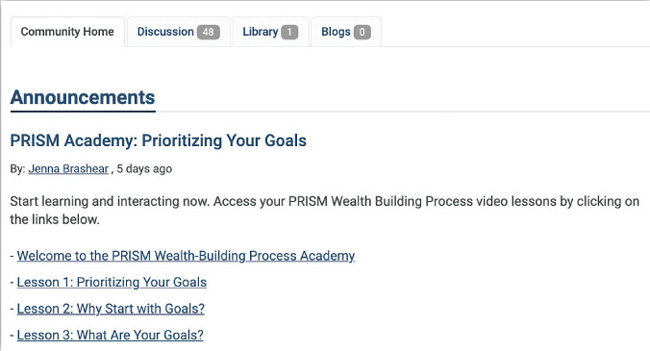
We launched Community because we are passionate about connecting our members so you can take advantage of a “collective investor brain.” Sharing investment wisdom and experiences can help you become a better investor as well as take control of your financial freedom.
Both the PRISM Wealth-Building Academy and AAII Community are available to all members. We’ve already seen many AAII members take advantage of these new benefits and hope you will too.
Life stage changes are any big event that would potentially alter your goals and/or tolerance for risk. These include family changes, employment changes and health changes. When any life stage change happens, it’s essential to go back to Step 1 and review the entire PRISM process. Doing this ensures your wealth-building plan properly reflects the changes that have occurred.
Family changes can not only alter your goals but also your finances. The birth or adoption of a child will lead to new goals (e.g., college education) and also changes in how much you can save. Marriage increases the amount required to fund retirement (two people instead of one) and potentially adds a new stream of income (or new debt). It can also introduce new goals (e.g., a house, children, etc.). Divorce reduces wealth and leads to a reevaluation of goals. The death of a spouse can reduce income (e.g., one person receiving Social Security benefits instead of two) and also leads to a reevaluation of goals.
Any time there is a change in your family, it is important to review all beneficiary information and estate plans. Update them as necessary.
Changes in employment directly impact your income and ability to save—two significant influences on any financial plan.
Starting a job brings income and potentially access to an employer-sponsored retirement plan. A raise or cut in pay alters how much you can save, and thereby the progress you will be able to make toward your goals as well which goals are realistic and which ones will have to be viewed as aspirational. A loss of a job, such as a layoff, will disrupt the ability to save for goals. A prolonged period of unemployment or underemployment may require adopting a more conservative allocation to preserve wealth and a reevaluation of goals.
Transitioning to retirement should be a prompt to allocate a portion of the portfolio more conservatively as insurance against a drop in the stock market soon after you start taking withdrawals. Retirement will shift a high-priority goal for many from the building savings phase to the spending savings phase—and require appropriate adjustments to the allocation strategy used.
A negative change in health can have several impacts on your wealth-building plan. Cognitive declines will mean altering your investment preferences to include professional help—or at least assistance from someone close you can trust (e.g., a member of your family). A deterioration in your, your spouse’s or close family member’s health will lead to a reevaluation of goals and tolerance for risk. The same would apply to your spouse’s or a close family member’s death. Your death would impact your spouse’s and potentially your children’s or other heirs’ wealth-buildng plans.
There are many other life events that could create the need to go back through all five steps of the PRISM process.
A significant change in wealth alters what goals you will be able to reach and your tolerance for risk. You could experience a large, positive change in wealth (proceeds from selling a business, employee stock options, a large inheritance, etc.) or a significantly negative impact (a prolonged period of unemployment, high medical bills, a business failure, etc.).
Housing changes alter your wealth and expenditures. The purchase of your first house incurs a large outflow of wealth and new expenses. Downsizing by selling a larger house and buying a smaller one untaps wealth and reduces expenses. Paying off a mortgage frees up cash that can be used to boost savings or spend on other goals. Taking out a reverse mortgage can increase a retiree’s tolerance for risk by providing an additional source of income for use during down markets. Moving to a retirement community may introduce new expenditures—potentially costly ones if assisted living or memory care is needed.
Monitoring your progress and life stage changes should be scheduled at regular intervals. Once per year is appropriate. Should something happen between the scheduled reviews, it is appropriate to accelerate the timing of the review. Life stage changes would be the most common reason to accelerate a review of the portfolio.
While you could monitor your progress toward your goals more often than once per year, it is important not to compare your portfolio to the LRE too frequently. The portfolio will rarely be on the line; rather it will move above and below it. As long as those movements are within the typical range expected for the allocation strategy followed, you should allow your portfolio room to fluctuate. The PRISM Wealth-Building Process is designed to help you create a plan that gives you the confidence to focus on your goals and not the shorter-term fluctuations of the financial markets.
We think you’d like this related webinar! Creating Your Own Personalized Wealth Plan With PRISM
PRISM Wealth-Building Process
Level3 Passive Portfolio


JOHN L from NJ posted over 4 years ago:
A B from WA posted over 4 years ago:
JAMES M from MT posted over 4 years ago:
You need to log in as a registered AAII user before commenting.
Log InCreate an account