

Related

PRISM Wealth-Building Process
The PRISM Wealth-Building Process helps you establish metrics to analyze your portfolio and make changes in line with your long-term allocation.

Charles Rotblut leads a class in AAII's new Essential Investing Video Course. Go to https://www.aaii.com/ves for more information and to subscribe.
Charles (“Charley”) Ellis once described the secret to successful investing as “simply not making big mistakes.” Many big mistakes occur when investors look at or review their portfolio. Emotions, biases, failing to consider the timing and duration of goals and an overall sense of needing to do something commonly leads to mistakes.
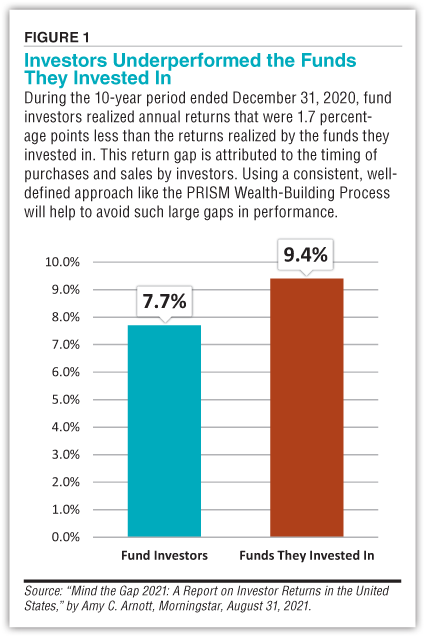
We see the impact of these mistakes in studies on investors’ returns. Morningstar’s “Mind the Gap 2021” report found the returns realized by investors were 1.7 percentage points below the returns realized by the very funds they invest in (Figure 1). This was an annual return gap (aka behavior gap), meaning investors forfeited 1.7 percentage points in return each year due to their buy and sell decisions. This is a huge amount to have left on the table.
Step 5 of the PRISM Wealth-Building Process—monitoring your allocation, progress and life stages—is designed to limit the mistakes leading to such large return gaps (Figure 2). It helps you to create a disciplined process for interacting with your portfolio. What you look at, how frequently you look and the decisions you make are all based on your goals, desired allocation, buy and sell rules and changes in your life.
The advantage of this process is that it reduces the noise that so often affects investors’ decisions. Your choice of whether to sit still or to make modifications is governed by your own wealth-building process, not the headlines or the “advice” you hear from the various outlets of investing commentary. PRISM provides you with much needed clarity.
There are three key parts to the portfolio monitoring process. The first is monitoring your allocation. The second is monitoring the progress toward your goals. The third part is monitoring your personal situation for any changes in your life or family status. In this article, we address the first part. In a forthcoming article, we’ll discuss monitoring your progress toward goals and life stage changes.
You might notice nothing was mentioned about reviewing the individual investments constituting the portfolio as part of Step 5. This is because such reviews are part of Step 4 of the PRISM Wealth-Building Process—selecting and managing your investments.

Step 5: Monitoring Your Allocation, Progress and Life Stages is a higher-level review of your portfolio. Its intention is to determine if your portfolio continues to be properly allocated relative to your goals and tolerance for risk. Step 5 prompts you to consider whether your allocation is what it should be, if you are still on track to achieve your goals and whether your goals themselves are still valid.
Consider Elizabeth. She is early in her career and has started to save for retirement through her employer’s 401(k) plan. She is following AAII’s aggressive portfolio allocation model and is fully invested in equity funds. At the same time, she is building up short-term savings in cash to cover unanticipated expenses to pay for things like the security deposit on a new apartment.
Elizabeth uses Step 5 each year to determine if the mix of large-cap, mid-cap, small-cap and international funds held in her portfolio remain reasonably close to her target weightings. She reviews how much she has contributed to her retirement account relative to her salary as well as her contributions to her short-term savings account to ensure both remain on track. Were Elizabeth to become involved in a serious relationship or have another significant change in her life, she would review her goals to see if any needed revising.
Elizabeth could choose to review the funds she invests in at the same time. In doing so, she would use the rules she established in Step 4 of the PRISM process. She’d consider the funds’ performance relative to their peers, expense ratios and whether anything has changed in the funds’ objectives.
If her parents or grandparents were to help her save for retirement by gifting her money to invest in individual stocks, Elizabeth may opt to review them on a different schedule. She would use the rules she added to Step 4 for individual stocks to determine whether any are meeting a sell rule.
The decision to sell a specific fund or stock does not alter her choice of allocation. Rather, it is a tactical extension of her allocation. If either type of investment were to meet a sell rule, Elizabeth would seek a similar type of fund or stock as a replacement. A sold international stock fund would be replaced by a new international stock fund. A sold stock would be replaced by a new stock.
Could a needed adjustment to your allocation lead to the selling of an individual fund or stock? Absolutely. The need to adjust the allocation is a higher-level decision than the decision as too which investment to sell, pare, reinvest in or buy. These latter choices reflect the tactical execution of the allocation strategy. The allocation itself is determined in Step 2 of the PRISM Wealth-Building Process—recognizing your risk tolerance and allocation.
Portfolio allocations are rarely stable. As soon as a portfolio’s weightings among different asset classes and asset class groups are established, they will begin to shift. Typically, significant changes in allocations develop over time. During periods with sharp market moves, allocations can change quickly.
The coronavirus bear market of 2020 was one such event when allocations rapidly changed by large amounts. Yet, an investor who looked at their allocation on January 1, 2020, and then again on January 1, 2021, noticed a far smaller change in their portfolio’s allocation than those who looked in March 2020.
Monitoring portfolio allocations less frequently is advantageous. Volatility is reduced over time as up and down moves are smoothed out. Plus, neither your goals nor their timing or duration change quickly. And we believe your allocation should be reflective of your goals.
Looking less often has another benefit: It reduces the temptation to act. Making adjustments to one’s allocation leads to transaction costs and potentially capital gains taxes. It also increases the odds of incurring the return gap. A key reason why many investors underperform the very funds they invest in is because they buy and sell versus simply holding onto the fund.
Most importantly, transacting less often gives your winners more time to run. If, say, small-cap stocks are outperforming, refraining from frequently checking your allocations allows them to benefit from their upward momentum.
Looking less frequently should not be confused with not looking at all. The PRISM process calls for regularly monitoring your allocation. The frequency is a personal choice, but most investors can get by with an annual review of their allocations. Semiannual reviews are an option for those who want to monitor their allocations more frequently. Shorter intervals for monitoring allocations are only appropriate when a tactical allocation strategy is purposely being used.
Investing is messy. Trying to hold allocations to specific percentages (e.g., 90% stocks and 10% intermediate bonds or safe assets—AAII’s aggressive allocation model) will lead to high transaction costs and will generally drive an investor crazy.
Allocation bands are a helpful solution: Rather than acting every time a portfolio’s allocation appears to have strayed from its targeted allocation, set an allocation range to determine when to act and when not to act. Vanguard has found that allowing portfolio allocations to move within a band of five or 10 percentage points strikes a good balance.
Bands like these will lead to fewer transactions. When a change is warranted, the dollar size of those changes will be bigger too, however. This can be an issue for those who are concerned about the tax implications of rebalancing or otherwise prefer gradual over large changes.
There are three workarounds.
The first is to redirect portfolio income. Proceeds from dividends, interest payments and fund distributions can be allocated to the underweighted asset classes (e.g., stocks) or asset class groups (e.g., international stocks). In the current low-interest-rate and dividend yield environment, there may not be enough portfolio income generated to adequately rebalance, however.
The second is to use planned contributions or withdrawals to rebalance the portfolio. New contributions could be directed to the underweighted asset classes or asset class groups. Withdrawals can be taken from the overweighted asset classes or asset class groups. This uses transactions that would have occurred otherwise to rebalance the portfolio. The effectiveness of this approach is dependent on the proportionate size of contributions and withdrawals relative to the dollar value of the rebalancing required. Such approaches may work better when an annual rebalancing strategy is desired.
A third approach is to use the proceeds from the sale of portfolio holdings to fund withdrawals. Say large-cap stocks are overweighted and bonds are underweighted, and a large-cap holding meets the sell rules specified in Step 4 of the PRISM process. The proceeds from the sale of this stock could be used to buy additional shares of a bond fund to reduce the large-cap stock exposure and increase the portfolio weighting in bonds. The advantage of this approach is that it makes dual use of a transaction. Lower turnover strategies, such as holding index funds, may not lead to enough transactions, however.
The three approaches are not exclusive to each other. Any three can be used in conjunction with each other. And if additional rebalancing is still needed, it can be done.
AAII founder James Cloonan’s Level3 withdrawal approach uses the stock market to adjust a portfolio’s allocation.
The base allocation is a twist on AAII’s aggressive allocation. The Level3 approach calls for an equity allocation mixed with four years’ worth of planned withdrawals allocated to short-term (defensive) assets. These are safe assets like cash, money market funds, short-term Treasuries and certificates of deposit (CDs). The defensive allocation is built up over a period of four years before the planned retirement date.
Monitoring of the portfolio’s allocation is done annually (e.g., on January 1). On the monitoring date, the level of the S&P 500 index is compared to the all-time highest level of the index. If the current level is more than 5% below the all-time high of the S&P 500, the portfolio is put into defensive mode. Your withdrawals in the year you determine to be a down year will come out of the safe investment part of your portfolio.
Withdrawals will continue to be taken from the safe portion each year until the S&P 500 is above the level used to choose the defensive mode on a portfolio monitoring day. At this point, annual withdrawals are resumed from the equity portion of the portfolio. In addition, the safe investment segment will start to be replenished. Cloonan recommended replenishing the safe assets over a two-year period, restoring half of the deficit (the amount below four years of withdrawal) each year. Any restoration would stop if a new down year occurred, and withdrawals would revert to the safe portion. Table 1 shows a hypothetical example.
TABLE 1. Establishing Defensive Funds
Investors following a more traditional bucket approach could use a similar strategy, assuming the safe bucket holds an adequate amount of assets to fund withdrawals. In this case, the short-term bucket and intermediate-term bucket (if used) would only be replenished from the long-term bucket when the S&P 500 is near its high.
Though the AAII Asset Allocation Models do not incorporate traditional bucket approaches, buckets can be easily substituted into the PRISM Wealth-Building Process. The number of buckets and the allocation among them would be determined by an investor’s risk tolerance as defined in Step 2 of the PRISM process.
During the portfolio monitoring process, you may realize that your target allocation weightings need to be revised. There may have been a large change in your wealth, you may be transitioning to retirement, one of your goals may be approaching or one or more of your goals may have changed.
We suggest going through all five steps of the PRISM process before making a change to your allocation weightings. The change requiring a different allocation should stem from your goals and your tolerance for risk. Since PRISM follows a top-down process, it is helpful to reassess your goals—including their timing and duration—as well as your tolerance for risk.
Once this is done, then you can begin adjusting your portfolio to reflect your new desired allocation. The same strategies previously mentioned for rebalancing—using contributions, withdrawals, portfolio income and proceeds from the sale of specific investments—can be used. Chances are that you will also need to pare down or outright sell certain investments to complete the reallocation.
The shift does not need to be done at all once. A two-year transition can work. AAII’s Allocation Models include a suggested transition midpoint of 75% diversified stocks/25% bonds when moving from the aggressive model to the moderate model. A midpoint of 50% stocks/50% bonds is suggested for those transitioning from the moderate to the conservative model. These midpoints could be used for the first year of the transition, with the new allocation being fully implemented in year two.
If taxes are not an issue and a more aggressive allocation is being switched to, a shorter time frame is an option. Lump-sum investments in stocks can lead to higher returns than dollar-cost averaging. Psychologically, a rapid change may be harder to stomach especially if the asset class taking a bigger weighting in the portfolio dips soon after the transition has occurred.
If there is one underlying theme here, it is to check your portfolio’s allocation less frequently but be more diligent when you do. The PRISM Wealth-Building Process helps you establish metrics to analyze your portfolio. When those metrics suggest no change is needed, don’t act. When a change is needed, act in a way that keeps your portfolio in line with your long-term allocation.
We think you’d like this related webinar! Creating Your Own Personalized Wealth Plan With PRISM
PRISM Wealth-Building Process

Portfolio Strategies

Retired Investor

FERNANDO R from FL posted over 5 years ago:
You need to log in as a registered AAII user before commenting.
Log InCreate an account