

Related

AAII How-To
Broad guidelines and considerations can help you select investments appropriate for the type of investor you are.
by Charles Rotblut | June 2021

Charles Rotblut leads a class in AAII's new Essential Investing Video Course. Go to https://www.aaii.com/ves for more information and to subscribe.
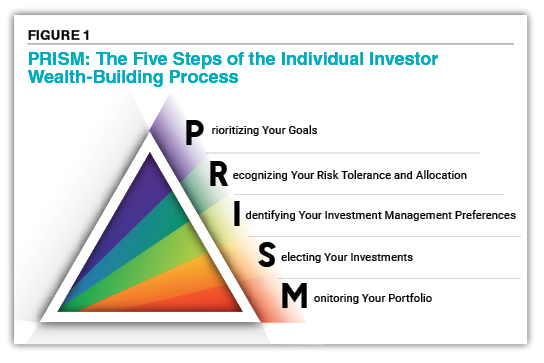
There is an overall flow to populating your portfolio with specific investments that is embedded into The Individual Investor Wealth-Building Process. It is the first three of the five steps of PRISM: prioritize your goals, recognize your risk tolerance and allocation and then identify your investment management preferences (see Figure 1). Combined, these steps narrow the field of potential investments and enable you to move to step four: selecting among just those investments most suitable for you.
In this article, we provide broad guidelines and considerations for selecting investments by the type of investor. We show how one’s allocation and preferences follow through to the specific decisions about which investments to buy and hold. We also provide broad guidelines and considerations for selecting investments by the type of investor. In future articles, we will get more into the guidelines for selecting individual investments and determining when to remove them.
We start with index investors because purely passive strategies are the easiest to implement. An index investor primarily seeks two things: returns similar to major indexes, and low expenses. Such strategies call for matching the index funds to one’s asset allocation.
We use Elizabeth to demonstrate. She is early in her career and is saving for retirement. Her employer’s 401(k) plan only offers index funds. This constraint makes her an index investor by default.
Elizabeth is following an aggressive allocation, given her lengthy time horizon until retirement. Growth of capital is her primary goal.
Her goal is to match funds with her allocation. A good starting point would be to look for index funds following recognizable indexes. These could be funds tracking the S&P 500 index, the S&P MidCap 400 index and the S&P SmallCap 600 index or the Russell 2000 index. For the international portion of her portfolio, she might look for a fund tracking a broad-based MSCI index. Her allocation to bonds will be very small but should she choose to allocate a little to it she might consider an investment-grade bond fund tracking a Bloomberg Barclays index.
The precise portfolio weightings will depend on the allocation model she follows. Should Elizabeth choose to follow AAII’s aggressive allocation model, she would evenly split her contributions to the large-, mid- and small-cap funds as well as an international fund. It would be her option whether to include an emerging market fund. This may depend on the offerings in her 401(k) plan. For any investor using a 401(k) or similar type of account, the choices will depend on what precise funds are being offered. Were Elizabeth to also allocate to a bond fund, using our allocation model as an example, she would consider a weighting of approximately 10%.
Let’s assume that instead of using a 401(k) plan, Elizabeth was using a brokerage account. This might be the case if she were saving through an IRA as opposed to through a workplace retirement plan. In such a case she would have the option of considering exchange-traded funds (ETFs) in addition to mutual funds. This would allow her to consider alternatives such as equally weighted index funds instead of market-cap-weighted funds. The choice between an ETF and a mutual fund is dependent not only on the type of account used but also the preference of the individual investor making the decisions.
In all cases, the index investor seeks low cost funds following traditional, broad indexes. Index investors avoid individual securities as well as funds and ETFs following more niche strategies or niche indexes.
Here’s a brief list of factors that may determine the type of investments you consider for your portfolio.
Fund investors are similar to index investors. Both prefer to use mutual funds or ETFs instead of selecting individual securities. The difference is that fund investors are willing to consider active strategies. Fund investors may alternatively choose to invest in ETFs tracking lesser-known indexes, closed-end funds and/or perhaps even make tactical decisions involving sector funds.
An investor with a preference for index funds may find themselves being a fund investor simply because of the options offered through their workplace retirement plan. Suppose for instance that Elizabeth was offered a retirement plan with actively managed funds instead of index funds. In this case, she would become a fund investor. This is a case where a constraint alters her investment decisions.
The strategy for implementing her asset allocation does not change. She will continue to seek out funds matching the allocation model or strategy she chooses to follow. Each fund’s expense ratio would especially be considered because actively managed funds typically come with higher expense ratios. Additional emphasis would have to be given to relative performance. She would want to look at how the individual funds have fared relative to their peers over various periods of time.
If Elizabeth was in a plan that offered both active and passive strategies, then her choices become a little more complicated. There could be certain asset class groups where a preference for index or active strategies may come into play. Perhaps she prefers index funds for large-cap stocks. For, say emerging market funds or for bonds, she could prefer active management. Such a choice should be predicated on identifying the asset class groups where she believes active managers have an advantage over index funds.
Index fund investors may find themselves in this situation if they have workplace retirement plans in addition to their IRAs and other brokerage accounts. In such a situation, they might be forced to use actively managed funds even though their preference is for pure index funds. Asset location strategies—which consider the tax treatment of each type of account—could come into play here, with the retirement plan used for less tax-efficient funds and the other accounts used for index funds.
A simple example would be where there is a taxable brokerage account and a 401(k) plan account. If such an investor believes there are certain advantages to active investing or wishes to avoid the higher tax costs associated with active strategies, they could use the 401(k) plan to hold the actively managed funds. More tax-efficient index funds would then go into the taxable account.
The asset allocation strategy followed would not change. Only its implementation will evolve. More rules regarding which investments will be selected for which account will be needed. It’s an added level of complexity, but one that could be easily managed.
Of course, like Elizabeth, an investor might prefer combining active and passive strategies. Again, the asset allocation strategy would not change. The only thing that would change is where the investor intends to use active strategies and where they intend to use passive strategies.
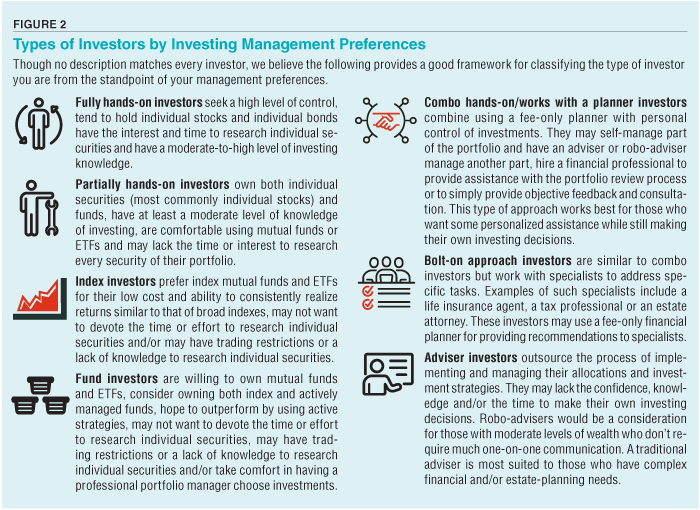
Partially hands-on investors hold both individual securities and funds. This type of investor may invest in individual stocks and fill the remaining part of their allocation with funds. An example would be an individual investor who uses stocks for their domestic equity allocation and uses funds for their international allocation and their bond allocation.
A self-described do-it-yourself investor may find themselves being a partially hands-on investor due to constraints. This could include the presence of a workplace retirement plan or restrictions related to their job. Index funds could be required to avoid professional conflicts of interest. Alternatively, investors may choose to use funds for certain parts of their portfolio because they lack enough time to do the adequate research.
Couples with differing investment management preferences would be partially hands-on investors. One partner may be comfortable purchasing individual securities, while the other partner is more comfortable owning funds.
Consider Frank and Sue, a young couple who is saving for retirement as their joint primary goal. Frank likes to select stocks using the AAII stock screens, while Sue prefers to use funds. The process for selecting investments, again, starts with their asset allocation. They then decide together where they want to hold individual securities and where they want to use mutual funds or ETFs.
They would want to look at how their overall portfolio is distributed across accounts. In doing so, they should consider the proportionate size of each account, what investment options are available in each account and what constraints may exist.
If a workplace retirement plan is in the mix, they will need to factor in any related constraints. They might be limited to index funds for certain asset class groups, or they may have a choice between actively managed and passively managed funds.
It’s a more complex approach to allocating the portfolio because there are more moving parts and potentially more constraints. Working through this exercise would prevent unnecessary overlap as well as address any potential gaps between the actual portfolios and the desired allocation that may occur.
When there is a choice between actively managed and passively managed funds, a decision will need to be made regarding preferences. How much of the portfolio should be actively managed and how much of the portfolio should be passively managed? Are there certain asset class groups the couple prefers for active or passive management?
For situations where either a couple agrees on investing preferences or a single person is managing their portfolio, the approach is a little simpler. It comes down to where individual security selection will be used and where funds will be used. An investor who feels very comfortable selecting stocks may use this for the equity portion of the portfolio. They could then use mutual funds or ETFs for asset class groups they either don’t feel comfortable doing individual security selection for or have restrictions on doing.
An investor may want to implement the domestic portion of their equity allocation themselves. A lack of available research or knowledge about international securities may prompt them to use mutual funds or ETFs. Similarly, for bonds, they may be more comfortable using mutual funds or ETFs. This will be the case if they either feel they lack the ability to research bonds, lack enough wealth to buy bonds from a variety of issuers and/or lack the available time to build a diversified portfolio of bonds.
The fully hands-on investor is a true do-it-yourself investor. This investor enjoys selecting all the securities held in their portfolio and has the time and ability to do the necessary research.
A top-down approach to being a fully hands-on investor would mean using the desired asset allocation strategy or model to determine which asset class groups to look at. If there was a need to fill the small stock bucket, this investor will look at small-cap stocks. If there is a need to hold large-cap stocks, this investor would look at large-cap stocks. The same logic would apply to other asset class groups such as bonds. This investor is simply looking for the best securities matching their allocation needs.
We can use another hypothetical investor named Bill. Bill wants to pick the stocks for the equity portion of his allocation. He will determine what types of stocks to look at based on his allocation needs. This may mean that he would hold a combination of large-, mid- and small-sized stocks. If he desired international holdings as well, he would consider finding companies with American depositary receipts (ADRs) or American depositary shares (ADSs) listed on U.S. stock exchanges.
In doing so, Bill would consider how he’s going to identify which stocks to hold. He could use stock screens, investment newsletters or perhaps recommendations from analysts or other people he trusts. He would also want to establish rules regarding the addition or deletion of stocks from his portfolio.
For the bond portion of his portfolio, Bill would want to think about what types of bonds he wants to hold. Does he prefer Treasury, corporate or municipal bonds? Credit quality and duration, which shows how sensitive a bond is to changes in interest rates, are also considerations. Depending on the size of Bill’s portfolio and how much he has to allocate to fixed income, he would also have to consider which bonds are available for purchase. As is the case with stocks, he would need rules for buying and rules governing whether to hold the bonds until maturity or part with a bond before maturity is reached.
There are situations where an investor is managing part of their portfolio themselves but also works with a financial planner. A simple example is someone who uses a financial planner to provide feedback and general guidance about their portfolio and their progress toward their goals. Investors may also have part of their portfolio managed by an adviser while managing the remainder themselves.
An adviser or other financial professional might be hired for specific tasks. An investor might use a financial planner to assist with retirement planning, buying annuities and/or managing life insurance policies.
For these types of situations, it is important to clarify what the financial professional is being used for. Doing so will allow you to avoid having unnecessary overlap and more importantly ensure the portion of your portfolio that you are managing syncs up with the portion of the portfolio they are managing. Communication and coordination are key. It will avoid unnecessary overlap and potential mistakes.
Regardless of what your investment management preferences are, all portfolio strategies start with prioritizing your goals, recognizing your risk tolerance and allocation and identifying your investment preferences. Once you have done this, you can populate your portfolio using investments matching your investment management preferences and your allocation needs.
Future columns will provide suggestions for establishing both buy and sell rules. These vary depending on the type of investment held. Understanding what type of investments you will hold and what might prompt you to sell them will help you better establish portfolio management rules that best fit your personal needs and preferences.

Go to the Learn & Plan section of AAII.com to walk through the entire five-step Individual Investor Wealth-Building Process. To aid in building your plan, there are short videos to watch and fun challenges to work through.
Individual Investor Show: Picking Right Investments, First Cut Large Growth Funds, and Convertibles
AAII How-To

First Cut Mutual Funds

Investor Professor

HOWARD F from MA posted over 5 years ago:
Hugh P from WA posted over 4 years ago:
You need to log in as a registered AAII user before commenting.
Log InCreate an account