

Related


AAII InvestoGraphic
Once you turn age 50, the tax code provides help in saving for retirement through catch-up contributions.
Charles Rotblut leads a class in AAII's new Essential Investing Video Course. Go to https://www.aaii.com/ves for more information and to subscribe.
If you’re approaching or already over the age of 50, you may feel discouraged if the balance in your IRA or 401(k) retirement account is not what it should be. However, you still have time to build up your retirement savings.
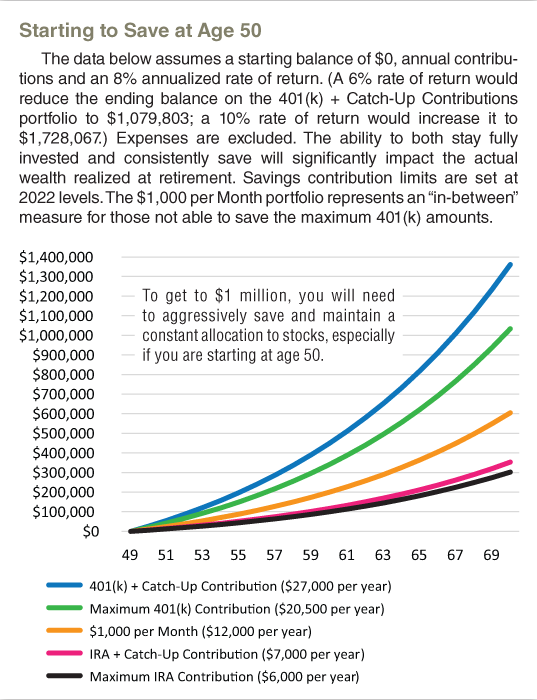
Once you turn age 50, the tax code provides help in saving for retirement through catch-up contributions. A maximum of $6,000 can be contributed to a traditional IRA, a Roth IRA or a combination of the two in 2022. An additional $1,000 catch-up contribution can be made by those who are age 50 or older. Workers with access to a 401(k), 457, 403(b) plan or the Thrift Savings Plan (TSP) can contribute a maximum of $20,500, plus an additional $6,500 in 2022 if they are age 50 or older.
It’s possible to accumulate $1 million by retirement even if you haven’t started saving yet. Included here is an updated version of a chart we originally published in the May 2017 AAII Journal article, “When You Haven’t Saved Enough for Retirement.” Contributing at least $20,500 per year to retirement savings through age 70 will allow a person with no retirement savings at 50 years of age or older to “catch up” by accumulating more than $1.03 million in retirement savings, assuming an 8% annualized return.
Notably, you can’t get there with IRA contributions alone. A 50-year-old person will only accumulate $353,000 at age 70 assuming an 8% annualized return. It would take an annualized return of close to 18% to accumulate $1 million at age 70 at this savings rate. Even saving at a midpoint of $12,000 per year would require an annualized return of 12.2% to reach $1 million at age 70.
Conversely, a couple where one spouse maximizes their 401(k) contributions and the other maximizes IRA contributions will have $1.7 million at retirement with an 8% return. At a 6% return, they will reach $1 million in savings by age 67.
There are a few things to keep in mind when looking at the chart. Expenses are excluded from the calculations but would reduce ending wealth. Employer matching contributions were also excluded but would supplement savings amounts. Contribution limits (except for IRA/Roth IRA catch-up contributions) are indexed to inflation and will be periodically increased. IRA and Roth IRA contributions are subject to income phaseouts.
While it’s not too late to catch up on retirement savings at 50, starting earlier is better. You’ll have more time to benefit from compounded returns and more years of contributions to grow. Still, now is always better than later.
AAII InvestoGraphic


No comments have been added yet. Add your thoughts to the discussion!
You need to log in as a registered AAII user before commenting.
Log InCreate an account