

Related

Behavioral Finance
A study found that Generation Z adults (ages 18 to 23) exhibit lower financial literacy compared to older generations, with financial well-being directly tied to literacy levels.

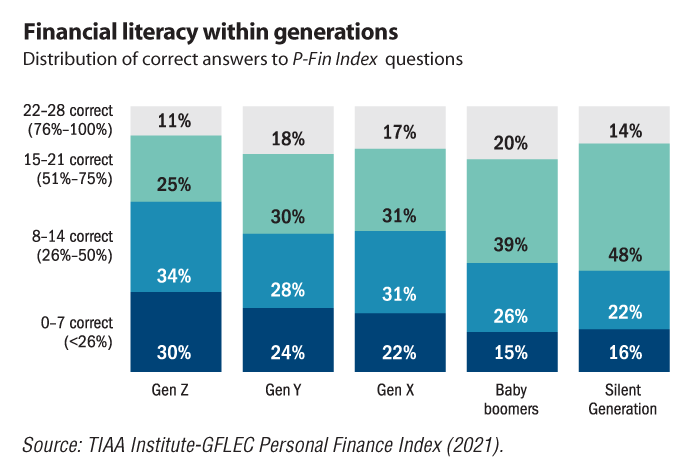
While financial literacy increases with age and education in the U.S., it remains low with each succeeding generation.
A study found that Generation Z adults (ages 18 to 23) exhibit lower financial literacy compared to older generations, with financial well-being directly tied to literacy levels. Nevertheless, access to financial education has grown over the decades, and the economic strain from the coronavirus pandemic is motivating more to become financially literate.
Conducted in January 2021, the annual P-Fin index surveyed Americans on financial literacy and financial well-being as it relates to generation, college education and financial education. Gen Z scored the lowest on the financial literacy assessment, with only 36% of adults scoring above 50%. In comparison, 48% of those in both Generation Y and Generation X, 59% of baby boomers and 62% of the silent generation scored above 50%.
Within Gen Z, those who received financial education and those who attended college scored higher than respondents without these advantages. Gen Z adults who received financial education averaged 49% on the assessment, while those with no financial education averaged 39%. Gen Z adults who attended college averaged 45%, while those without college experience averaged 39%.
Among eight fundamental concepts tested, borrowing and saving had the highest percentage of correct answers in every generation. Comprehending risk was least understood overall. The concept with the largest dispersion was insuring, with Gen Z and Gen Y scoring significantly lower than other groups.
In addition, the P-Fin index found that the percentage of those who have been offered and participated in a financial education program has increased with succeeding generations. Forty-eight percent of respondents in Gen Z have been offered a program, while only 32% of the silent generation have.
Finally, the study shows that Americans—especially young adults—are motivated to increase their financial literacy due to recent events. Around 50% of respondents in the Gen Z and Gen Y groups either strongly or somewhat agree that they have been motivated to learn about finances.
Source: “Financial literacy and well-being in a five generation America,” by Paul J. Yakoboski, Annamaria Lusardi and Andrea Hasler; The 2021 TIAA Institute-GFLEC Personal Finance Index, October 2021.
Behavioral Finance

PRISM Wealth-Building Process

AAII InvestoGraphic

No comments have been added yet. Add your thoughts to the discussion!
You need to log in as a registered AAII user before commenting.
Log InCreate an account