

Related

PRISM Wealth-Building Process
An investor’s overall tolerance can be determined both by the timing of their goals and financial and psychological factors.

Charles Rotblut leads a class in AAII's new Essential Investing Video Course. Go to https://www.aaii.com/ves for more information and to subscribe.
What is risk?
From a financial standpoint, it could be simply defined as not having the money available to spend at the time you need to spend it. From an investing standpoint, AAII founder James Cloonan described it as “the likelihood that when we must withdraw assets from our portfolio, they will have a lower value than we could reasonably expect based on our investment strategy.”
The definitions overlap. Both have implications for how you should invest.
Not having the money that you need at the time you need it can be caused by several factors. A big one is simply not saving enough. If you have not adequately saved for your goal and lack enough wealth and/or cash flow from other sources to pay for it, you’re not going to be able to afford it. Failing to build up and preserve adequate savings will require an adjustment to the timing of when the goal will be realized or a reassessment of the goal itself.
Beyond not making large enough contributions to savings over a long enough time period and avoiding unplanned withdrawals, there are other factors influencing the risk of not having enough when you need it.
One is the sequence in which returns occur. An ill-timed correction or bear market near the time withdrawals are planned can potentially be damaging. Such a market event reduces your wealth at the very time you need to be at a certain level to fund the goal. It is possible to reduce the impact of sequence of return risk through portfolio allocation. One example would be to invest part of the portfolio in so-called “safe assets.”
Following too conservative of an allocation for too long of a time period creates a different type of risk. Failure to adequately grow your portfolio’s value could also leave you short of your goal, leaving you with less wealth than is needed.
Part of the reason being too conservative is a risk has to do with purchasing power. Purchasing power is the ability to buy goods and services with the dollars you have. Over time, inflation—even low levels of inflation—erodes your purchasing power. The longer the time between now and when your goal will be completely funded, the more important it becomes to realize a long-term return in excess of the rate of inflation. The annualized rate of return has to be high enough to grow your portfolio in both absolute size and above the rate of inflation.
An aggressive allocation is not the correct strategy in all situations. Dollars needed within a few years should be invested conservatively because of the sequence of returns risk. There simply is not enough time to recover from an ill-timed drop.
Mismatching one’s allocation relative to their goals is one type of psychological risk incurred by investors. Getting greedy by seeking out a higher return on dollars needed soon can leave you short-handed. Conversely, conservatively allocating dollars not needed for many years into the future based on shorter-term trends can have a damaging long-term impact on your wealth.
Often what deters investors from adhering to a long-term strategy is volatility. Volatility, as you know, is the fluctuation in prices and portfolio returns. Nobody minds when volatility sends the value of their portfolio upward. Downward volatility is often noticed and rarely welcomed.
Cloonan used the term “phantom risk” to describe volatility. In his book, “Investing at Level3,” Cloonan observed that “for the long-term investor … it would seem that there is no concern with volatility.” He also believed that volatility creates opportunities “because high volatility leads to greater long-term returns.”
However, the threat of volatility wasn’t ignored. Cloonan acknowledged the ability of downside volatility to cause investors to abandon their long-term investment strategies. “It increases the chances of sub-optimal behavior, primarily selling out at cycle lows,” wrote Cloonan.
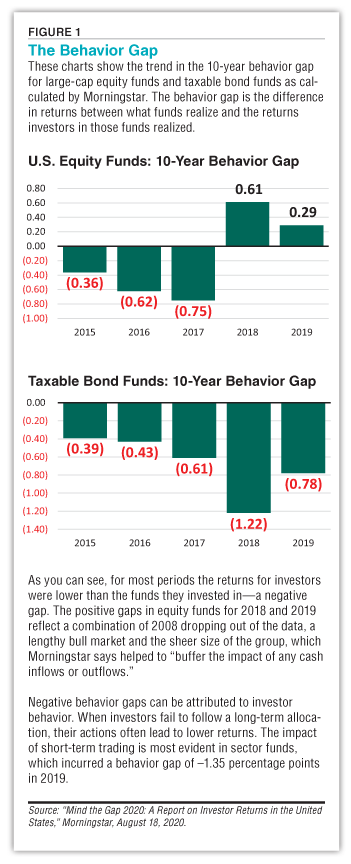
Morningstar and Dalbar have tracked the returns of mutual funds and the returns realized by investors who have invested in them (aka the behavior gap). Though the methodology used for calculating the behavior gap varies between the two firms, the conclusion is the same: The returns realized by many investors are often worse than the performance of the very funds they invest in. Figure 1 shows this data, along with notes about it.
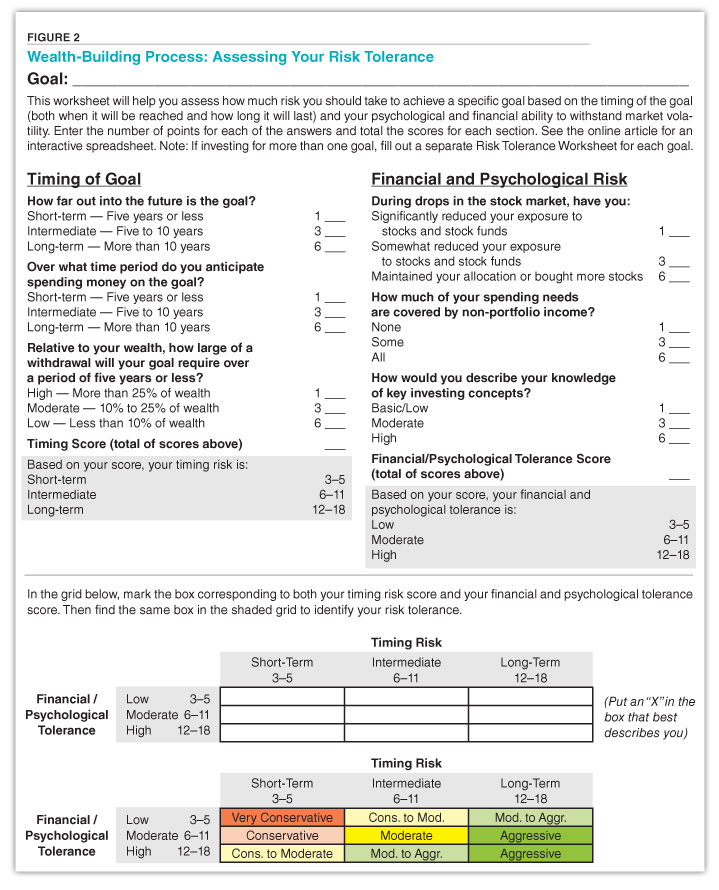
To help AAII members determine their tolerance for risk, we created a simple worksheet of six questions as part of the Individual Investor Wealth-Building Process (Figure 2). It will help you determine how much risk you should take to achieve a specific goal based on the timing of the goal, your wealth and your investing persona.
There are two parts to the worksheet. The first focuses on the timing of your goal. The second focuses on your financial and psychological ability to tolerate risk. We separated them because they represent different aspects of risk. A person can be completely comfortable with turbulent market conditions from a psychological standpoint but if they need the money within a few years, then an aggressive allocation could put them at high risk of incurring a shortfall of wealth. Conversely, a person could have a very long investing time horizon, but also be very uncomfortable with market volatility. For such a person, a more moderate allocation may be more useful if it keeps them from panicking.
I discuss all six questions that make up the worksheet below. By sharing the rationale for including each question, I hope to give you have a better understanding of where investing risk may appear and how each of these components of risk may impact your allocation decisions.
I also include examples of hypothetical investors to demonstrate how these components of risk can impact the decisions and challenges that real investors face.
Download this PDF worksheet.
The following three questions about the timing of goals help to assess when you will need to spend money on your goals. Combined, they consider when the goal is expected to be reached, whether the goal is a one-time event or will last over several years and how much of your wealth you expect to spend on it.
This first question is very simple: When do you expect your goal to be reached?
Some goals will have very clear dates. College is one such example. Consider Sue and Frank. Their second child was just born. They expect her to go to college right after high school. Based on this, they can plan on having to start paying for the goal 18 years into the future.
Others are not as certain. Bequests are one such goal. Bob and Jane, a recently retired couple, would like to leave an inheritance to their family. Obviously, they don’t know when they’ll die. They can make an approximate guess based on their health, family history and average life-span. At age 66, they may live for at least another 20 years, if not more. The number isn’t exact, nor does it need to be. Bob and Jane can simply establish the expectation of their estate not being passed on to their heirs for a long time (assuming no planned gifting in between now and then).
We established three time periods on the worksheet to answer this question. The first is five years or less, including now. The short-term nature of this spending implies a very low tolerance for risk because there is no time to recover from sudden drops in the stock market.
The second is intermediate: five to 10 years from now. This time frame allows for some recovery from the stock market downturns but potentially not enough to fully recover savings lost to downside volatility. Since World War II, bear markets—defined as a drop of at least 20% in the S&P 500 index—have occurred once every six years on average. Excluding the unusually short coronavirus drop, bear markets have taken an average of 18 months to reach bottom. Though the actual length varies, short bear markets have averaged more than two years in total length while long bear markets have lasted more than three years on average, according to calculations by Sam Stovall at CFRA.
The third is long term. We define the long term as periods longer than 10 years. There is still a chance of losing money, but it is small. It is possible to extend this time frame.
Put another way, what is the duration of the goal? Whereas the first question asked when the goal will be reached, this second question asks over what time period you expect to spend money on the goal.
Bob and Jane’s bequests will occur on a single date. Once the estate is settled or ownership or the assets are otherwise transferred, the goal will be fulfilled. Similar examples include the purchase of a vacation house, a dream vacation or splurging on a luxury car. These are either single transactions or ones that occur over a very short period of time.
Other goals will require years of spending. Let’s consider Elizabeth. She is in her mid-20s and starting to save for retirement. She’d be prudent to assume retirement lasts 25 years or longer. Put another way, Elizabeth’s goal of retiring one day comes with a long duration of spending. She’ll have to balance her need for shorter-term withdrawals in retirement with the longer-term requirement of ensuring that her savings continue to grow at a rate faster than inflation.
The same time frames are used for spending duration as for reaching the goal: short (less than five years), intermediate (five to 10 years) and long (over 10 years).
While timing matters, so does proportionate size. Needing $20,000 out of a $2 million portfolio is different than needing $20,000 out of a $50,000 portfolio. The withdrawal amount equates to 1% of the bigger portfolio but 40% of the smaller portfolio.
Two well-known life events will put this into additional perspective. At retirement, the withdrawals over the first few years will not be large relative to the total amount saved. College expenditures will consume everything saved over a short period for most families.
There is a rule at play here. Your ability to take risk is inversely related to the amount you need to withdraw relative to the size of your portfolio. The smaller the percentage of your total portfolio you need to withdraw, the more risk you can take. The larger the percentage of your total portfolio you need to withdraw, the less risk you can take.
One way to think about this is how much will be left in your portfolio to recover should the market drop near the time you need to take withdrawals? The more you need to withdraw, the less there will be left to benefit from the rebound in asset prices.
These three questions measure your ability to tolerate market fluctuations and changes in the value of your portfolio. They will help you assess how comfortable you are with volatility. They also provide feedback on whether you are more or less likely to panic when the next market downturn occurs.
During drops in the stock market, have you (reduced, maintained or increased your exposure to equities)?
This question prompts you to consider your past behavior. Ideally, before answering it, you’ll review your past brokerage records to see what you actually did during past downturns.
The question is a twist on what appears on risk questionnaires given by brokerage firms and advisers. These questionnaires ask how comfortable you would be if your portfolio fell by X% in value. Unfortunately, the answer you give will be heavily influenced by how comfortable or nervous you are about current market conditions.
Your past brokerage statements shed light on how you’ve previously behaved. Could your behavior have changed between then and now? Yes, but until the next downturn occurs, you won’t know for sure. This is why it’s important to consider actual behavior as opposed to predicted behavior.
Behavior is a risk because panicking could prompt you to sell at a market bottom, locking in losses. Past behavior can also be a sign of your ability to handle volatility. If you have been stoic in the face of market downturns or viewed them as an opportunity to buy stocks at discounted prices, you are better able to handle a more aggressive allocation.
Whereas the proportionate amount you need to withdraw is a timing risk, the amount of cash flow you have (or don’t have) helps to determine your financial risk. The more reliant you are on savings to fund your goal, the less short-term volatility you will be able to withstand. Conversely, the greater your non-portfolio cash flow, the less volatility should matter.
Let’s go back to our recently retired couple, Bob and Jane. If their pension and Social Security benefits are large enough to cover their living expenses, then fluctuations in the value of their retirement savings won’t have a big impact. No matter what happens to the market, they have guaranteed sources of income to rely on.
Elizabeth is in a very different boat when it comes to her short-term savings. If she, like many her age, are balancing college loans and, potentially credit card debt, along with an early-career salary, she’ll have very little ability to handle risk with her short-term savings. She will need to have these dollars available anytime there is a large expense, such as a medical bill or a deposit on a new apartment.
Understanding how the financial markets act over time reduces the temptation to react to both upside and downside volatility. It also enables you to better set your expectations for how certain assets will perform.
If Elizabeth is new to investing, she might not understand what the funds she chooses are designed to do. For example, a drop in her target-date fund’s value might catch her off guard because she doesn’t realize that it’s heavily allocated to stocks by design given her age. This lack of knowledge may cause her to be more reactive to market moves.
An educated investor who has taken the time to read market history will bring a different perspective. They will view corrections and bear markets as a normal part of the investing cycle. They’ll understand how changes in interest rates can drive bond prices up or down. They’ll naturally expect correlations between domestic and international stocks to increase during turbulent periods and decrease afterward. This knowledge can lead them to be less reactive to market conditions.
As shown in Figure 2, the answers for each question are assigned point values of 1, 3 or 6. Higher scores imply greater tolerance while lower scores imply lower tolerance. An investor’s overall tolerance is determined both by the timing of their goals and the financial and psychological factors. Depending on the combination of both, a suitable portfolio allocation can range from very conservative to aggressive.
You can see how we define risk tolerances at the bottom of Figure 2. Our allocation models provide examples of how to implement such strategies.
If you have more than one goal, we suggest filling out a different risk worksheet for each goal. Doing so will allow you to align your allocation needs based on the timing and wealth needed for each goal.
This particularly works well if you segment your portfolio accordingly. An example would be a married couple who is saving for retirement via their 401(k) plans and IRAs while using a 529 savings plans to save for their children’s college education. ?

Go to the Learn & Plan section of AAII.com to walk through the entire five-step Individual Investor Wealth-Building Process. To aid in building your plan, there are short videos to watch and fun challenges to work through.
PRISM Wealth-Building Process

Behavioral Finance


MONK JR. M from TX posted over 5 years ago:
CRAIG B from WI posted over 5 years ago:
DAVE K from CA posted over 5 years ago:
ROBERT A from NC posted over 4 years ago:
Hugh P from WA posted over 4 years ago:
Hugh P from WA posted over 4 years ago:
You need to log in as a registered AAII user before commenting.
Log InCreate an account