

Related

Investor Professor
Although there are some methods for individual investors to gain access to private equity, these are either in the form of diluted exposure in open-end mutual funds or exchange-traded closed-end funds that are a very small part of the retail investment market.

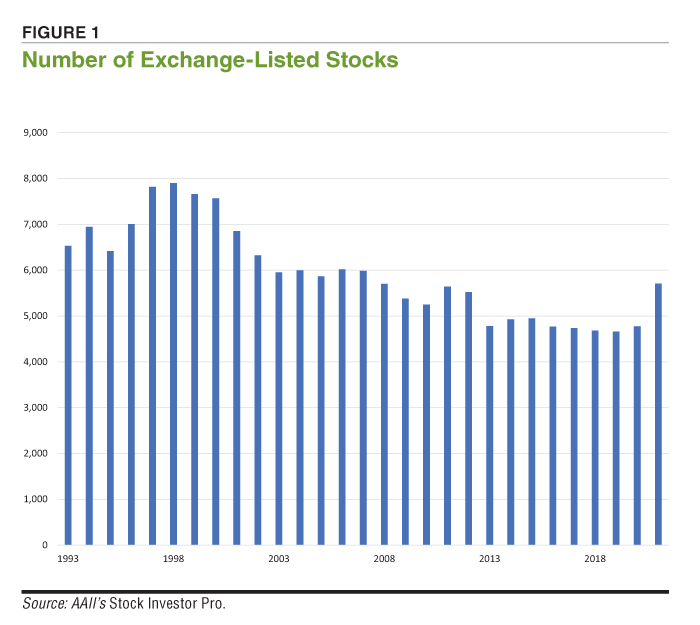
Over the last 20 years, the public market for domestic equity has been shrinking. The number of publicly traded companies decreased by 39% (Figure 1), while the total market capitalization of the domestic market increased by 492%, according to data from the World Bank. Private equity is making up part of the difference, currently totaling about $4.5 trillion.
Retail (individual) investors are particularly impacted by this trend. Traditionally, only institutional investors, pensions and affluent investors invested in private equity. Individual investors haven’t had much direct access.
The trend of the shrinking pool of public equity is impacted both by startups waiting longer before going public and large buyout funds acquiring public firms and keeping the companies private. Founders can more easily gain access to investing capital and maintain control instead of turning to an initial public offering (IPO) for funding. This reduces the regulation and scrutiny the leaders of company are subject to regarding required public disclosures and regular filing of financial statements.
Private companies can obtain ample funding from venture capital, which is at a historically high level of fundraising. Increasing flows of capital and liquidity in the private market have also created momentum that makes the private market more accessible to those with the qualifications to enter.
An increasing number of institutional investors are allocating a part of their portfolios to private equity exposure with the hope of establishing greater portfolio diversification and the possibility of gaining returns above the market.
It can be a challenge to directly compare the returns of private equity investments to investments in public firms. Private equity investments are less liquid and tend to be highly leveraged. Pricing information is more opaque and subject to valuation assessments. Private equity funds tend to have relatively high annual management fees as well as performance-based compensation.
With private equity’s growth, the U.S. Securities and Exchange Commission (SEC) has examined how to increase its accessibility to retail investors. A first step would likely be to increase transparency, requiring more regular financial data.
Private equity is considered an alternative investment. Conventional categories of investments include stocks, bonds and cash. Other alternative investments include venture capital, hedge funds, managed futures, art and antiques, commodities and derivatives contracts, as well real estate.
Alternative investments are characteristically less liquid than conventional investments and are overseen with fewer regulations from the SEC. Liquidity refers to how quickly an investment can be purchased or sold at a price reflecting the current value of the investment. Private equity funds are primarily formed to invest in securities of companies that are not listed on public exchanges such as the New York Stock Exchange. However, the investment is not passive in the way of a mutual fund. Private equity can and does influence and control private companies, often selling them in whole or piece by piece.
Private equity funds and investors can invest directly in private companies or engage in buyouts of public companies that results in their delisting. Venture capital funds focus on investing in startups but typically only hold a minority stake. Since many startups fail, a venture capital fund typically seeks to build a portfolio of startups with hope of finding a few big winners. More established private growth firms form the core of growth equity private funds, while buyout funds focus on acquiring mature public companies and taking them private. Buyout funds actually make up the largest portion of the private equity landscape.
Many private equity funds and hedge funds attempt to increase returns by adding value in other ways: leverage, high-speed trading, arbitrage, conversion activity as well as buying, reorganizing and selling companies can all add to an investment firm’s returns.
Private equity funds and hedge funds are similar organizations, with similar fee structures. They can invest in a wide range of vehicles not open to mutual funds such as swaps (complex options), commodities, unlisted securities and all forms of arbitrage. Hedge funds can share in profits and not share in losses. A typical arrangement is for the fund manager to receive 2% of assets plus 20% of any profits. Many of the popular hedge funds can only be accessed through a fund of funds or through an investment adviser, both of which result in another layer of fees.
Certain individual investors can access private equity directly. These individuals are considered accredited investors or qualified clients. The designated sophistication authorizes the purchase of securities that are not registered with regulatory authorities like the SEC. These investors are considered to have greater financial security and knowledge to deal with the characteristics of investing in private equity and should be in a better position to deal with the risk of significant loss of their investment.
Private equity typically requires a lengthy period of investment illiquidity that locks up funds. There is an increased level of risk in private equity inherent with the unlisted nature of the fund, which limits financial oversight. A wide range has been observed between the performance of the best funds and the worst-performing funds.
To be an accredited investor, an individual must have a net worth of at least $1 million (excluding the value of their primary residence) or have had income of at least $200,000 each year for the last two years and have the expectation to make the same amount in the current year. Joint income with a spouse or partner exceeding $300,000 for those years is also applicable. A recent change extended the accredited investor designation to financial professionals who hold certain licenses, such as a Series 7 license to buy and sell securities. Accredited investor designations are also assigned to financial entities such as trusts. Accredited investors include high-net-worth individuals, banks, insurance companies, brokers and trusts.
Performance fees are common with private equity funds, but the Investment Advisers Act of 1940 prohibits investment advisers from entering into advisory contracts that provide for performance-based compensation, unless the party is a qualified client. Just as with accredited investors, qualified clients are considered to have financial sophistication, high net worth and experience. The thresholds for considerations as a qualified client and accredited investor are maintained by the SEC. In 2021, the SEC increased the net worth threshold for qualified clients to $2.2 million and necessary assets under management to $1.1 million.
Accredited investors can invest in certain unregistered investments, while qualified clients pay a performance fee for that privilege.
Access to private equity is limited for the average individual investor. The main avenues are open-end funds—such as mutual funds—and closed-end funds, but most of both are limited to holding 15% of their assets in illiquid investments. Fund companies have generally avoided investments in private equity because of portfolio liquidity and expense ratio concerns. Some fiduciary responsibilities require managers to carry more accessible, liquid assets. Most of these funds do not approach the 15% threshold.
Mutual fund investors buy new shares and redeem their shares directly from a fund family. The fund must be able to price the value of its assets daily and handle redemptions, making it difficult to hold a large percentage of illiquid investments such as private equity.
Closed-end funds make up a small portion of the investment management market. The mutual fund market is significantly larger.
A closed-end fund issues a fixed number of shares through a single IPO to raise capital. Its shares are then typically bought and sold by investors on a stock exchange, but no new shares will be created and no new money will flow into the fund. The net asset value (NAV) of a closed-end fund is usually calculated daily, but it is done a voluntary basis. Since the share prices of the closed-end funds are determined in the secondary market, the share price often deviates from the NAV of the fund. Most close-end funds are bond funds, preferring liquid assets. However, closed-end funds are better suited than open-end funds to holding less liquid securities such as private equity. Some closed-end funds can hold up to 100% of their assets in private assets; however, exchange-listed closed-end funds must limit their investments in private equity to 15% of net assets. The purchase of shares of closed-end funds holding more than 15% of private equity is limited to accredited investors.
There are two types of closed-end funds that offer private equity investment opportunities for individual investors: interval funds and tender offer funds. These closed-end funds can be sold (or offered) directly to investors and then redeemed on a regular schedule (interval) or at the discretion of the board (tender offer).
Interval funds repurchase shares at an established regular period (every three, six or 12 months) and up to a certain percentage (between 5% and 25%). Interval funds normally calculate their NAV weekly but will calculate the value daily during the five business days preceding a repurchase request deadline and on each day that investors purchase or redeem shares. The proceeds or the repurchase must be made within seven days of the repurchase pricing date and there are additional portfolio liquidity requirements around the time of redemptions.
Primark Private Equity Investments Fund (PMPEX) is an interval fund open to non-accredited investors that targets private equity fund investments, listed private equity and private company investments. Its investment minimum is $5,000 and charges a 1.5% management fee plus fund operating expenses.
Tender offer funds are registered closed-end funds that also continuously offer their shares but have greater flexibility with respect to the timing and amount of repurchase offers compared to interval funds. Shares are repurchased at the discretion of the board of the fund and there are no liquidity requirements. However, tender offer funds must comply with specified Securities Exchange Act tender offer rules that are less streamlined than the redemption rules that apply to interval funds. Most tender offer funds are engaged in private equity, in contrast to interval funds.
Although there are some methods for individual (retail) investors to gain access to private equity, these are either in the form of diluted exposure in open-end mutual funds or exchange-traded closed-end funds that are a very small minority of the retail investment market, representing less than 2% of mutual fund assets under management (AUM). Closed-end funds are better suited to holding a larger percentage of private equity but may require investors to be accredited or qualified.
Recognizing the shift in the public and private markets, the SEC is looking into its regulation regarding the accessibility of private equity to retail investors.
Investor Professor

Alternative Investments

Portfolio Strategies

No comments have been added yet. Add your thoughts to the discussion!
You need to log in as a registered AAII user before commenting.
Log InCreate an account