

Related

Dispatches
Two major additions to the offerings of online brokers are fractional shares and cryptocurrency trading.
by Matthew Bajkowski, Adam Scheg, Dylan Dease, Jack Gilleland, Charles Griswold, Sean Murphy | March 2022
The cost of using an online broker has never been cheaper. The industry trend of offering zero commission trades on stocks and exchange-traded funds (ETFs) is now the standard for all brokerages. More recently, there have been two major additions to the offerings of online brokers: fractional shares and, for some, cryptocurrency trading.
Fractional investing allows investors to buy a portion of a stock or fund instead of a full share. Trading fractional shares is not a new concept, but it is becoming much more common. Much like the elimination of commission fees, brokers are now more commonly offering fractional shares to remain competitive. In the past year, a surge in younger retail investors has made fractional share trading a very desirable function because many cannot afford to invest in stocks with a high share price.
Since the start of 2021, cryptocurrency has been making its way into portfolios of many investors. Large financial firms such as JPMorgan Chase & Co. are now allowing high-net-worth clients to allocate a small percentage of their portfolios to cryptocurrency. This effect can be seen on the retail (individual investor) level as well, as several brokerages are now offering cryptocurrency trading, most commonly bitcoin and ethereum.
Three-quarters (75%) of surveyed AAII members use either Charles Schwab, Fidelity, TD Ameritrade or Vanguard as their broker. The main reasons members gave for their broker choice are the amount of research provided, the different assets and diversification offered and the location of their workplace retirement account.
A little over half of the members surveyed said they do not use their broker’s mobile app (compared to 66% last year). The most common reason for this was that they didn’t need or want to use the app. Other comments included security concerns with mobile apps as well as a preference for using a computer. Of those who do use mobile apps, the ease of use and convenience were the biggest reasons.
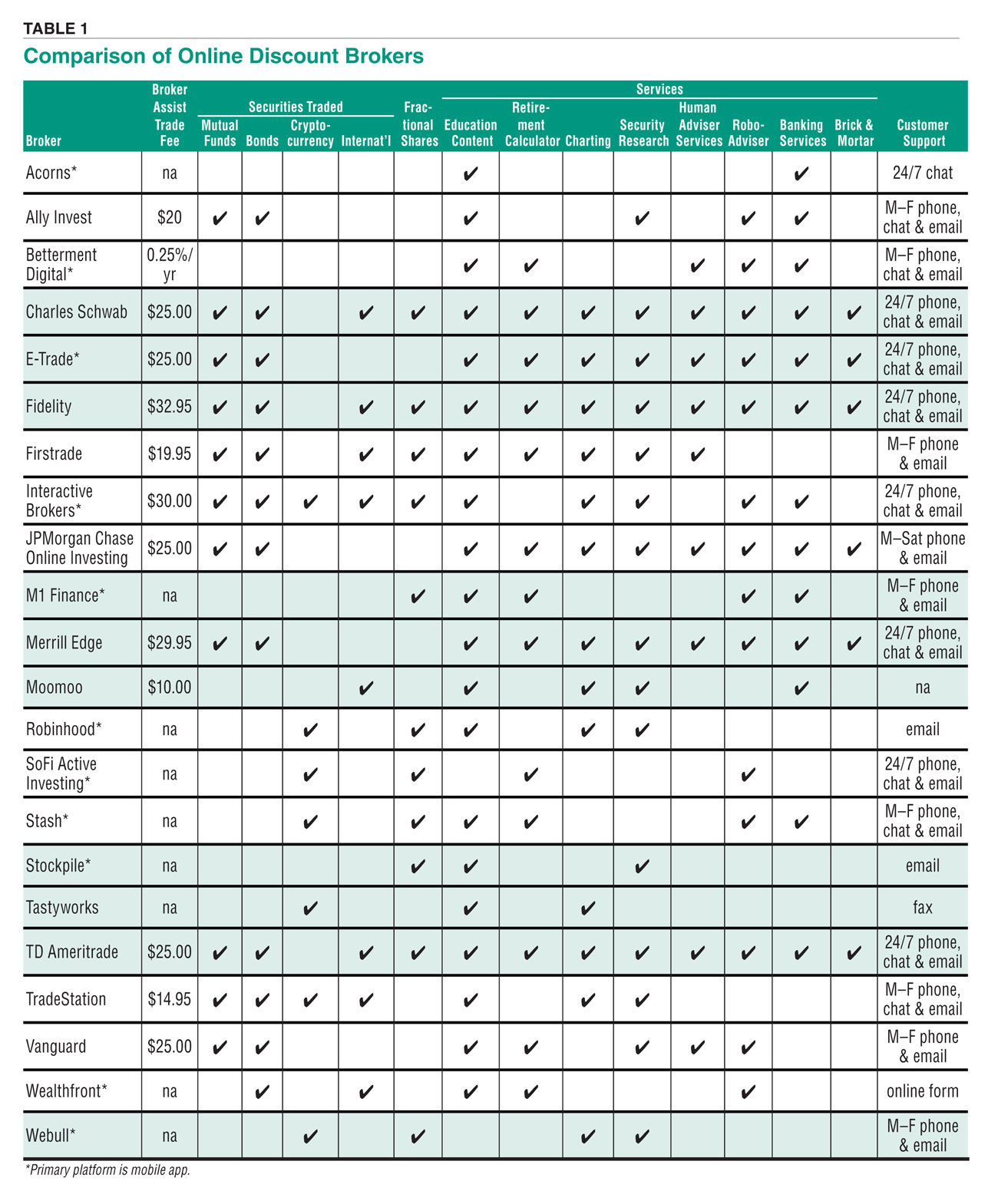
Every year, technology is providing increased features and services for investors to take advantage of. The cost of investing is lower than ever, and the variety of assets offered by brokers continues to grow. This year’s discount broker guide includes 22 companies as we try to cover an ever-expanding industry. Table 1 summarizes the services offered by each for easy comparison.
When choosing a broker, it is important to understand the different fees they charge to hold and manage your investments. Some fees that you should take into consideration are trading fees, account fees and margin interest rates.
In the past few years, trading costs have decreased considerably, but fees for trading options, mutual funds, futures and broker-assisted trades have remained.
Most brokers that provide options trading services charge a $0.65 fee per contract. Webull, Ally Invest and Vanguard charge $0.01, $0.50, and $1 per contract, respectively, whereas Firstrade and Robinhood offer no-fee options trading. Options trading fees may be attributed to transaction fees charged by the U.S. Securities and Exchange Commission (SEC) to the exchanges that are passed on to the investor.
Mutual fund trading fees vary considerably between brokers. Firstrade offers 11,000 mutual funds on a transaction-free basis. Fidelity and Vanguard, among others, offer many funds on a transaction-free basis but charge for other mutual funds: Fidelity charges $49.95 and Vanguard charges $20.00. TD Ameritrade charges $74.95 for funds from certain fund families. Some brokers may also charge for mutual funds held for less than 60 days.
Six brokers in our survey offer futures trading services: E-Trade, Interactive Brokers, Schwab, Tastyworks, TD Ameritrade and TradeStation. Of these, Interactive Brokers has the lowest fee for traditional futures contracts, charging $0.85 per contract. The others charge a fee that ranges from $1.25 to $2.25 per contract.
If you’re someone who would prefer trading securities with help from a live broker—at, say, Fidelity or TD Ameritrade—then it can cost you anywhere from $25.00 to $32.95 per broker-assisted trade. Table 1 shows which brokers offer assistance with trades and how much they charge.
Minimum deposit requirements to open accounts have mostly become a thing of the past. From our list of brokers, only M1 Finance and Wealthfront have a minimum deposit requirement. M1 Finance requires $100 and Wealthfront requires $500.
A few brokers from our list offer subscription-based fee models including Acorns, Betterment Digital and Stash. For example, Acorns charges a $3 monthly fee for an individual plan and a $5 monthly charge for a family plan. These plans can offer various services including multiple account types, banking and planning advice.
Account fees that you should take into consideration especially for retirement accounts are IRA annual fees, IRA closure fees and account transfer out fees. Of the brokers covered here, TradeStation is the only one that charges an annual fee for an IRA account ($35).
On the other hand, about half of the listed brokers charge IRA closure fees. When closure fees exist, they range from as little as $20 to as high as $100 with M1 Finance. Brokers that do not charge an IRA closure fee are Betterment Digital, Charles Schwab, E-Trade, Fidelity, Firstrade, Interactive Brokers, TD Ameritrade and Vanguard.
To make a partial transfer out of an account, about half of the listed brokers charge fees. For partial transfers out, fees range from $25 to $75. JPMorgan Chase Online Investing, Robinhood, SoFi, Stash and Webull charge $75. Brokers that do not charge a fee for partial transfers out are Betterment Digital, Fidelity, Firstrade, Interactive Brokers, Merrill Edge, Tastyworks, TD Ameritrade and Vanguard.
To fully transfer out of an account, most of the listed brokers charge fees, which range from $49.95 to $75.00. Brokers that do not charge for a full transfer out include Betterment Digital, Fidelity, Firstrade, Interactive Brokers and Vanguard.
In 2020, Charles Schwab completed its purchase of TD Ameritrade and Morgan Stanley completed its acquisition of E-Trade. In late January 2022, UBS reached an agreement to purchase Wealthfront. Here is a brief update on the status of all three mergers.
TD Ameritrade
Schwab expects to convert “most” TD Ameritrade accounts “somewhere between April and September of 2023.” Until then, TD Ameritade will continue to operate separately. TD Ameritrade and Schwab clients should continue to contact their respective brokerage firms. Answers to many common questions can be found on Schwab’s website at https://welcome.schwab.com.
E-Trade
E-Trade will continue to operate as a separate website. “Certain Morgan Stanley resources” are currently being offered to E-Trade customers. “In time, both companies hope to offer a comprehensive array of E-Trade and Morgan Stanley products and services all under one roof.” Answers to many common questions can be found on E-Trade’s website at https://us.etrade.com/l/morganstanley/faqs.
Wealthfront
According to UBS, Wealthfront’s existing clients “will see no immediate change.” In the future, Wealthfront clients will have access to UBS’ products and services, though no specifics have been given. The merger is expected to close “in the second half of 2022.”
Almost all of the brokers listed here offer stock, bond, options and margin trading. Acorns and Betterment Digital are the only brokers that do not allow trading of individual stocks. Instead, they offer pre-built portfolios.
As mentioned, many brokers have begun offering fractional share trading. Table 1 shows the brokers that allow investors to buy fractional shares. With the recent growth of cryptocurrency such as bitcoin and ethereum, several brokers have added crypto trading abilities—these are also marked in Table 1. SoFi offers the most options, with 30 different cryptocurrencies available to trade. TD Ameritrade allows you to trade bitcoin futures but not the actual cryptocurrency.
Nearly all of the brokers here offer market, limit, stop and trailing stop orders as well as placing orders after-hours. In addition to this, many brokers offer human adviser services and robo-adviser services for a small annual percentage fee.
Many brokers feature educational and beginner resources for those who are new to investing. These resources can range from informational articles to videos, webinars and even quizzes. Many brokers also offer educational resources on retirement.
Brokers typically provide educational content relating to the securities they have available to users. For example, large brokers like Merrill Edge and Fidelity provide educational resources covering stocks, ETFs, bonds, mutual funds and options. Educational videos are offered by these two and many others. One bonus of Merrill Edge is that investors have access to interactive quizzes that test how much they know or have learned about a particular topic. Interactive Brokers and E-Trade also have quizzes of a similar fashion.
One broker that stands out in the education area is Charles Schwab. The firm’s website has a section titled “Learning Center” that gives an extensive view into various investments ranging from simple stocks to options. What is unique is the relatively simple categories and language that Schwab uses to describe complex securities such as options and futures. Furthermore, it breaks down the options category itself into various subsections of articles and videos pertaining to characteristics, speculation and income generation.
These types of educational resources encourage investors to broaden their investment horizons and potentially realize greater returns by simplifying a seemingly daunting investment class.
When picking a broker, it is important to factor in what educational resources one might need or want for their own personal use. While many of the larger, more traditional brokerages have ample resources ranging from articles to webinars, other brokers may offer a limited amount. For example, Robinhood offers basic stock learning materials and an investor dictionary, but it doesn’t have more sophisticated learning tools such as videos or webinars. Additionally, Robinhood’s resources are not as extensive as those offered by Charles Schwab. Webull, on the other hand, has no educational or beginner resources and is considered a better platform for more advanced and veteran investors.
Investors should investigate or at least be aware of the educational materials provided by the respective broker to make sure that the platform covers all of their investment needs and desires.
Discount brokers today offer a wide variety of investment options, tools, research, interfaces and more. Choosing a broker that fits all of your needs is important, but many already have an established connection with their broker of choice.
Individual investors are keen to use the larger, more established brokers, with 27% of surveyed AAII members using Charles Schwab, 26% using Fidelity and 14% using TD Ameritrade. As Charles Schwab integrates TD Ameritrade following the 2020 merger, it will further cement itself as the largest U.S. stock brokerage firm. Of respondents who use two or more brokerage firms, 19% said that they use Vanguard and 6% use E-Trade.
Surveyed members were also given 15 characteristics of brokerage firms and asked to rank their importance. The most important broker characteristic to AAII members was security and privacy, selected by 96% of respondents. Second was customer service, with 91%. Other notable features important to AAII members included the broker’s commission and transaction fees at 89%, trade execution options and speed at 88% and investment choices offered at 81%.
The process of buying and selling securities has never been easier and more convenient for the individual investor. A big reason for this is the advent and implementation of mobile apps. Apps have become a standard offering for brokerage firms, in addition to their more traditional websites. Allowing investors to make trades, conduct research, monitor accounts, transfer assets and much more, it is easy to see why mobile apps have risen in popularity with investors. Every brokerage firm included in the table offers both iOS and Android versions of their app.
While most brokerages offer an app as a supplement to their main websites, some are app-only platforms. Some offer more than one app, like TD Ameritrade with its base app and its thinkorswim trading platform app. Charles Schwab has two mobile apps, Schwab and StreetSmart, both with similar features offered by TD Ameritrade. Table 1 notes which brokers consider their mobile app their primary platform.
Each platform has a unique interface that may be geared more toward beginner, intermediate or advanced investors. Many also offer accompanying screening tools, charting capabilities and have a variety of research resources to aid investor decisions. With the sheer number of brokerages to choose from, it is important to find one that fits your needs.
Brokerage apps that novice investors may find easier to use include Acorns, Betterment Digital, M1 Finance, Robinhood, SoFi Invest, Stash, Stockpile, Vanguard and Wealthfront. They all offer incredibly simple interfaces. Complicated analytical tools are rare with this group of mobile apps, and those looking for advanced tools will be disappointed. Charting capabilities are nonexistent and equity choices may be limited. However, all of these platforms, aside from Robinhood, use investment pies to represent which stocks are chosen or the style of investment, keeping it simple for beginners. In addition, most of these apps have educational resources to aid those just starting out.
An intermediate investor can be classified as one who is looking to utilize resources for investment decisions but does not use advanced analytical tools. For this style of investor, brokerages such as Ally Invest, Firstrade, JPMorgan Chase Online Investing, Moomoo, Tastyworks, TradeStation and Webull may be sufficient options to consider. They go more in-depth than the beginner platforms, offering features like analyst ratings, customizable indicators and charting, education materials, retirement accounts, community chats, fractional shares and other tools. They also allow investors to trade options, mutual funds, ETFs and cryptocurrency.
Active traders or those seeking to make use of advanced tools will find that larger name brokerages like Charles Schwab, E-Trade, Fidelity, Interactive Brokers, Merrill Edge and TD Ameritrade deliver sophisticated features. Along with the features previously listed, these options can include app-, web- and desktop-based trading capabilities. Such platforms provide a full suite of trading features—including advanced charting—and may offer futures, bonds and foreign exchange trading. They are also more likely to have active customer service.
Many of the online brokers included here offer similar kinds of basic research and analysis, along with specific tools like screeners for investors to use when constructing their portfolios. The research differs in depth and variety depending on the size of the broker as well as which securities each broker specializes in.
Large brokers, such as Charles Schwab, Fidelity and Merrill Edge provide investors with a wide variety of research covering an extensive range of investments. These well-known brokers offer reports and additional analysis on stocks, ETFs, mutual funds, bonds and more. This wide range of research goes together with educating the investor as they seek to build a portfolio.
As investors seek to diversify their investments, they can get an in-depth look at a wide array of assets using both charting and screening tools. While most brokers provide some basic analytical tools, many more well-known platforms have additional and more in-depth analytical features. For example, Interactive Brokers has 70 variations of technical charting studies for stocks. Charles Schwab has 32 variations. Like many other large brokers, Schwab also provides users with independent research and analyst reports from providers such as Credit Suisse and Morningstar. Many of these reports not only give recommendations on securities, but also offer in-depth industry and sector analysis and identify risks or growth opportunities for the company or security.
In addition to research reports and charting tools, many brokers offer their clients access to screeners. Large brokers such as E-Trade and Fidelity have screeners for stocks, ETFs, mutual funds and bonds.
While some analysis tools are becoming more readily available on mobile platforms, it’s crucial to note that many of the more in-depth broker analysis tools will still only be found on web or desktop trading platforms.
It’s also important to highlight that some brokers geared more toward mobile app users may provide little or no analysis or screening tools. Robinhood is an extreme example of this: The broker offers no screeners on its mobile- or web-based platforms. It also has very limited research pertaining primarily to stocks and ETFs. In contrast, Morgan Stanley’s E-Trade caters to a more sophisticated mobile app user base and offers a much more robust selection of research, screens and charts.
In terms of research and analysis, almost all brokers in this guide provide at least basic information to investors. Certain smaller platforms may provide comparatively limited amounts of information and research. Investors will find much more information when accessing an established broker’s full website. As a consequence, those looking to build a truly diversified portfolio with multiple types of securities may favor one of the larger and better-established brokers. When choosing a broker, take special care in evaluating your needs and skill level, to assess what level of analysis you expect to perform and what tools will be most useful to you.
Robo-advisers—digital platforms that provide financial planning services with little to no human supervision—continue to grow in popularity. Assets under management (AUM) by robo-advisers are projected to reach almost $2 trillion in 2022 and are expected to experience a compound annual growth rate (CAGR) of nearly 17% from 2022 to 2025, as provided by business data platform Statista. The data firm also anticipates the number of users to be near 500 million by 2025, with an average AUM per user of $6,000.
The typical robo-adviser collects information from clients about their financial situations and future goals, usually through a survey, and uses a preprogrammed algorithm to both generate advice and automatically invest in assets for a client. The top robo-advisers on the market offer simple account setups, advanced goal planning, account services, portfolio management and security features, attentive customer service, comprehensive education and low fees. Most robo-advisers charge an annual flat fee in the range of 0.2% to 0.5% of a client’s total account balance. However, some also require a minimum deposit.
Looking at our list of brokers, the overwhelming majority provide robo-advisory services. Smaller app-based brokers such as Acorns, Robinhood, Stash, Stockpile and Webull typically do not offer robo-advisory services.
Most of the established discount brokers discussed in this article offer some type of banking services through their website and/or apps. Partnerships with banks have allowed even the smallest brokers such as Acorns and Stash to offer account services insured by the Federal Deposit Insurance Corp. (FDIC) that come with a debit card.
Mobile app banking features generally allow users to deposit checks, transfer money and pay bills. Brokers with online banking services have generally integrated these features with a cash management account, but some keep them separated from individual broker accounts. Interest rates offered on savings accounts vary. Most brokers do not charge for banking services and offer free check writing and online bill pay services.
Read the disclosures if you are unsure about the bank. While JPMorgan and Chase Bank are under the same corporate umbrella, other brokers may rely on banking partnerships. For instance, Acorns partners with Lincoln Savings Bank to provide FDIC-insured checking accounts and debit cards. Also, pay attention to which services qualify for FDIC insurance and which do not.
Digital security is key to protecting your assets and investments. Weak security or a compromised system are to be avoided. However, brokerages take cyber-security seriously, as they are required to by law. Every brokerage on this list with fraud protection guarantees or requires two-factor authentication when accessing an account. Additionally, encrypted websites and platforms are utilized. Online banking carries security alerts coupled with the ability to restrict money transfers in the event of a potentially compromised account. Brokers are required to meet SOC 2 compliance standards, meaning audits are conducted by a licensed certified public accountant (CPA) firm with expertise in information security. Brokers issue reports attesting that the relevant systems conform to information security standards. All brokers on this list are also insured by the Securities Investor Protection Corp. (SIPC) for up to $500,000.
It is a good security practice to use different passwords for different accounts. Use a combination of upper and lowercase letters, numbers and special characters in your passwords to ensure their strength.
Customer service ranked highly with AAII members in the list of broker features. Almost all brokerages offer email support, with most offering phone support. For those who prefer to handle certain investing and wealth management activities in person rather than over the phone or the internet, the location of physical offices matters. However, newer brokers are forgoing in-person services in favor of digital-only services to offer the most cost-effective automated solutions.
Larger brokers with additional in-person advisory services are the ones that typically still have accessible networks of physical offices. Charles Schwab, E-Trade, Fidelity, JPMorgan Chase Online Investing, Merrill Edge and TD Ameritrade are the discount brokers featured in this article that have networks of physical offices to visit.
Mobile apps often offer live chat features to allow quick access to a representative when help is needed.
We think you’d like this related webinar! Individual Investor Show: The Discount Broker Face-Off
Dispatches

Financial Planning

Investor Professor

BARRY J from TX posted over 4 years ago:
ROBERT A from NC posted over 4 years ago:
ANDREW M from TX posted over 4 years ago:
STEVEN H from CA posted over 4 years ago:
MICHAEL D from CA posted over 4 years ago:
J A from NJ posted over 3 years ago:
You need to log in as a registered AAII user before commenting.
Log InCreate an account