



Spencer Jakab is the editor of the “Heard on the Street” column at The Wall Street Journal. His latest book is “The Revolution That Wasn’t: GameStop, Reddit and the Fleecing of Small Investors” (Portfolio, 2022). We spoke about the meme stock mania, including the role that social website Reddit and apps like Robinhood played in it.
—Charles Rotblut, CFA
Would it be fair to describe the meme stock mania as a bubble that was driven by a positive feedback loop between the Robinhood brokerage app and Reddit?
Those are two vital elements. Social media in general, then Reddit specifically in this case, played a really big role. It had a symbiotic relationship with Robinhood and apps that are copycats of Robinhood, like Webull and eToro. They played a vital role in funneling people into the market and organizing them.
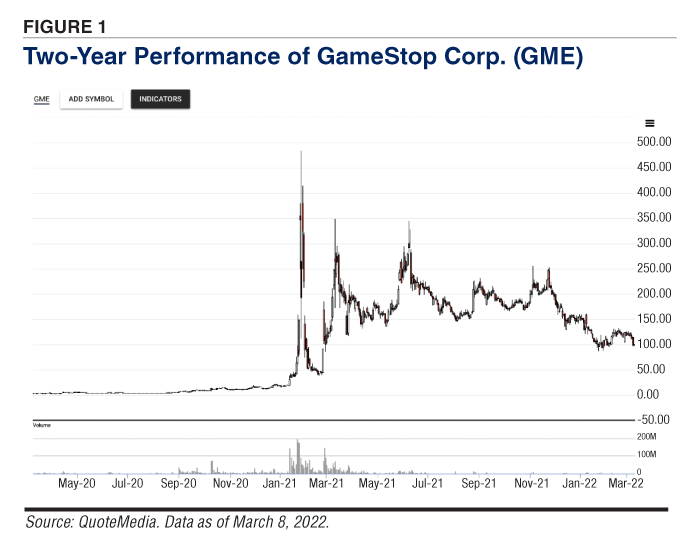
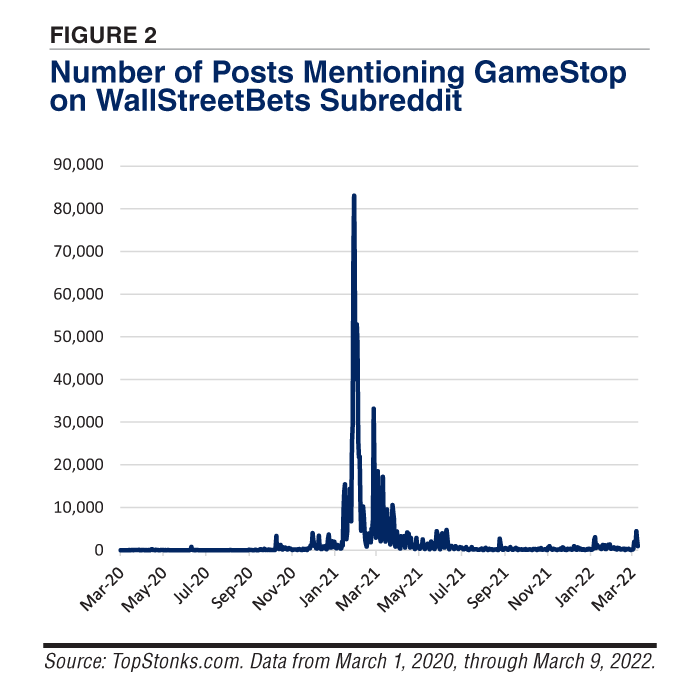
At the beginning of the story that I chronicle in my book, the WallStreetBets subreddit went from just over one million people to about two million people when GameStop Corp.  (GME) mania began to take off and then ballooned to eight million by the end of the following month. The explosion of activity and chatter on WallStreetBets coincided perfectly with things like call option volume, stock buying and GameStop’s share price.
The interesting thing is that many pieces had to fall into place for this to happen. In defending himself during a congressional committee hearing, Robinhood CEO Vladimir Tenev called it a black swan event: odds of one in 3.5 million.
I don’t think it’s a black swan event if you cause it. It was a very improbable event because lots of things in the economy and in society contributed to it happening. There was the move to $0 commissions by every other broker. There was the legalization of sports betting, which attracted primarily young men through their smartphones because they had already been pulled in by daily fantasy sports. Then, you had the pandemic, of course. You had stimulus checks. You had lockdowns. You had the disappearance of sports, in particular March Madness, which is the most bet-upon sporting event. All of this coincided with this crazy, extremely volatile period in the market, where you had the most rapid descent from a record high to a bear market ever, and then the most rapid recovery in stocks.
From that pandemic bottom to a point one year after, 96% of American stocks rose. So, if you were new to investing—and several million young people were new to investing—it was very unlikely that you would pick a loser. It was also especially unlikely that you would pick a loser if you were picking stocks that you were hearing about on social media because those stocks happened to be the ones that, for a while, did the best.
There was a lot of excitement and a lot of early success. Success is the worst teacher, as we know.
An essential character in your story is Keith Gill, who went by the aliases of Roaring Kitty and DeepF—ingValue. He started off by buying long-dated and deep out-of-the-money options. Could you explain to our members what he was doing and why he thought it would work?
An option is a promise for you to be able to purchase or sell a stock at a certain price. If you want to get the maximum bang for your buck in a speculative endeavor, you buy a derivative as opposed to buying the underlying security. Within the world of derivatives, if you want the maximum bang for your buck, then you purchase something that has a very remote chance of paying off.
An analogy is going to a racetrack, wanting to walk away with a ton of money and having very little money to bet with. You don’t bet on the favorite to win. You bet on the lame nag that’s expected to come in last to win. You’ll probably lose all your money, but if you happen to be correct, then the multiplier is the greatest.
Gill pursued a very unusual strategy, even for this time, because he was not purchasing the most volatile type of option but rather very long-dated call options. For the initial contracts he bought, GameStop was trading at around $4.00 and would have to reach $8.00 in a year and a half in order for the contracts to have any value. The stock would actually have to rise more than that for the contracts to have enough value to pay him back for the premium he paid. But the premium that he paid was very modest.
Gill wasn’t just betting pennies—he invested about $53,000 in these call options. This was a wild bet, any way you slice it.
I don’t think that Gill was 100% convinced that he was right. I do think he had many qualities of a patient value investor. But it was like being a patient value investor on steroids. Gill made this bet based on his analysis of the value, but it was a bet where there was a significant chance of him losing all of his money.
It seemed like Gill actually did the analysis and really thought the stock was undervalued.
Yes. But the funny thing about Gill being the Pied Piper for this crowd is that, for 90% of my story, he is ridiculed and is a marginal figure.
Then he became central to the whole mania. There’s a record of him having touted GameStop for a long time on social media because he had made such a wild bet. People who make wild bets tend to get attention on social media, but not if they’re cerebral. Gill was very cerebral in his approach.
The moment that he went from not explaining his thesis but posting his pretty large account balance, he began to get a lot of influence. Then, Gill turned completely to just posting memes [media shared widely on the internet] that conveyed messages to people his age and posting account statements. That turned out to be far more influential than any actual reasoned argument as to why GameStop was worth more. [GameStop is considered the first “meme stock,” which is defined as a stock whose market price is pushed up solely by chatter among traders on social media.]
Of course, by the time Gill burst onto the scene, there was no value argument to be made. The argument was that there would be an increasingly severe short squeeze in GameStop. It no longer had anything to do with the value of the stock. It was past that point where he probably would have sold his options, had this scenario not unfolded.
Taking a step back, commission-free trading also played a role. Robinhood is very reliant on payment for order flow. Could you explain what payment for order flow is for those who are unfamiliar with it?
Payment for order flow went from being this arcane thing that only nerds talked about to being characterized as a nefarious plot that was behind this whole thing. It isn’t nefarious.
When you go on Facebook or Instagram and you’re posting pictures and you’re spending a lot of time there, even though you’re not paying any money, you’re the product, not the customer. When you’re making free trades through a broker and being very active, the same thing more or less applies. Even though you’re not paying money explicitly, you are paying the broker’s bills. You’re paying through your degree of activity. The more active you are, the more money a broker like Robinhood makes. In 2020, about four-fifths of the revenues Robinhood realized was by selling stock and option trades to market makers like Citadel Securities.
The system, ironically, is one of the few areas where retail investors actually get a pretty good deal. They get a better deal than institutions because a market maker that’s like a black box—sort of like a stock exchange except there’s no transparency to it—will give you and must give you at least as good of a price as you can see on the stock exchange. But they will frequently do a little bit better than a stock exchange and give you a tighter bid-ask spread.
The market maker keeps some of that spread for themselves and pays some of that spread to the broker that sent them the trade. Then, maybe the broker will give a little bit of that money back to you. But in Robinhood’s case, we know that they don’t give that back to you because that’s how they provide $0 trades.
So, payment for order flow isn’t really a nefarious, corrupt thing. It’s just how the system happens to work for most brokers.
When you have a broker providing several services—like banking, credit cards, robo-advisers and retirement planning—they make money in many ways. They don’t need to induce you to trade. But Robinhood can only make money if a significant subset of its customers are very active. That is key to its business working.
The issue that I have with payment for order flow is that the motives it sets up are deleterious to an investor’s performance because we know that activity correlates inversely with results. Many studies show that. Furthermore, Robinhood also has a very alluring, addictive gamified app and that gets you to check it frequently. Especially if you’re a young person who is already on Instagram or TikTok all the time, it’s just one more app.
Robinhood’s active customers would look at their accounts seven or eight times a day at the peak. There’s no reason to check your investments seven or eight times a day. The more frequently you check your investments, the poorer your performance tends to be because you’re more likely to check and see something either exciting or scary.
Interestingly, Robinhood makes more money from option orders than stocks, even though just 13% of its clients actually trade options. Is Robinhood encouraging them? Are those people seeking out Robinhood? Or a combination of the two?
Well, Robinhood was criticized for making option trading too easy. If you set up an account today at any broker, you can’t buy options and you certainly can’t sell options right away. You need to go through an approval process. You need to read a document with lots of fine print, you need to check all kinds of boxes and fill out online or actual paperwork. Robinhood made that process very streamlined.
So, even though it had a significant number of novices among its customer base, it also had a very active group of options buyers in its population. I’m not saying that there is some evil plan to lure people into trading options, but it’s a very profitable product for Robinhood. That’s how it makes money, by having people trade things. With options being more profitable to Robinhood than stocks, of course it was delighted that its customers became very active options traders too. Then in January 2021, that activity almost put Robinhood out of business.
I wanted to get to that because there were trading restrictions placed on meme stocks by Robinhood and other brokers. In your book, you pointed out that the problem was a function of too many investors using margin.
It wasn’t just margin. When you open a Robinhood account, before your money has hit your account, they will allow you to trade immediately. If you’re extremely impulsive and your friend told you to open a Robinhood account and buy GameStop on January 26, 2021, and you went ahead and did it, normally it would take some time for your money to clear. But the default option was to allow you to trade right away before your money arrived at Robinhood.
It was real money, but it wasn’t in the account yet. It was Robinhood’s money rather than your money that was backing the trade. That also was part of the problem.
The combination of Robinhood’s model combined with all the interest in the meme stocks led Robinhood itself to essentially face its own margin call.
It wasn’t because the stocks had gone down. It was because the stocks could go down. Brokers have their own broker. Brokers have to make sure everybody gets paid through a clearinghouse. A clearinghouse is a systemically important financial institution, as determined after the financial crisis.
Clearinghouses have to be very vigilant. In the past, brokers have gone bust. Because they’re mutualized, this caused every other broker to have to make up for the losses.
The clearinghouses saw that many of Robinhood’s customers were buying the same small group of stocks. They looked at a stock like GameStop that had risen from $2 to $400 in the course of less than a year. The clearinghouses asked what happens if the stock goes down to $200 or $100 in a few days? How many people purchased this stock on margin? What losses would they incur? Are they going to be good for it? Is Robinhood going to be good for it because cash has to be delivered for settled trades in two days?
A broker has to have cash on deposit with the clearinghouse. The clearinghouse called Robinhood in the middle of the night and said, by their calculations, the brokerage firm needed to pony up $3 billion. This large amount was not going to be forthcoming in three hours. So, Robinhood was basically three hours away from insolvency.
The only thing that Robinhood could do was go back to the clearinghouse and say that it would restrict further purchases in those stocks because there was a wave of people ready to buy them at even higher prices that morning. Of course, a million conspiracy theories have been spawned because that was very convenient for anybody betting against the stock. There were a lot of people on Wall Street who were betting on GameStop’s stock falling in price.
It ended up working out nicely for Robinhood, but it wasn’t something that investors asked Robinhood to do. The evidence is clear about what happened: Robinhood’s own customers were so enthusiastic, and Robinhood was so undercapitalized for an event like that, that the broker came close to insolvency.
Reddit, Robinhood and Lessons From the Meme Stock Craze Video
We think you’d like this related webinar! Individual Investor Show: The Emotional Psychology and Behavior Behind Investing
Are there any lessons investors should take away from this meme stock craze?
If you’re a prudent, long-term investor, then you should recognize that the same technologies that I described, not on the social media side but on the financial side, are also benign technologies. Just like a smartphone: It is a very useful thing if you’re lost, if you want to look something up or if you’re curious about the world. But a smartphone can be used for dumb stuff too. It can waste your time and rot your brain, or it can enhance your brain and get you unlost.
The technology that made it possible for people to trade for free, that made all these financial transactions instantaneous and almost free, also works to your advantage as an investor and a saver.
Think about those discussions of what would have happened if you had invested a dollar in 1926—it’s all theoretical. Your pockets were regularly picked along the way. There were no index funds. Just reinvesting dividends cost you a lot of money. So, all those amazing long-run returns that people talk about couldn’t fully be realized by individual investors after costs were factored in.
Today, you can capture almost all of those long-term returns. The way to do it, ironically, is also unfriendly to Wall Street. By using a low-cost, buy-and-hold approach, you are hurting the people on Wall Street who are really into fleecing investors in the long run, the people who get you to buy expensive things and be very active and switch funds.
You can just be passive. You could have a robo-adviser or buy a bunch of index funds, or even buy a bunch of stocks. You can even do it through Robinhood. You can be a free rider on Robinhood. They won’t like you because they won’t make money on you. They have to keep your account open and keep it insured. You can do the same thing through any reputable broker.
You can be a free rider. Your inactivity is being subsidized by all the active people. That’s how Wall Street can afford to do this. There are other hyperactive people who are probably going to do worse than you financially in the long run who are subsidizing your ability to invest so cheaply and efficiently.
Definition of Terms
 To increase your financial capability, visit the Education section of AAII.com where you’ll find our complete Financial Terms Dictionary and a wealth of explanatory articles covering basic investing concepts.
Black Swan
A very negative financial event or occurrence that is so unexpected it cannot be predicted. The term was popularized in the book “Fooled by Randomness” (Random House, 2008) by former Wall Street trader Nassim Nicholas Taleb.
Market Maker
A company that agrees to buy and sell a stock at publicly quoted prices. The role of market makers and specialists is to help ensure that when someone wants to buy or sell a stock there are enough shares available. They also help to mitigate the overall price swings in the marketplace. Market makers and specialists provide liquidity to ensure that fair and orderly markets exist in our marketplace.
Margin
The use of borrowed money to purchase securities (buying “on margin”). The portion of the purchase price that you must deposit with your brokerage firm is called margin and is your initial equity or value in the account. The loan from the firm is secured by the securities you purchase.
Meme Stock
A stock whose market price is pushed up solely by chatter among traders on social media. As the stock’s popularity grows, it trades at prices far above its intrinsic value. GameStop is considered the first meme stock, as traders began talking up the low-priced stock in 2020 on social media website Reddit.
Options Trading
Options are contracts giving the owner the right to buy or sell an underlying asset at a fixed price on or before a specified future date. Options are called derivatives because they derive their value from their underlying assets. Some traders use options to time entry and exit points to take advantage of short-term price changes. An option to buy is out-of-the-money if the specified buy price is below the actual stock price (or if the option’s specified sell price is above the actual stock price).
Payment for Order Flow
The industry practice of market makers paying brokers for the right to execute the broker’s clients’ buy and sell orders. Payment for order flow enables zero-commission trading but raises questions about whether individual investors are having their trades executed at the best possible price. The U.S. Securities and Exchange Commission (SEC) position is that “a broker-dealer does not violate its best execution obligation solely because it receives payment for order flow or trades as principal with customer orders.”
Retail Investors
An industry term for individual investors. Institutional investors, in contrast, tend to be pensions, endowments and mutual fund companies.
Short Position
A type of security trade where the investor sells a security with the desire for its price to fall. A short position is taken by borrowing shares from a broker and selling them at the current market price. This creates an open position with the broker. If the stock’s price drops, the short seller can buy the shares back for less than the total price they sold the shares for earlier, and the excess cash is their profit. Short stock positions are typically only given to accredited investors, and the investor is usually required to place a margin deposit or collateral with the broker in exchange for the loaned shares.
Short Squeeze
An additional increase in a security’s price caused by short sellers attempting to close out their position. A short squeeze typically starts when a heavily shorted security shows signs of making a significant rebound in price. This causes short sellers to place orders to buy the security to close out their short position. These buy orders create additional upward pressure on the security’s price, thereby leading additional short sellers to close out their positions.
Related
Trading Strategies
Shorting: A Strategy for Profiting From Price Declines
Related
Discussion
FREE REPORT

ROBERT A from NC posted over 4 years ago:
DANE K from MO posted over 4 years ago:
You need to log in as a registered AAII user before commenting.
Log InCreate an account