


Related

Dispatches
ADRs represent shares of foreign stock and make investing abroad both simpler and less costly for the average individual.

Investing internationally gives two potential benefits: diversification and growth.
Adding international exposure to a portfolio of domestic securities may reduce the risk that an investor will lose money if there is a drop in U.S. markets. Foreign companies and markets can move in different directions than domestic companies and markets at different times.
Emerging markets offer the potential for higher rates of economic growth relative to more developed economies.
U.S. investors can invest in foreign companies on domestic markets through American depositary receipts (ADRs). Each ADR represents one or more shares of foreign stock or a fraction of a share.
ADRs allow U.S. investors to invest in non-U.S. companies and give non-U.S. companies easier access to the U.S. capital markets. Many non-U.S. issuers use ADRs as a means of raising capital or establishing a trading presence in the U.S.
The ADR was introduced in the 1920s to address many of the difficulties of trading foreign stocks. The first ADR was created in 1927 by JPMorgan Chase & Co.  (JPM) for the British retailer Selfridges. The first exchange-traded ADR, British American Tobacco PLC (BTI), was listed on the American Stock Exchange in 1928. However, ADR offerings by other countries grew slowly. It was not until 1960 that the first Mexican ADR appeared. A year later the first Japanese ADR was created.
ADRs make investing abroad both simpler and less costly for the average individual who might be trading only a few hundred shares each of a handful of different investments. Such investors have neither the expertise of large institutional investors, such as foreign stock mutual funds, nor the buying power to trade in the volumes necessary to reduce the per-share costs of foreign stock transactions.
You can buy an ADR through a broker, just as you would any U.S. security. ADRs are attractive not only because investors can directly decide how much of their portfolio should be allocated to a given company, but also because they provide control over the timing of buying and selling. The latter is particularly important if taxes are a concern. With international mutual funds and exchange-traded funds (ETFs), the capital gains can be realized and distributed at times that may not be particularly advantageous from an individual’s tax standpoint. ADR investors also avoid the management fees and other expenses that funds carry.
An ADR is a negotiable certificate that evidences an ownership interest in American depositary shares (ADSs). An ADS represents an interest in non-U.S. company shares that have been deposited in a U.S. bank. It is similar to a stock certificate representing shares of stock. The terms ADR and ADS are often used interchangeably by market participants. ADRs trade in U.S. dollars and clear through U.S. settlement systems, allowing ADR holders to avoid having to transact in a foreign currency.
The number of shares represented by each ADR is determined by the ADR ratio. The simplest is 1:1, where one ADR represents one ADS. But other ratios commonly exist, such as 1:10 and 10:1. The purpose of trading ADRs in these ratios is to adjust their dollar prices to levels that are customary and will appeal to U.S. investors.
ADRs trade, clear and settle in accordance with U.S. market regulations and permit prompt dividend payments and corporate action notifications. If an ADR is exchange-listed, investors also benefit from readily available price and trading information.
There are two basic types of ADRs, sponsored and unsponsored. If an ADR is sponsored, it means the original issuing company has selected a single U.S. bank to serve as the depositary and transfer agent for its shares. Firms that sponsor their ADRs will supply shareholders with English translations of company information made public in the home country. In addition, holders of sponsored ADRs have the same voting rights as do the ordinary shareholders, with certain possible exceptions.
A depositary is a bank that provides stock transfer services in connection with a depositary receipt program, including issuing and canceling ADRs, maintaining the register of holders, distributing dividends in U.S. dollars, providing annual meeting services and executing corporate actions.
Unsponsored ADRs are created at the initiative of a broker or bank reacting to an increase in the demand for a specific foreign stock. In this case, the broker or bank purchases the underlying shares and deposits them in a depositary. Multiple banks in this scenario may be serving as depositaries.
All ADRs are registered with the U.S. Securities and Exchange Commission (SEC) but to different levels. Registration statements used to raise capital or list ADRs on an exchange are required to contain extensive financial and nonfinancial information about the issuer. Such ADRs trade on the New York Stock Exchange (NYSE) as well as on the Nasdaq. The rules are less strict for ADRs that are not exchange-listed. These ADRs trade over the counter (OTC).
The basic differences that exist between ADRs can have important implications for their liquidity and risk. There are three levels that reflect the amount of information that a company is required to provide U.S. investors.
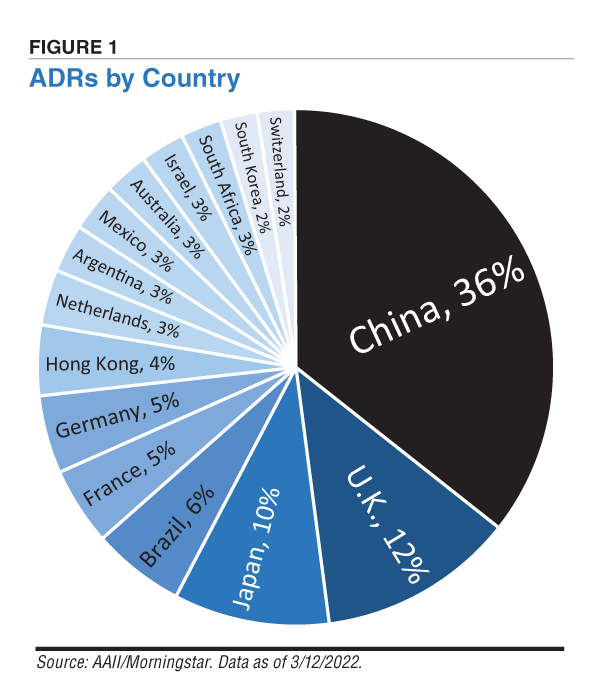
ADRs have generally been represented by the most widely held, actively traded non-U.S. issues and are mostly categorized as mid- and large-cap stocks. Bayer, Canon, Gucci, Honda, Nokia and Sony are just a few examples of prominent ADR issues (see Table 1).
TABLE 1. Top 25 ADRs by Market Capitalization
Information beyond what is presented in the regulatory filings may not be as easily accessible. Quarterly and annual earnings may be announced in the home country’s currency with different accounting methodologies used in press releases.
When looking at per-share data such as the earnings per share figure, you must determine if the figures are presented on the basis of the underlying common stock or the ADR. This becomes important when determining price-related ratios, such as the price-earnings multiple. ADR share prices need to be converted if the reporting basis is in underlying shares in order to calculate meaningful price ratios. The reporting of this data may vary between data vendors, so be sure to check this before making any assumptions.
Share statistics for ADR companies—including price-earnings ratios, earnings per share growth rates and shares outstanding—may be difficult to interpret unless you understand the per-share conversion ratio and the inconsistent reporting of quarterly financial statements.
The per-share figures for ADRs reported on AAII.com are calculated on a per-ADR basis. AAII members can use the AAII ADR screen to find potential candidates. The screen seeks ADRs that are trading at a discount to their projected growth and have above-average levels of relative strength (share price momentum).
A+ Investor subscribers can use the AAII Custom Stock Screener to identify ADRs with desired characteristics. Of the more than 500 ADRs included in the screener’s universe, about 25% are indicated as trading over the counter. The ADR screen also includes ADRs that trade over the counter.
Dispatches

Stock Strategies

AAII Stock Ideas

Ruth B from WI posted over 4 years ago:
Philip H from MI posted over 4 years ago:
DARYL R from CA posted over 4 years ago:
You need to log in as a registered AAII user before commenting.
Log InCreate an account