

Related

Investor Professor
Online Exclusive: Understanding Bond Yields

PRISM Wealth-Building Process
Uncertainty about future environmental regulatory changes is raising the perceived risk of bonds from issuers with poor environmental profiles or high carbon emissions.
by Jack Gilleland | July 2022

Uncertainty about future environmental regulatory changes is raising the perceived risk of bonds from issuers with poor environmental profiles or high carbon emissions. As a result, these bonds are assigned lower credit ratings and investors are demanding higher yields from them.
Researchers used two criteria to determine how the environmental profiles of corporations affected the perception of their credit risk. One was environmental, social and governance (ESG) from third-party ratings agency Sustainalytics. The second was carbon emissions data from the Carbon Disclosure Project (CDP). Companies were assigned a score of 0 to 100, with a higher numerical score indicating stronger environmental performance. Additionally, credit ratings were assigned on a range of 1 to 22. Each numerical value represented a specific Moody’s rating, with 1 matching the lowest rating of D and 22 matching the highest rating of Aaa.
Bond issuers with better environmental emissions scores tend to have stronger credit ratings. Specifically, an increase in an issuer’s environmental score of one point is associated with a statistically significant 0.027 increase in credit ratings (higher numbers indicate a better credit rating). The reverse is true for greater carbon emissions. A one-ton increase in carbon intensity per $1,000 of revenue decreases a firm’s credit rating by 0.514. The relationship signals pricing in of carbon risk by the bond markets.
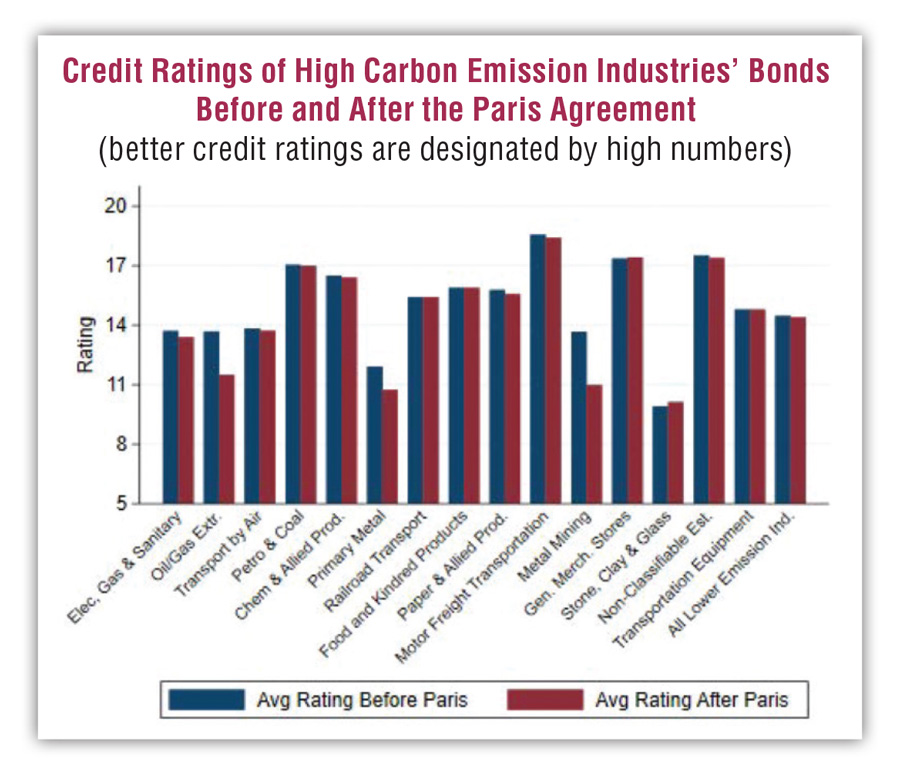
Following the 2015 Paris Climate Agreement, a significant increase in perceived regulatory risk for companies with high emissions was observed. Consequently, firms located in states that have more restrictive environmental procedures showed a more significant association with the trend of decreased credit ratings and increased spreads.
When examining corporate bonds, potential environmental risk is a concern to both credit ratings analysts and investors. Increased environmental regulation is associated with increased costs, and those who are deemed the worst offenders in terms of emissions are more likely to see those costs reflected in their bond prices.
Source: “Climate Regulatory Risk and Corporate Bonds,” by Lee H. Seltzer, Laura Starks and Qifei Zhu; National Bureau of Economic Research, 2022.
Investor Professor
PRISM Wealth-Building Process

MICHAEL H from FL posted over 4 years ago:
You need to log in as a registered AAII user before commenting.
Log InCreate an account