

Related

Portfolio Strategies
The ability to be comfortable with being uncomfortable can help you keep your emotional and mental health in check.
by John Deysher | August 2022

As a portfolio manager, it seems that pain is often a good indication of fruitful investing. Let me explain. We’ve had to endure the pain and discomfort of waiting for months or even years for our investment thesis to play out on stocks that turned out to be our biggest winners. The shorter-term pain that occurred before the big profits was often in the form of a falling share price. Conversely, ideas that we thought were slam dunks have often proved to be disappointing. We experienced very little pain but also had very little to show for our efforts in selecting and monitoring these stocks.
When we say pain, we’re referring to the discomfort associated with investing. This pain can be psychological, financial or both. The discomfort may surface when you are buying or selling. You buy a stock and despite your best efforts, the price declines, sometimes by a lot. Or you’ve got a winner that you sell, only to watch its share price continue to rise. Both may give an investor heartburn.
To be a successful investor, you must have the temperament to be a contrarian. You must buy low and sell high. Planting and harvesting sound easy, right? But we humans are herd animals, and we like the safety of a crowd. That makes it difficult to buy a stock when the consensus view is dismal or to sell when the consensus opinion is rosy. In today’s fast-paced investment world, the news changes continually and we all have instant access to 24/7 coverage. This sometimes accelerates our inclination to go with the crowd rather than think independently.
How can we make investing less painful, or at least learn to tolerate the pain? Here are my suggestions.
Investing is a marathon, not a sprint. It may often take time for your investment thesis to play out and there may be speed bumps along the way. Maybe two steps forward, one step back. Remember, Mr. Market is a voting machine in the short term but a weighing machine in the long term. If you believe your analysis is correct, don’t be stampeded out of a position just because the price falls.
Before you invest, learn as much about the company as possible. This should include understanding the bear case for the stock, meaning what might go wrong. Participate in earnings conference calls. Knowing your company well always gives you the conviction to hold on (or perhaps buy more) when the going gets tough.
Read third-party commentary and research too. If possible, bounce your ideas off like-minded investors. You can find other investors who follow the same stock on websites like Seeking Alpha as well as others. If many others share the same investment thesis as you do, your thesis may already be embedded in the share price. Contrarians seek out stocks whose potential upside has yet to be recognized by large numbers of other investors.
When we’ve completed our due diligence on a firm of interest, we’ll often establish a small, starter position. We’ll see how the shares trade, participate in quarterly conference calls and try to identify additional issues we may have missed. Likewise, when it comes time to sell, we’ll often start small and hopefully move the shares out at successively higher prices. Both approaches are less painful than buying or selling a full position immediately.
No investor can pick the bottom or top price, so a gradual approach often works best.
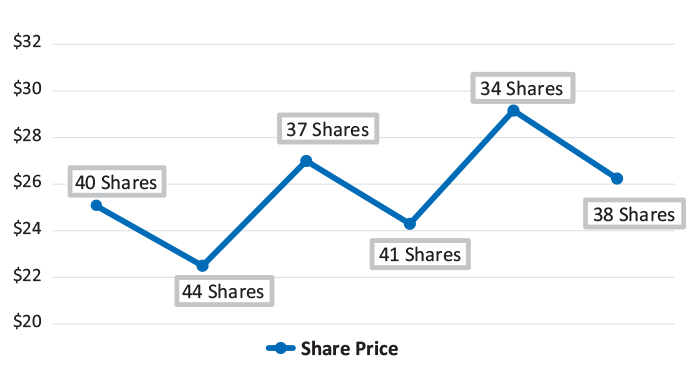
Once you have built a starter position, when should you add to it? We are big fans of dollar-cost averaging (Figure 1). Assuming no negative news, we generally add to our position in small increments to avoid moving the share price. We often use limit orders on the bid side and patiently wait for the share price to reach our limit. We may adjust the limit price up or down depending on how the firm’s fundamentals unfold.
Figure 1. Dollar-Cost Averaging
Dollar-cost averaging is the practice of investing equal dollar amounts over a period of time. In the example shown below, $1,000 purchases of a stock are made at different intervals. When the share price is higher, fewer shares are purchased. When the share price is lower, more shares are purchased. The same practice can be used for selling, with a portion of the position sold at various time intervals instead of the entire position being sold at once. In both cases, the risk of buying or selling at the wrong time is diminished. It also gives you the flexibility to change your opinion should new information come to light. An additional benefit is reducing the likelihood of moving the share price with your buy or sell orders when trading in a lower-volume stock.
Once a decision is made, many of us have trouble altering that decision when we discover we might be wrong. We’re committed to the decision even though it may not be right.
You buy a stock and the price declines. Why? New information that alters the outlook for the company or industry may have come out. A market decline that takes all stocks down occurs. Maybe there are just more sellers than buyers on a particular day. A declining stock price is not an automatic reason to sell. Rather, you will want to identify the reason and, most importantly, determine whether the issue is temporary or long-term. If you know your company well and believe the adverse situation is temporary, you might consider buying more shares. Some of our biggest gains resulted from temporary declines that allowed us to build a large position at favorable prices, which moved the needle when prices rebounded.
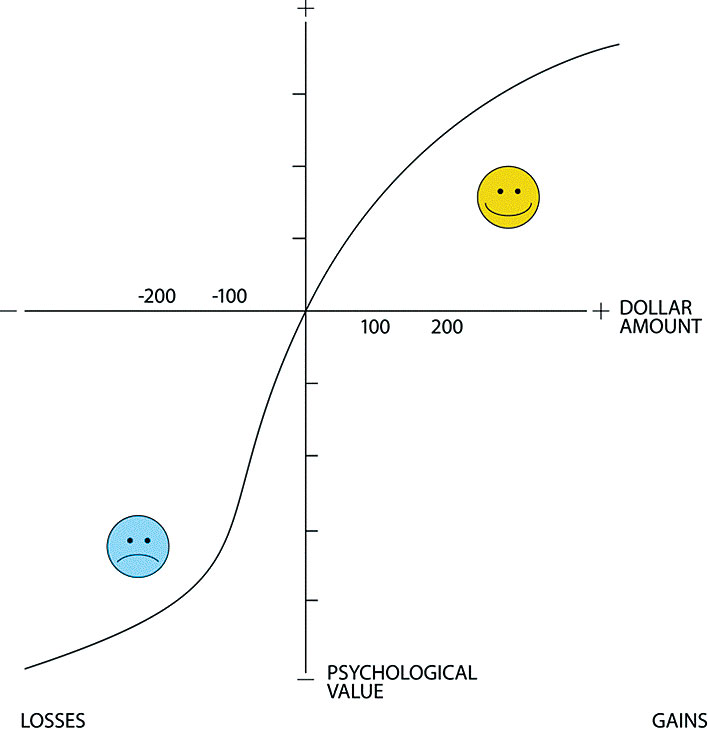
Figure 2. Risk Aversion Can Lead to Suboptimal Decisions
Prospect theory holds that humans overweight the probability of losing money relative to the same probability of making money. This can cause investors to make suboptimal decisions, and thereby realize lower portfolio returns by attempting to avoid or limit losses.
This often leads an investor to embrace one strategy above all others: Don’t lose money! This may cause an investor to sell immediately at the first sign of a loss or worse, to hold on blindly when the price declines in the hope of breaking even when it rebounds.
Holding a losing position is always challenging—what should you do? Generally, if something happens that seriously disrupts our thesis on a long-term basis, we’ll sell all or part of our position depending on its size. We can always revisit the investment later. However, if the price is down but the investment thesis remains intact, we’ll hold and perhaps buy more at bargain prices.
Investors often give more weight to the opinion of journalists and others than their own better judgment. Sometimes the talking heads are real authority figures: politicians, Federal Reserve officials, company executives, sports and entertainment figures. Try to understand their viewpoint and whether their statements are fact or opinion.
We once knew a portfolio manager who disliked meeting with executives whom he believed would always spin the company in the most favorable light possible. He preferred to get his information from independent sources and was quite a successful investor.
We’re always interested in what management has to say. We spend a lot of time formulating the proper questions to obtain the best information possible and then double-checking the answers.
Some of the more common biases that bedevil investors are listed in the box below. The more you are able to limit their impact when making investing decisions, the better your returns will be.
These common behavioral biases often bedevil investors and make it more difficult to deal with the pain of investing.
Confirmation Bias
This occurs when we embrace a narrative or rhetoric that confirms our thesis while ignoring the facts or evidence that challenge our thesis. Keep an open mind and always try to identify perception versus reality. You want to invest on the basis of facts, reasoning and logic and always be aware of events that may dissuade your thinking from these key tenants.
Loss Aversion Bias
For some reason, investors often find losses to be much more painful relative to the joy realized from a gain of an equivalent amount. Losing $100 feels twice as bad as gaining $100 as illustrated in Figure 2.
Recency Bias
Investors have a tendency to think what happened recently will continue to happen. Stocks that are going up will continue to go up while those declining will continue to fall. Past performance can be a strong driver of investor behavior—buying a particular stock, fund or asset class that’s gone up generally feels good, at least in the short term.
All of us are social animals and like to go to the most popular movies, concerts, restaurants or sporting events. This is fine when it comes to entertainment but applying the same behavior to investing can lead investors to buy when the market or a stock is high and sell when it’s low. So, before you take action on an investment, stop and assess whether the actions of others are right for you and only then proceed.
Disposition Bias
This occurs when an investor “disposes” of a winning position to make up for prior losses. This may result in taking a profit when it’s best to hold on. Assess each position independently. Take gains if necessary for good reasons, but don’t focus on taking gains just to offset losses especially since those losses can be used to offset other income for tax purposes.
Familiarity Bias
Investors commonly exhibit a preference for familiar or well-known investments while ignoring unfamiliar investments beyond their comfort zone. While it’s important to stay within one’s circle of competence, it’s also important to stay open to new ideas.
Our universe of potential investment ideas is probably a couple hundred firms—all of which we would purchase at the right price. We are very familiar with each company on the list, but that doesn’t stop us from looking at unfamiliar names that come to our attention. Often, after proper due diligence, we understand these unfamiliar names and they are added to our universe with the intention of placing them in the portfolio under the right circumstances.
Anchoring Bias
This is our tendency to rely heavily on or anchor to a past reference or piece of information in making a decision. Perhaps an investor has an emotional tie to a certain stock that was received as an inheritance, gift or employment benefit. While the emotional bond may be strong and the tax basis low, investors should carefully monitor such positions to avoid unpleasant “surprises.”
For some investors, an obvious anchor is the share price. An investor sitting on a loss may vow to sell as soon as the share price returns to breakeven. By doing so, they give up further gains as the share price moves higher.
Alternatively, an investor may refuse to buy until the price returns to a prior low and completely misses the upside when the stock doesn’t retest the bottom. Remember, the past share price provides no indication of whether the stock is currently a good value. Only the current share price compared to company fundamentals will tell you that.
Hindsight Bias
Our tendency to brood over past losses can often prevent us from objectively analyzing opportunities going forward. We all make investing mistakes. The important thing is to learn from what we did wrong and move forward. While we often analyze our mistakes to pinpoint what went wrong, dwelling on past losses is counterproductive.
Oversimplification Bias
Most investors want a clear and simple explanation of why to buy a stock. Unfortunately, it’s not always so easy. Modern life is increasingly complex and so is investing. Complexity and uncertainty are part of investing. It’s important not to oversimplify or rationalize the decision in order to justify an investment.
Sometimes an idea is just “too hard” to understand. In such cases, we won’t waste time trying to do so. However, one of the joys of security analysis is learning new things and we relish every opportunity to do so.
Availability Bias
Investors often misjudge risks when they rely too heavily on readily available information and underweight the importance of information that isn’t readily available. The internet has made reams of data publicly available, some of it true, some not. Just because you saw it on the internet does not make it true. Check the source. Ask whether it is reputable.
We always try to prioritize true information that is fresh in our mind over information we learned a while ago that we thought at the time was highly relevant. Perhaps it is still relevant but needs to be augmented with more recent information to provide a more accurate picture. We always try to filter out the “noise” to focus on what is knowable AND important.
Action Bias
Most of us are wired for action and sitting on our hands often makes us feel uncomfortable. This often leads us to embrace what’s trending rather than what’s a good value. Resist making portfolio changes just to act, do your homework and invest in companies that you know well for the long term.
Hopefully, these suggestions will help you avoid or at least minimize the pain that sometimes goes with investing. The ability to be comfortable with being uncomfortable can help you keep your emotional and mental health in check. The Navy SEALs, Army Rangers and other special operations forces are trained to deal with being wet, cold, tired and hungry. While they don’t enjoy being uncomfortable, learning how to deal with it leads them to make better decisions. The same holds true for investing. Investors who learn how to embrace the “pain” of investing tend to make better decisions and realize better results.
Portfolio Strategies

Beginning Investor


BARRY J from TX posted over 4 years ago:
Ethan A from NC posted over 4 years ago:
You need to log in as a registered AAII user before commenting.
Log InCreate an account