

Related

AAII How-To
Comparing Funds That Track the Same Index

Level3 Passive Portfolio
Passive funds tracking market-capitalization-weighted indexes like the S&P 500 index generally buy high and sell low as they attempt to mimic changes made to the index.

Passive funds tracking market-capitalization-weighted indexes like the S&P 500 index generally buy high and sell low as they attempt to mimic changes made to the index.
This trading can lead to tracking error, which is the difference between a fund’s returns and the index’s returns. Tracking error can be positive (better returns than the index) or negative (worse returns).
Seeking alternatives to this buy high/sell low phenomenon, researchers proposed three strategies: Trading ahead of index funds, delaying fund reconstruction by three months to 12 months, or straying away from direct replication of an index fund.
During the period of October 1989 to June 2021, stocks added to the S&P 500 outperformed by 46.5%, on average, in the 12 months leading up to the index announcement date. Stocks removed from the index trailed the index by an average of 36.3% over the same period. Fund managers who could trade the shares of the discretionary deletions on the day after the announcement would have gained a 12-basis-point (0.12%) advantage over the S&P 500.
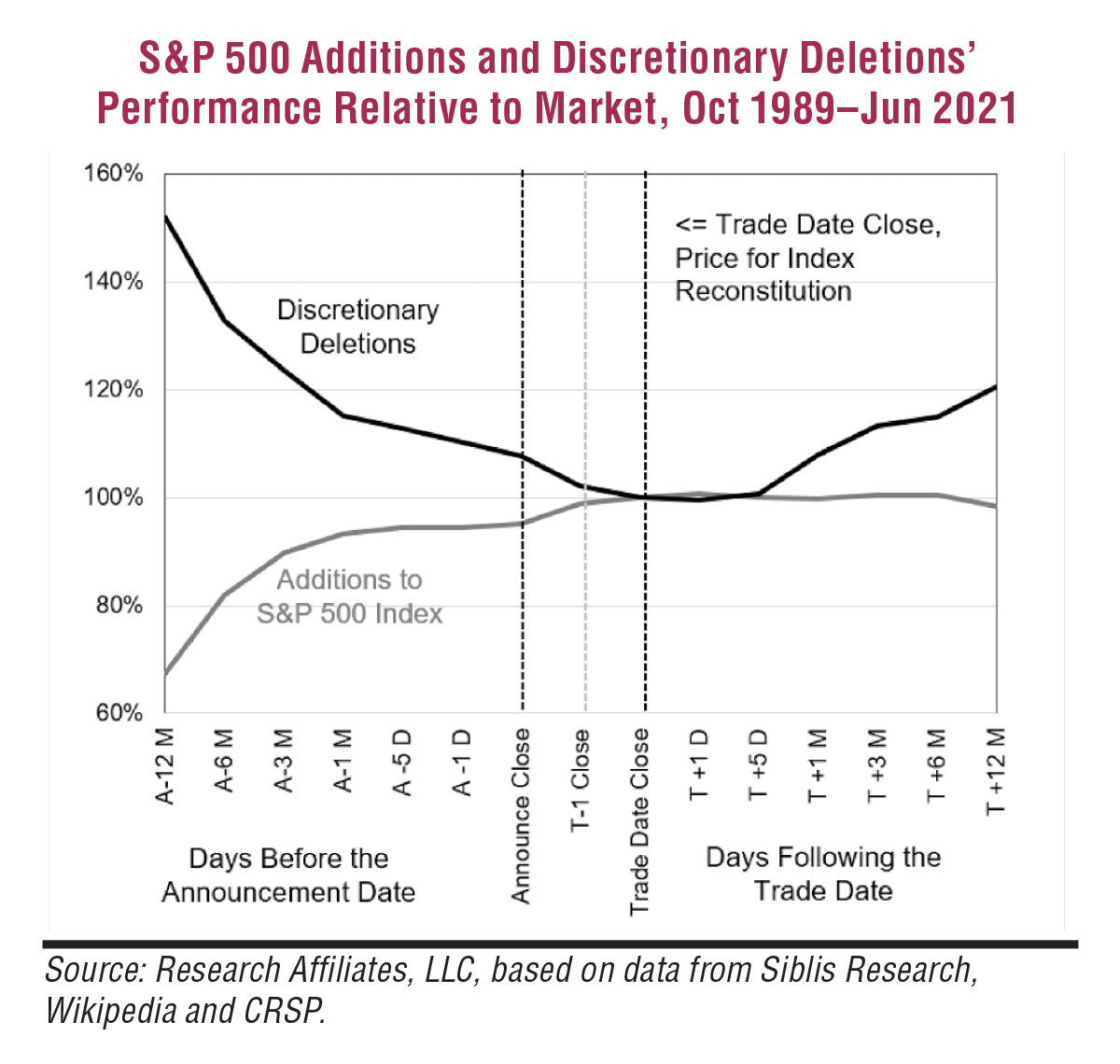
Another strategy involves delaying a portfolio change until three months and 12 months after the index announcement. This strategy outperforms the S&P 500 by 13 basis points (bps) and 23 bps, respectively. By not tracking the index fully, the fund is able to avoid the buy high/sell low phenomenon.
The third strategy is cap-weighting stocks based on fundamental size. Fundamental size is “a blend of company book value adjusted for intangibles, past five-year-average sales adjusted for company debt-to-asset ratio, past five-year-average cash flow adjusted for company R&D expenses and past five-year-average of dividends plus share repurchases, each measured as a percentage of the publicly traded universe.” Such a strategy would have outperformed by 46 bps.
Source: “The Avoidable Costs of Index Rebalancing,” by Rob Arnott, Chris Brightman, CFA, Vitali Kalesnik, Ph.D., and Lillian Wu; Research Affiliates, 2022.
AAII How-To
Level3 Passive Portfolio


Greg F from AR posted over 4 years ago:
You need to log in as a registered AAII user before commenting.
Log InCreate an account