

Related

AAII How-To
The choices you make regarding how often you want to invest and what you want to invest in should all lead you to the same conclusion.
by Anine Sus | March 2024

Before you put your money into an investment, you must know why you want to invest, what you want to invest in and how often you want to add money to your portfolio. The way you invest must be as unique as you are, and all these decisions have to come from you, acting as your own portfolio manager. Your answers to these questions will help you shape your investing strategy.
Are you someone who puts away a certain amount in savings every month through your budget? If so, you may want to consider dollar-cost averaging as part of your investing strategy. The process involves regularly adding a specific amount of money to your investment account and putting it right to work over a period of time. Most typically, the contributions are distributed according to a set allocation. Advantages of dollar-cost averaging include a lower per-share cost over time, reduction of timing risk and protection from fluctuating prices. The idea is that the more you regulate your investing approach, the less you are thinking about it. Dollar-cost averaging also commits you to your strategy regardless of how the market is performing.
Lump-sum investing is generally a better-performing strategy, but it’s best to still have a disciplined schedule in place for accumulating and then allocating your investment funds when they are ready. According to Vanguard, lump-sum investing outperforms dollar-cost averaging 68% of the time. Personally, I try to amass $2,000 chunks in one of my high-yield savings accounts before investing that amount by dividing it equally among my holdings. One risk with lump-sum investing is that you could put a large amount of money into your investments during a time when the market is experiencing downward volatility; you may lose more than you would if you had built up your portfolio’s value slowly over time.
If you want to think less about when to invest and just invest your money consistently on more of an automated basis, dollar-cost averaging might fit the bill. If you want to generate a certain amount of money and have that be your signal to allocate it to your investment account on a semiregular basis, lump-sum investing might be more your speed. Ultimately, it depends on how your brain works and how manually involved you want to be in your investing process.
Like everything in this life, investing isn’t free. Even your investments come with a little extra cost on top of the share price. An easy way to avoid heavy fees is to invest in index mutual funds and exchange-traded funds (ETFs). An index fund follows a passive investment strategy by tracking the performance of an index such as the S&P 500 index. Because the fund’s portfolio is determined by the stocks that make up the index, no one is actively selecting investments for the fund, which leads to less turnover and lower transaction costs.
You do have some control over expense ratios when choosing your investments. You can use AAII’s stock screens to find stocks and the mutual fund and ETF guides to find funds with low expense ratios for their category as a first step. If you buy a fund with an expense ratio of 1.00%, you are paying $10 for every $1,000 invested each year you hold the fund. Investing in any security with an expense ratio above 1.50% is basically like giving your money away, so it’s best to be picky and find something that will be cheaper to hold in your portfolio.
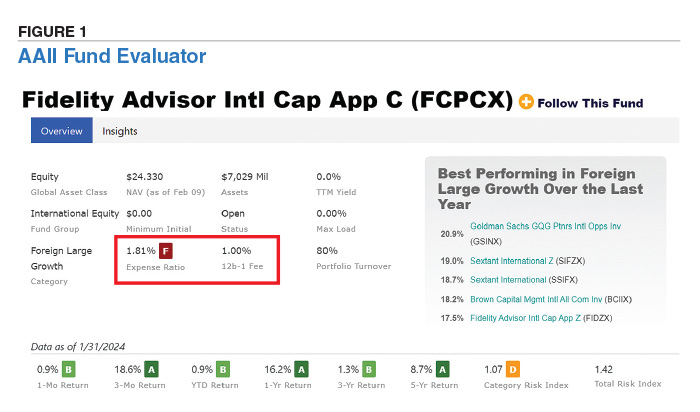
If you are investing in mutual funds, be wary of 12b-1 fees. A 12b-1 fee is an annual operational fee charged for marketing and services and is usually 1.00%—the maximum allowed. If the fund you are looking at charges a 12b-1 fee, check to see if it is separate from the expense ratio. We use Morningstar’s data, which separates the 12b-1 fee from the expense ratio. AAII’s Fund Evaluator page shows a fund’s 12b-1 fee right next to the expense ratio to make it easier to add up the fees (Figure 1).
Transaction costs have largely been reduced in recent years, but they’re still out there ready to take your money if you’re not careful. Transaction costs include broker commissions, taxes and the bid/ask spread. The bid/ask spread represents the difference between the price at which a stock or ETF can be sold and the price at which it can be bought. This fluctuates throughout the trading day, so to limit your transaction costs you can enter a limit order at a price in between the bid and ask prices. A limit order locks in the highest price you are willing to buy or the lowest price you are willing to sell the security at. It’s especially helpful if the investment has a large bid/ask spread.
If you’re going to be a profitable beginning investor, there are some types of investments you’ll want to run far away from. Investments with high fees include actively managed funds, derivatives and investments in obscure asset classes.
Actively managed funds usually have higher expense ratios to pay their portfolio managers. Investors should expect a higher return on their investment to compensate for the costlier expense ratio and any other fees. In addition, taxes can be higher on actively managed funds due to more portfolio turnover.
A derivative is a contract valued by its underlying asset. Common types of derivates are options and futures. An option represents the contract owner’s right to buy or sell a security at a specific price during a period of time. A future is similar to an option but requires that cash or the physical commodity underlying it, such as oil, be delivered at expiration. Derivatives are both complex and risky investments, making them dangerous to beginners. When options were first described to me at AAII, I knew immediately that I would never want to invest in them. The main risk of investing in options is that most expire worthless, often in a matter of months. Even trying to explain options as simply as I can makes my head hurt, which is a sign that I still shouldn’t go anywhere near them!
Securities in obscure or alternative asset classes like cryptocurrency, commodities, precious metals and private equity are considered risky investments for beginners due to less regulation, lack of liquidity and/or the investment vehicles used to get exposure to them. Generally, you are better off finding a mutual fund or ETF that invests in one of these asset classes as part of its strategy instead of trying to directly invest in them. Do so at your own risk!
Now that you know what’s fit for beginners, what do you feel comfortable investing in? Your answer to this question should also align with why you are investing in the first place.
If you’re investing for a luxurious retirement, keeping fees low and returns high over a long time period by investing in an index fund might be the way to go. Some investors describe this investing method as “boring,” but it has proven its historical outperformance of the market. If you’re more interested in selecting individual stocks, you will need to spend a lot more of your free time analyzing and monitoring them like the portfolio manager of an active fund. Either way, be sure to save in a disciplined manner even if you opt for lump-sum investing over dollar-cost averaging.
The most important part of building the foundation for your investing strategy is being disciplined enough to follow your plan. A strategy that you think sounds good but doesn’t mesh with how you manage your life will be difficult to stick with when the market takes a turn and you’re not prepared.
The choices you make regarding how often you want to invest and what you want to invest in should all lead you to the same conclusion. But if you find yourself wanting to change direction further down the line in your investing journey after you have learned more, there’s nothing wrong with trying out something new.
AAII How-To

AAII How-To

Beginning Investor

ROBERT A from NC posted over 2 years ago:
Peter N from TN posted over 2 years ago:
LISANNE P from OR posted over 2 years ago:
You need to log in as a registered AAII user before commenting.
Log InCreate an account