



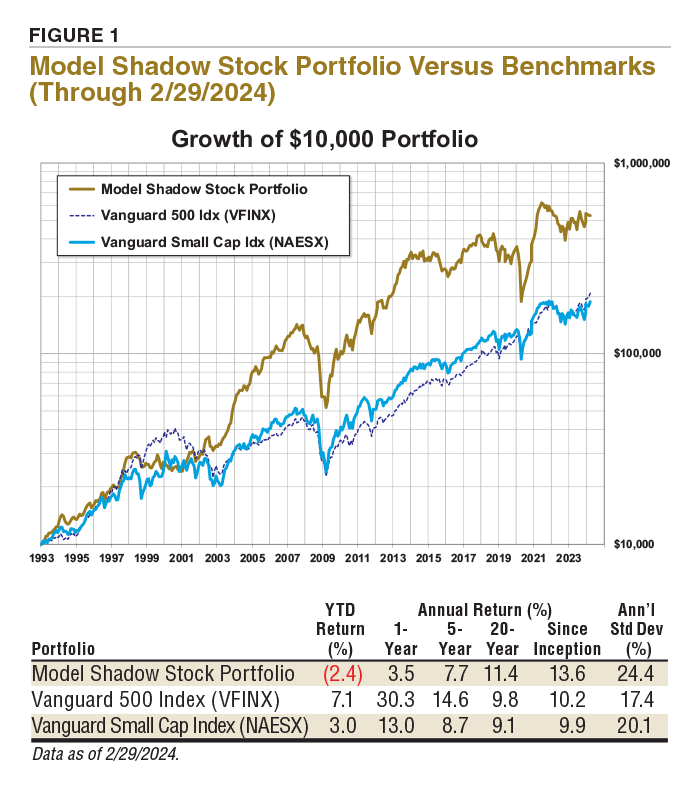
Investor sentiment continues to be positive, with interest primarily focused on growth-oriented companies. The Vanguard 500 Index fund  (VFINX) is up 7.1% year to date while the Vanguard Small Cap Index fund (NAESX) is up 3.0% for the year. The DFA U.S. Micro Cap fund (DFSCX) is up 0.5% during the first two months of the year, while the Model Shadow Stock Portfolio is down 2.4% year to date.
Growth segments performed better than value-oriented stocks. In the large-cap segment, growth stocks are now up 10.4% for the year while large-cap value stocks are up 3.4% year to date.
In the mid-cap segment, mid-cap growth stocks are up 9.3% for the year while value stocks are down 1.2% year to date.
Small-cap growth stocks are up 1.6% year to date, while small-cap value stocks are down 3.1% for the year.
Small-cap stocks remain attractively priced relative to large-cap stocks. The median price-to-book-value (P/B) ratio of the companies in the S&P SmallCap 600 index is 1.75, well below the 3.49 median price-to-book ratio for the companies in the S&P 500 index. The S&P SmallCap 600 normally trades at a discounted multiple relative to the S&P 500. The discount has averaged 0.66 since 1998 and is currently 0.50. The stocks in the Model Shadow Stock Portfolio are even cheaper, with a median price-to-book value of 0.92.
Since its inception in 1993, the AAII Model Shadow Stock Portfolio has a compound annual average return of 13.6% versus the Vanguard 500 Index fund’s gain of 10.2% per year on average over the same period. Over the same period, the Vanguard Small Cap Index fund posted an average annual gain of 9.9%. Figure 1 shows performance over other time periods.
First-Quarter Review & Changes
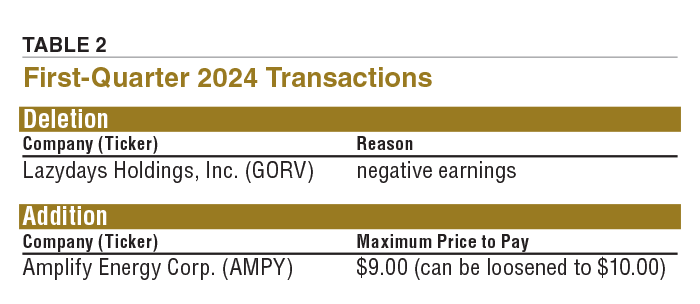
Table 1 shows the stocks currently making up the model portfolio. After conducting the quarterly review of the portfolio, there is one deletion and one addition to the Model Shadow Stock Portfolio, as summarized in Table 2.
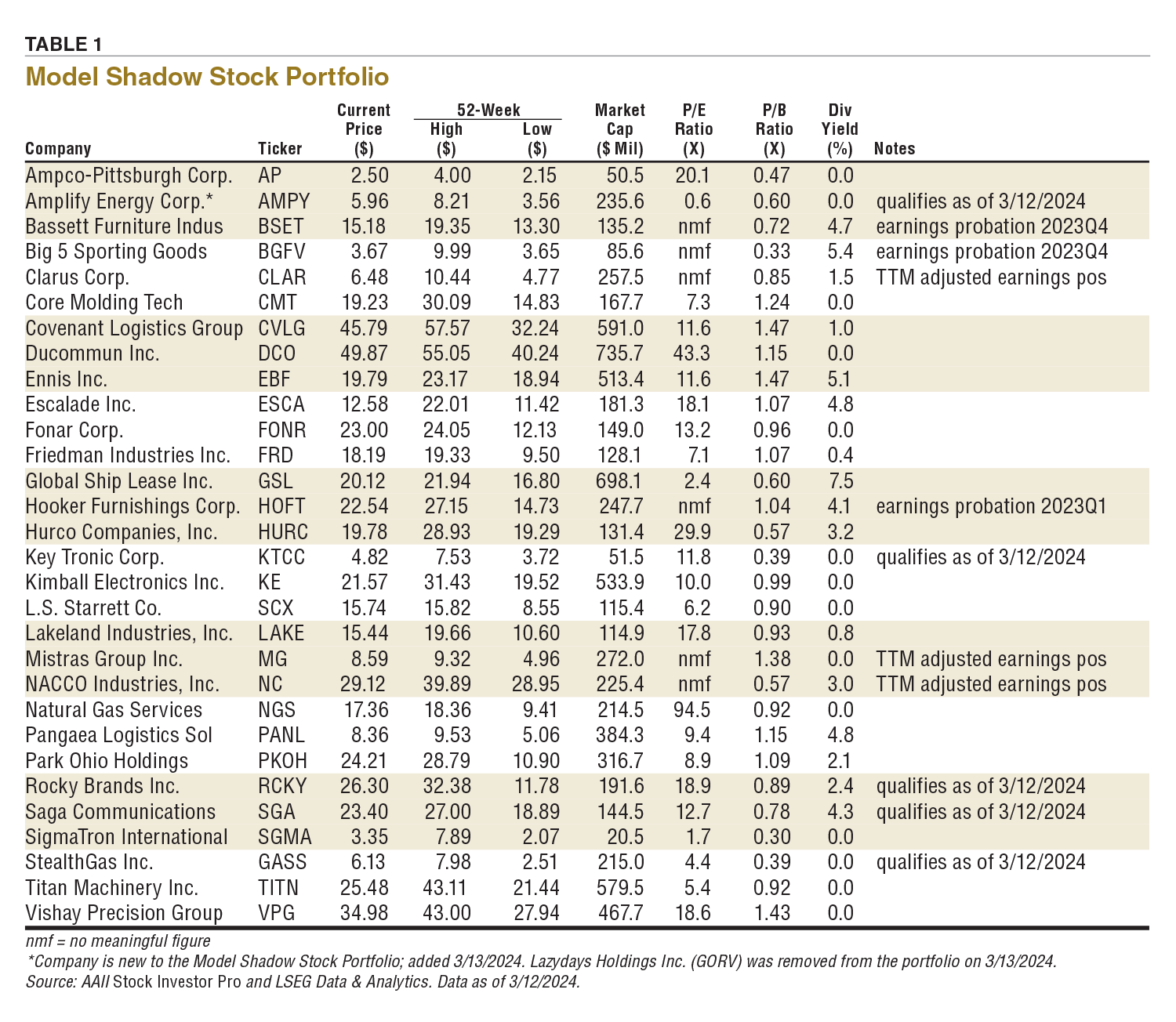
Approaching Size Limit: Stocks are sold if their market capitalization goes above three times the initial maximum criterion and there is a stock to replace it. The current market capitalization maximum for initial screening is $300 million. Stocks are marked “approaching size limit” if their current market cap exceeds 2½ times the initial criterion, or $750 million.
Approaching Value Limit: Stocks are sold once their price-to-book-value ratio goes above three times the initial criterion and there is a stock to replace it. The current initial price-to-book ceiling is 0.90. Stocks are marked “approaching value limit” if their current price-to-book-value ratio exceeds 2½ times the initial criterion, or 2.25.
Earnings Probation: If last 12 months’ earnings are negative, the stock is put on probation; if a subsequent quarter has negative earnings prior to 12-month earnings becoming positive, the stock is sold. When available, adjusted (non-GAAP) earnings are used to put stocks on probation or sell them. Otherwise, earnings from continuing operations are used. The date is the calendar quarter during which the company first reported negative trailing 12-month earnings.
Qualifies as of: Stock still qualified as a buy when the screen was run with current data. Stocks that don’t currently qualify as a buy are held until they meet one of the sell rules.
TTM Adjusted Earnings Positive: Trailing four-quarter GAAP earnings are negative, resulting in no meaningful figure for the price-earnings ratio. However, adjusted earnings for the period are positive.
The primary Model Shadow Stock Portfolio selection criteria target the intersection of the smallest 10% of domestic stocks as measured by market capitalization, along with the “cheapest” 10% of domestic stocks as measured by the price-to-book ratio. These decile breakpoints are determined by examining domestic companies that are listed on the New York Stock Exchange (NYSE) and then applying the size and value breakpoints for stocks listed on all domestic exchanges. This 1% intersection (10% and 10% combined) constitutes the primary initial selection universe.
The Model Shadow Stock Portfolio is reviewed quarterly to determine portfolio deletions and additions. The quarterly review cycle is tied to the reporting cycle of most firms and limits costly portfolio turnover. AAII’s fundamental stock screening and research database Stock Investor Pro, with data as of March 8, 2024, was used for the market decile analysis.
Value
The price-to-book cutoff has increased slightly from 0.81 in December to 0.84. The current initial qualifying maximum price-to-book ratio is 0.90 and we left it unchanged. Qualifying stocks must have a price-to-book ratio of 0.90 or lower when added to the model portfolio. As of March 8, there were 1,229 exchange-listed securities with a price-to-book ratio less than or equal to 0.90. Stocks in the model portfolio are removed for valuation if they exceed three times the initial maximum price-to-book ratio at the time of a quarterly portfolio review.
Covenant Logistics Group Inc. (CVLG) and Ennis Inc. (EBF) have the highest price-to-book ratio of 1.47 in the model portfolio. No stocks in the model portfolio exceeded the maximum price-to-book ratio at the time of review.
Size
We examined the market-cap levels of domestic companies listed on the NYSE to determine the size cutoff for the lowest decile when adding stocks to the model portfolio. The lowest decile market-cap level increased from $267 million in December 2023 to $297 million using data in Stock Investor Pro as of March 8, 2024. We left the maximum initial qualifying market-cap value unchanged at $300 million. There were 1,460 exchange-listed securities with a market cap between $30 million and $300 million as of March 8. Holdings are removed if their market cap goes above three times the initial criterion at the time of the quarterly review.
Ducommun Inc. (DCO) has the largest market cap of $735.7 million in the model portfolio. No stocks in the model portfolio exceeded the maximum market cap at the time of review.
Earnings
The other major factor that leads to portfolio turnover is tied to negative earnings. If a company reports trailing 12-month earnings from continuing operations that are negative, the stock is placed on probation; if a subsequent quarter has negative earnings prior to trailing 12-month earnings becoming positive, the stock is removed.
All publicly traded U.S. companies are required to report earnings based on generally accepted accounting principles (GAAP). Companies may also report non-GAAP earnings, as long as they provide GAAP numbers too.
When available, adjusted (non-GAAP) earnings are used to put stocks on probation or delete them. These are earnings that are reported in the media and have been adjusted to eliminate the impact of nonrecurring events such as markdown of inventory or goodwill. The LSEG I/B/E/S adjusted earnings reported in Stock Investor Pro are used for Model Shadow Stock Portfolio decisions when they are available. Not all of the stocks in the Model Shadow Stock Portfolio are followed by analysts, for those companies we use the diluted normalized earnings per share as calculated by LSEG Data & Analytics. Diluted normalized earnings per share represent the bottom-line earnings available to common stockholders, excluding the effects of all nonrecurring/unusual/one-off/extraordinary items, adjusted by the effects of dilution. This value is adjusted by minority interest, equity in affiliates, the U.S. GAAP adjustment, preferred distributions and all other adjustments to earnings per share.
Lazydays Holdings Inc. (GORV) and Hooker Furnishings Corp. (HOFT) were on earnings probation at the start of the latest earnings season.
Hooker Furnishings has been on earnings probation since the first quarter of 2023. While it reported positive quarterly earnings in July and December, its trailing 12-month earnings are still in the red as of March 8 and the company remains on earnings probation.
Portfolio Deletion: Lazydays Holdings, Inc. (GORV)
Lazydays Holdings has been on earnings probation since it reported a third-quarter 2023 loss of $0.48 per share, which pushed its trailing 12-month earnings into the red. Lazydays Holdings reported a fourth-quarter 2023 loss of $1.09 per share on March 8, 2024. It is the policy of the Model Shadow Stock Portfolio to remove a stock once its trailing 12-month adjusted earnings go negative and the company reports a subsequent quarterly loss while trailing earnings are still negative.
Lazydays Holdings operates recreational vehicle (RV) dealerships and offers a portfolio of products and services for RV owners and outdoor enthusiasts. After strong sales during the pandemic, demand has slowed recently, and financing costs for customers have increased along with higher interest rates. The company increased its marketing budget last year and aggressively discounted prices in 2022 and 2023 to reduce its amount of aging inventory. While the company anticipates returning to positive earnings for full-year 2024, the stock meets the negative earnings deletion rule.
Lazydays Holdings is being removed from the portfolio due to negative earnings. Lazydays Holdings was added to the Model Shadow Stock Portfolio on December 12, 2022, at a price of $13.98 per share. It was deleted on March 13, 2024, at $4.61 per share, for a loss of 67%.
Quarterly Addition
Running the numbers, 14 stocks met the initial selection criteria for the Model Shadow Stock Portfolio as of March 12, 2024, down from 19 one month ago. AAII members can see and research which companies are currently passing the initial selection criteria in the Shadow Stock Ideas table on AAII.com. The list of Shadow Stock Ideas is updated daily—Tuesday through Saturday.
Four qualifying stocks were already in the Model Shadow Stock Portfolio at the time of the review. The remaining 10 stocks were examined to ensure adequate liquidity, timely financial filings and appropriate industry and foreign considerations. The Shadow Stock Portfolio Rules on AAII.com provide guidance on factors to consider when selecting stocks for your portfolio.
With the proceeds from removing the stock, as well as the cash held in the portfolio, one stock was added at roughly the average position size for the existing holdings in the tracking portfolio.
Amplify Energy Corp.
Amplify Energy Corp. (AMPY) is an independent oil and natural gas company engaged in the acquisition, development, exploration and production of oil and natural gas properties in the U.S. Amplify Energy’s operations are focused in Oklahoma, the Rockies (Bairoil), federal waters offshore Southern California (Beta), East Texas/North Louisiana and the Eagle Ford Shale Basin. Amplify Energy is headquartered in Houston, Texas, and its properties consist of mature, legacy oil and natural gas fields.
Amplify Energy has a book value per share of $10.00 as of December 31, 2023. If you wish to stay within the 0.90 price-to-book maximum, you should pay no more than $9.00 per share ($10.00 (AMPY) 0.90). However, if the stock price has moved up after being added to the portfolio, you can still purchase the stock unless the price-to-book ratio goes above 1.00, which equates to a price of $10.00 per share. To calculate the maximum purchase price based on the maximum desired price-to-book ratio, multiply the current book value per share ($10.00 for Amplify Energy) by the maximum price-to-book ratio to be considered for the Model Shadow Stock Portfolio (currently 0.90, or 1.00 for loosened consideration).
Next Portfolio Review
The next quarterly review of the AAII Model Shadow Stock Portfolio will take place around the beginning of June 2024, after most of the holdings have announced their quarterly earnings. Any changes to the portfolio will be announced at the time they are made in a special Model Shadow Stock Portfolio Update email (sign up at www.aaii.com/email).
Discussion
FREE REPORT

EDWIN W from PA posted over 2 years ago:
JEAN H from IL posted over 2 years ago:
You need to log in as a registered AAII user before commenting.
Log InCreate an account