

Related

Financial Planning
The Importance of Considering Marginal Taxes When Taking Withdrawals

Retired Investor
The consequence of ignoring taxes in a tax-deferred portfolio is holding an unintentionally riskier portfolio.
by Grace Malone | April 2024

The consequence of ignoring taxes in a tax-deferred portfolio is holding an unintentionally riskier portfolio.
Two researchers observed that the values of a dollar in a traditional IRA, a Roth IRA and an ordinary taxable account are not always equal. The tax properties for these accounts when assets are invested and withdrawn are different. The aftertax value of holdings inside traditional IRAs is less than the aftertax value of holdings in Roth IRAs or recently purchased assets in taxable accounts.
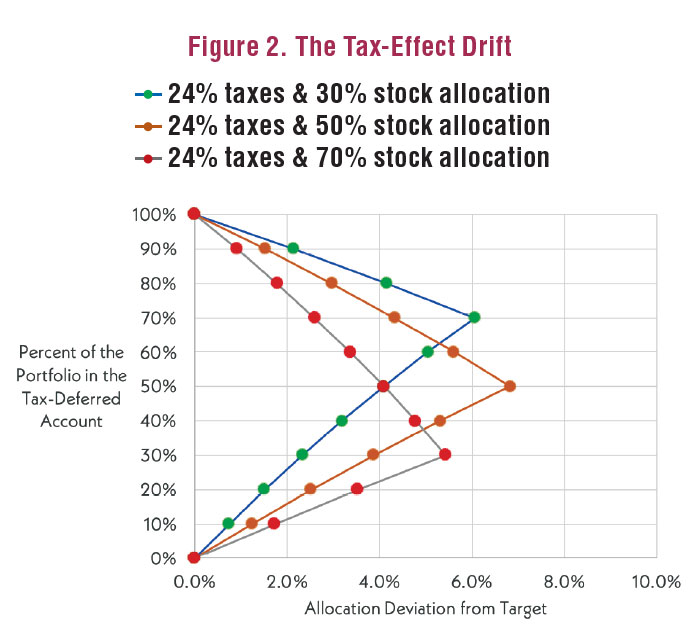
They note that the difference between aftertax asset allocation and standard, tax-blind asset allocation can be quite large. Assuming a 40% tax rate, a 60% stock/40% bond allocation with the stock portion in a traditional IRA is actually a 50%/50% stock/bond allocation after taxes. The researchers call this aftertax affect the tax-effect drift (Figure 2).
These observations led the researchers to develop artificial aim-points that adjust a target allocation for an aftertax setting. The metaphor of Kentucky windage is used to describe these adjustments. Windage is the practice of adjusting a rifle’s aim-point left or right to account for a crosswind that causes horizontal motion. Similarly, by setting an artificial pretax asset mix, the portfolio is able to achieve the target asset mix after taxes.
Source: “Kentucky Windage for Asset Allocation,” by William Jennings and Brian Payne; SSRN, January 15, 2024.
Financial Planning
Retired Investor


DAVE G from TX posted over 2 years ago:
ROBERT A from NC posted over 2 years ago:
You need to log in as a registered AAII user before commenting.
Log InCreate an account