

Psychological Factors Strongly Influence the Timing of Social Security Benefits

Feelings of ownership and loss aversion drive many to claim their Social Security benefits early, despite the economic benefits of delaying claims to maximize payouts.

Feelings of ownership and loss aversion drive many to claim their Social Security benefits early, despite the economic benefits of delaying claims to maximize payouts.

Researchers utilized a combination of psychological assessment and experimental manipulation techniques to explore what affects Social Security claiming intentions. The study targeted those approaching retirement age or making decisions about retirement, using questionnaires to measure the respondents’ feelings of loss aversion and entitlement to their Social Security benefits. Informational displays called “nudges” were presented illustrating the long-term benefits of delaying the start of benefits to test whether clearer information could lead individuals to make financially optimal claiming decisions.
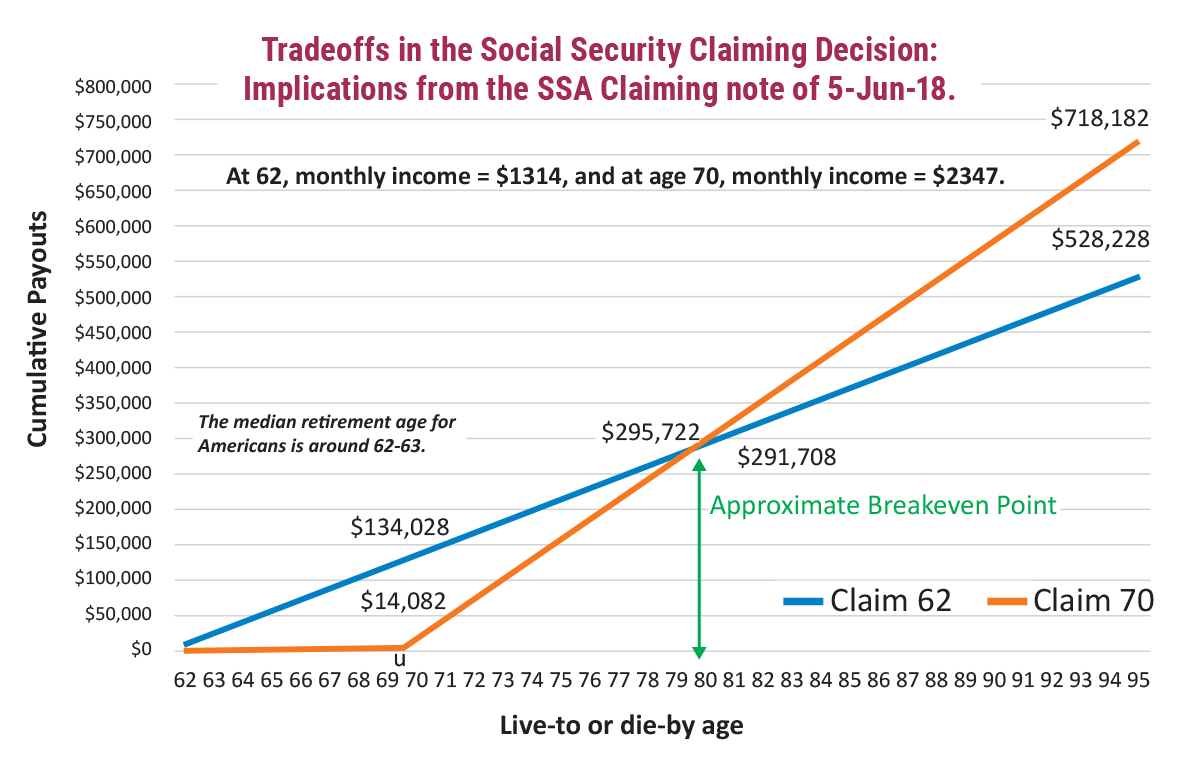
Tradeoffs in the Social Security Claiming Decision: Implications from the SSA Claiming note of 5-Jun-18.

The findings revealed a strong influence of psychological factors on claiming decisions. Individuals feeling a strong sense of ownership to their Social Security benefits tended to start claiming earlier, driven by a desire to quickly access what they perceived as their own assets. Those with high levels of loss aversion often claimed benefits at the earliest opportunity to ensure financial security.

The interaction between loss aversion and informational nudges was notable. The nudges—intended to emphasize the advantages of delaying Social Security claims—prompted earlier claiming, particularly among more loss-averse participants. This suggests that the displays might have emphasized immediate access to funds, triggering a protective response among loss-averse individuals.

This research underscores the significant influence of psychological factors and the occasionally counterproductive effects of well-intentioned informational framing. Tailoring communication strategies to individual psychological tendencies may guide more effective financial choices.

Source: “Social Security Claiming Intentions: Psychological Ownership, Loss Aversion, and Information Displays,” by John W. Payne and Suzanne Shu; National Bureau of Economic Research, July 2023.

Discussion

ROBERT A from NC posted over 2 years ago:

I've decided to take my SS when I turn 65 and go on Medicare. To me, it makes more sense to have a little extra cash while I'm still young enough to enjoy it. By the time I reach my "breakeven" point, I might be unable to do the things I now enjoy. I might even be dead by then. My view is not based on mere "feelings." It's a rational analysis.


JOHN B from OH posted over 2 years ago:

I don't see any indication of what the age 62 retiree has done with the $134000 he received from SS until he reached age 70. What if he invested and received 10%, about the average return of a broad based stock index fund. The breakeven point would be pushed far to the right.


RANDY K from FL posted over 2 years ago:

Health issues need to be mentioned in this discussion: smoking, obesity, high blood pressure, cholesterol, diabetes, lack of exercise...make it hard to make that 80 yr breakaway point. Physical therapists say anyone who takes 3 more more prescription medicines are at a greater risk of falling.


CHARLES F from MA posted over 2 years ago:

The breakeven point can be pushed out by two other factors. First, a discount rate should be applied to the cash flow. Second, reduced ordinary income puts many retirees in a tax sweet spot until the ordinary income of RMDs come into play. Some one who retires and collects at 62 could have ten years of very low taxes rates applied to the SS Benefits while the counter part who collects at 70 receives only 2 or three years of lower rates.


BARRY J from TX posted over 2 years ago:

I pile on the above observations of my fellow AAIIers and add a few more. #1 The research quoted UNDERSHOOTS the average investing IQ of the AAII audience by about 18 years and over 50 points on a 0-100 investing knowledge scale. I will add a few more comments on the graphic provided on page one. #2 We don’t know what the SSA Claiming Note 06/05/18 says. I have to assume it effects are neutral to the curve in the graphs. So, I ignore it. #3 Most people age 28 years from age 62 to age 90, which is the basis for the LOWER projected flat “curve” to the higher projected returns for delaying SSI claims to age 70, an 8-year forbearance, which produces HIGHER returns at age 95, which is 25 years after age 80. Thus, we have a significant time factor (25 vs 33 years) that increases the difference in the projections. #4 The key to the graph is the age 80 “breakeven point.” At age 80, the age 62 retirees and the age 70 retirees have received approximately the same total amounts of SSI compensation to date at approximately $293K. #5 The “flat curves” have uniform rates of increase but have different slopes. The age 70 curve slope is steeper because age 70 retirees receive higher monthly/annual SSI income amounts. #6 With these data points, we can guestimate that the $4,014 annual difference @ age 70 contributes about $100,350 to the total age 95 difference in total return @ $143,636. #7 This $100,350 represents 69.8% of the $143,636 total compensation at age 95. #8 Thus, the TOTAL difference in SSI compensation over 33 years is the residual 30% (the $143,636 above) … or $ #4,352.60 per year … or $ 362.71 per month … or $12.09 per day … or $1.51 per hour for an 8-hour work day. #9 Based on my application of 5 minutes of public school 3rd grade math, I am not certain how important this research is to AAII members decisions. #10 The “research” focuses on a limited set of psychological factors proposed by behavior economists - loss aversion, entitlement, and nudges -- as the idiosyncratic (”individual”) factors in play here. All three concepts are part of the Nobel-winning research led by Dick Thaler of Univ of Chicago GSB, only a 10 mile/20 minute field trip south (through some of the world’s worst traffic) from the North Michigan Avenue AAII offices. #11 As we see from the comment of the “real,” not hypothetical, comments of the AAII “rational economists” above, there are considerable economic, not just psychological, factors working here. #12 As my fellow AAII economists observed, taking the money early gives you the opportunity to have up to $100,350 to invest for 8 years. Investing this sum at an average market rate of 8% ROI COULD yield approximately $1,600,000 over the next 33 years while you live on SSI base monthly payments during that 25-year period. #13 Most AAII members belong to the 1946-1964 Boomer cohort of current retirees living under the ancient Chinese curse “may you live in exciting times.” #14 Although our parents were truly the “Great Generation” that survived The Great Depression, Hitler and Stalin, Boomers can claim to have survived the “magical” psychological mis-directions of the US Social Security Administration that attempt to “nudge” (sucker) us into making poor economic choices.


MICHAEL P from TX posted over 2 years ago:

It seems to me that there are two very different audiences that ought to make very different decisions but all such articles target one (while most of AAII's readers are probably in the other group). The first group is the "I haven't saved a single dollar for retirement; I'm going to live on my Social Security." For this group, the idea that you can retire at 62 with $1314/mo and then live on only that (plus COLA) for life - yes, that's probably a pretty bad idea compared to working to age 70 and then living on $2347/mo (of today dollars, plus COLA) for life. However, we're conflating multiple decisions here - age of claiming, with a presumption that the money is then all spent as received (e.g. that the recipient retires). The second group is the "I've got money saved. Social security is not marginally necessary for my retirement standard of living. In fact, social security is not relevant at all to my retirement decision. I may well have already retired at 57 or be planning either way to work to 75. This latter group is then doing a standard PV analysis and articles like this always presume 0% time value of money (e.g. 0% investment return, e.g. that it's just out the door as it's received). If I can get a 8 year head start of getting $1314/mo and invest it at 10% per year, then there is no break-even age - I will always be better off retiring early and investing. So, the real question is one of two variables - expected investment return and expected life expectancy. Given one, you can solve for the other. I have only seen one such article ever (by JPM Chase) that made this argument and provided a graph that let you ask questions like "If I assume I will live to X, then I should claim early if I can return at least Y%, and late if I can't" or the inverse of that "If I believe I get a Y% return, then I should claim early if I think I'll die before Age X and claim late if I think I'll die after Age X." This question can get a little more complex if there's a spouse involved and it becomes conflated with spouse age and spouse earnings, but it's fundamentally the same question - decision on claiming early vs. late depends on your expected investment return.


DAVID H from NV posted over 2 years ago:

Taking social security at 62. My IRA/brokerage accounts have returned an annual rate of 9.6% since 2005. Why burn IRA/brokerage funds for a return of 8.0% per year. Additionally, you have to be alive to collect social security. My breakeven points are 79.2 and 78.8 years for waiting till 67 and 70.5, respectively. If I were to take my monthly social security benefits at 62 and purchase 10-year Treasury bonds, making the entire dollar amount guaranteed over 10 years, I push the breakeven points to well beyond 80. Finally, given the current state of the social security trust fund, who truly believes social security benefits will not be reduced in the future? Who ever conceived that a U.S. President would deliberately order followers to invade Congress to try and stop a legal election. The last time, and only time, the Capital was attacked was 1812 by the British, let alone American citizens! Newsflash old people - with each year, more of the voting power of baby boomers decreases exponentially as more of us die off or do not vote. Both of my children vote for social security to be terminated and each person's retirement responsibility placed in their own hands. I actually agree with them - once I am dead and gone. My IRA/brokerage accounts are already in my hands. Social security benefits do not become yours until the direct deposit hits your bank account each month. Cannot spend $$$ you do not have, yet!


You need to log in as a registered AAII user before commenting.
Create an account

Log In

Get your free copy of our special report analyzing the tech stocks most likely to outperform the market.

Download the FREE Report Here: