

Related

Financial Planning
Understanding the key concepts involved in calculating Social Security benefits can aid in your retirement planning.

Because Social Security is considered to be one of the three “legs” of retirement finances (retirement plans and savings being the other two), and for some it may be the only source of retirement income, it might be beneficial to understand how the Social Security benefit is determined under current law.
The following information is available on the website of the Office of the Chief Actuary of the Social Security Administration, but you must search for specific items. This article summarizes the most important concepts in a single location.
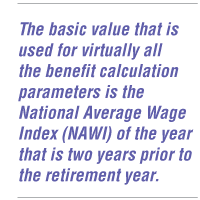 The basic value that is used for virtually all the benefit calculation parameters is the National Average Wage Index (NAWI) of the year that is two years prior to the retirement year. That will always be the latest value available. For elective retirement, the first eligibility year is age 62, and therefore the base year would be the age-60 year.
The base for calculating the parameters to determine benefits in 2020 is the NAWI of 2018, which is $52,145.80. This value is determined by multiplying the NAWI of 2017 ($50,321.89) by the percentage increase in the national average wages from 2017 to 2018. The ratio of $50,000.44 (national average wage of 2018) to $48,251.57 (national average wage of 2017) is 1.0362448; multiplying this by the 2017 NAWI of $50,321.89 arrives at the 2018 NAWI of $52,145.80.
The rule is that the NAWI of three years prior to the current year is multiplied by the rate of change of the national average wages of three years prior to the current year to two years prior to the current year.
The theory behind the concept of Social Security was that taxes assessed on the wages, up to a statutory limit, of those who are gainfully employed will be used to pay the benefits to those who have left the work force due to old age. The act was amended later to include disability and family benefits.

The statutory limit for “the current year” is determined by multiplying the NAWI of 1994 ($60,600) by the ratio of the NAWI of “two years ago” to the NAWI of 1992 ($22,935.42). For 2020, the formula is $60,600 × ($52,145.80 ÷ $22,935.42). The formula gives a value of $137,779.71, which is rounded to a 2020 limit of $137,700.
The limit for each new calendar year is announced in October.
Earnings that must be earned each quarter to be covered by Social Security is also a statutory amount that varies each year and is determined by a formula that multiplies 250 by the ratio of the NAWI of “two years ago” to the NAWI of 1976. For 2020, the formula is ($52,145.80 ÷ $9,226.48) × 250, which gives a value of $1,412.93. The number is rounded to the next lower $10, making it $1,410 for each quarter of 2020. This translates to $5,640 for the year ($1,410 × 4).
Four quarters of coverage are counted when the requirement for the year is met. The law requires 40 quarters of earnings to be fully insured under Social Security.
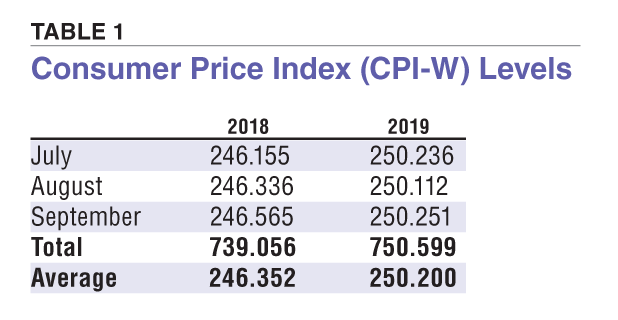
Since 1975, cost of living adjustments (COLAs) have been based on the Consumer Price Index for Urban Wage Earners and Clerical Workers (CPI-W). COLAs are calculated based on the CPI-W average of monthly values of the third calendar quarters (July, August, September) of two calendar years—but not necessarily consecutive years. The COLA to be applied in December of a current year would be determined by the increase from the third-quarter CPI-W of the year when a COLA was last applied to the third-quarter CPI-W of the current year. Table 1 shows the values that were used for the COLA of 2020.
The COLA to be applied to the 2020 benefits would be determined from Table 1 by dividing the difference of the 2018 and 2019 averages by the average of 2018 (246.352). The formula is (250.200 – 246.352) ÷ 246.352. The resulting value of 0.0156 is rounded to the third decimal place (0.016), which is the 1.6% COLA for 2020.
In 1983, then-President Ronald Reagan established a blue-ribbon commission to formulate a protocol to protect Social Security for the then foreseeable future. He named Alan Greenspan as the chair, and the commission has been referred to as the Greenspan Commission.
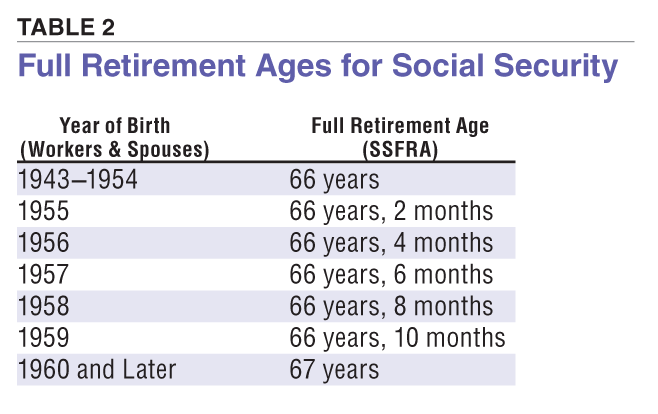
In addition to linking taxable earnings limits to inflation and increasing taxes to be collected according to the Federal Insurance Contributions Act of 1937 (FICA), the commission raised the full retirement age (FRA) from 65 to 67 over a period of 10 years in increments of two months. For those who were born in 1958 and will be age 62 in 2020, the full retirement age is 66 years and eight months.
Table 2 shows the full retirement ages for those born since 1943.
When the ability to claim benefits as early as age 62, instead of waiting until age 65, was enacted, the earned benefits needed to be actuarially reduced in order to equalize total lifetime benefits for all retirees. The 1983 amendments adjusted the formula to: a reduction in benefits of 5/9% per month for the first 36 months prior to the full retirement age, plus 5/12% per month for the next 24 months early.
A person taking benefits in 2020 at age 62 would have been born in 1958 with a full retirement age of 66 years and eight months. If the retiree was born on the first day of the month, they are considered to be age 62 for the entire month, and the reduction in benefits will be based on 56 months—12 times 66 years plus eight months (792 + 8 = 800 months) minus 12 times 62 years (744 months). The formula is [(12 × 66) + 8] – (12 × 62) = 56 months. The reduction will be 20% for the first 36 months plus 8.333% for the remaining 20 months, or 28.333%.
Most people are born after the first day of the month and will, in effect, retire at 62 years and one month, or 55 months early, if they elect to do so. Then, according to the formula, the reduction will be 27.917%. When the full retirement age reaches 67 (in two years), a reduction of up to 30% of the benefit earned as of the early retirement year may be imposed for early retirement.
If you take benefits early but continue to work, there is a limit on the amount you may earn without forfeiture of some of the benefits. If 2020 is the year of early retirement, the lower earnings test is $1,520 per month. In the years between the following year and the year of full retirement age, the earnings test would be indexed from $18,240 (12 × $1,520).
The forfeiture is $1.00 for every $2.00 earned above these test limits. This extends to a forfeiture of all benefits if you earn twice the benefit plus the test limit.
 In the year of full retirement age, up to one month prior to that age, forfeiture is $1.00 for every $3.00 above the upper earnings test, which is $4,050 per month in 2020. Thus, total forfeiture will occur if you earn three times the benefit plus the limit. The worker who began benefits early will have a COLA-increased amount in the full-retirement-age year. Total forfeiture will occur in any month where wages exceeded three times that benefit plus $4,050.
These limits are indexed each year. As of the Senior Citizens Freedom to Work Act of 2000, workers who retire at their full retirement age or later may earn unlimited amounts without forfeiture of benefits.
The 1972 Amendments to the Social Security Act instituted the concept of a delayed retirement credit, again to equalize total lifetime benefits for all retirees. Congress has increased this credit to a simple interest increase of benefit by 8/12% per month for each month of delay beyond full retirement age until age 70. At age 70, benefits are automatic by statute.
A worker who was born in 1954 will have a full retirement age of 66 (792 months since birth). If this worker delays benefits 48 months to age 70 (840 months since birth), they would receive a 32% increase in the primary benefit.
In order to arrive at a benefit for a retiring worker, their wages from age 22 through the year prior to the retirement year are included and indexed forward from each year to the age-60 year. From age 60 to the year prior to the retirement year, indexing stops and only the actual wages are included. The wages of the retirement year are not used in that the Social Security Administration will not be apprised of the amount until the following year, at which time it will recalculate the benefit.
Beginning with the age-22 year, an index factor for each year is determined by dividing the value of the NAWI of the age-60 year by the NAWI of that year. The index factor for the age-60 year and later is 1. Then, the worker’s actual wage, up to the maximum taxable wage, is multiplied by the index factor for that year to get a value of the indexed wage.
As an example, for an individual who was born in 1958 and will retire in 2020 at age 62, their age-60 year is 2018. The NAWI was $52,145.80 for 2018. This individual would have reached age 22 in 1980, when the NAWI was $12,513.46. The index factor for 1980 would be calculated as $52,145.80 ÷ $12,513.46, which equals 4.167177. If this person’s wages for 1980 were $25,000, the indexed wage would be 4.167177 × $25,000, or $104,179.42.
The process is repeated for each year and the highest 35 indexed wages are added and then divided by 420 (35 times 12) to arrive at the average indexed monthly earnings (AIME). Looking at two individuals who retire in 2020 at age 62, one of whom always earned wages equivalent to the NAWI and the other who always earned wages equal to the maximum taxable wages, as the highest 35 indexed wages, they would have AIMEs of $4,349 and $10,683, respectively.
In order to arrive at a worker’s benefit, a formula is utilized that includes two “bend points” for the age-62 year that are adjusted each year, based on the change in the NAWI. Fixed percentages of the bend points are applied as follows:
The Office of the Chief Actuary refers to these bend points as “dollar amounts.” The result of the arithmetic is rounded down to the next lower $0.10 and is defined as the primary insurance amount (PIA). The bend points that are used in the calculation are those of the age-62 year; for retirement in 2020 at age 62, the bend points are $960 and $5,785.
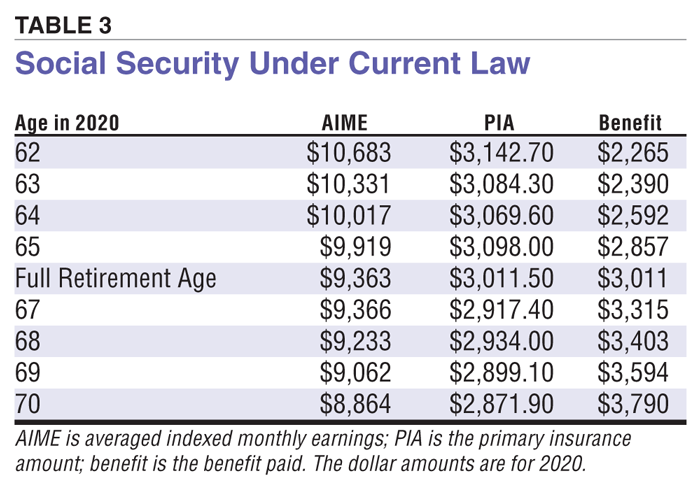
In order to equalize the total lifetime benefits workers will receive for different retirement ages, a reduction of the primary insurance amount is imposed for retirement prior to the full retirement age and an increase is applied to the primary insurance amount for delayed retirement. For the maximum-taxable-wage person cited previously, retirement in 2020 at age 62 and one month is 55 months prior to the full retirement age. This early retirement necessitates a 27.917% reduction, which results in a rounded-down benefit of $2,265. Table 3 is a compilation for ages 62 through 70 for workers who have always earned maximum taxable wages.
The amounts in the benefit column include COLAs from the age-62 year, prior to the reduction of the primary insurance amount for the number of months prior to full retirement age. The primary insurance amount for retirement that is delayed beyond the full retirement age includes COLAs from the age-62 year, after which the delayed retirement credit is applied. The inclusion of COLAs is not pure compounding. The procedure is to reduce each year’s increase to the next lower $0.10 before applying the next COLA.
The amount of the spouse’s benefit depends upon their full retirement age: If having reached that age when the worker retires, they would be entitled to 50% of the worker’s primary insurance amount. If the spouse is younger than the full retirement age, their benefit will be reduced by the formula of: 25/36% per month for the first 36 months prior to the full retirement age plus 5/12% per month for the next 24 months.
A recent change in the law now mandates that the worker must begin benefits before the spouse can collect spousal benefits.
Because articles about Social Security and early retirement inadvertently convey misinformation when interpreting the primary insurance amount definition shown on the website of the Office of the Chief Actuary of the Social Security Administration, I felt that a short primer would be in order. Typically, the article will state a benefit at full retirement age and reduce that value for early retirement. To illustrate, here is a quote from AARP.org (“How much does early retirement reduce Social Security benefits?”): “Filing at 62, 56 months early, permanently reduces your monthly benefit by 28.3%. If you would have been entitled to $1,000 a month at full retirement age, you will get about $716 if you start benefits when you turn 62.”
Fidelity.com has an article with the same misinformation (“Should you take Social Security at 62?”): “Consider the following hypothetical example. Colleen is 62 as of 2020. If Colleen waits until age 66 and 6 months (her FRA) to collect, she will receive approximately $2,000 a month. However, if she begins taking benefits at age 62, she’ll receive only $1,450 a month. This ‘early retirement’ penalty is permanent and results in her receiving up to 28% less year after year.”
These two examples would be true only if each individual stopped work at age 62, did not take benefits and there were no COLAs from the age-62 year to the full retirement year. Under these conditions, the benefit at full retirement age would equal the primary insurance amount that was calculated at the age-62 year. If there was no delayed retirement credit, the same would be true for taking benefits at any year subsequent to the age-62 year.
However, if a person continues to work beyond age 62, in order to know their benefit at full retirement age, they must reach full retirement age. At full retirement age, they cannot then go backward to decide whether to retire at 62. The Social Security Administration does provide an estimate of future benefits based on the last year’s wages for all future years, but it is only an estimate and will not be used in actual determination of benefits.
 The definition of the primary insurance amount on the Social Security Administration website is contrary to what is stated elsewhere on the website and what the regulations require. In the primary insurance amount section, the website says: “The ‘primary insurance amount’ (PIA) is the benefit (before rounding down to next lower whole dollar) a person would receive if he/she elects to begin receiving retirement benefits at his/her normal retirement age. At this age, the benefit is neither reduced for early retirement nor increased for delayed retirement.”
In the Social Security Benefit Amounts section, this example is given: “A person who had maximum-taxable earnings in each year since age 22, and who retires at age 62 in 2020, would have an AIME equal to $10,683. Based on this AIME amount and the bend points $960 and $5,785, the PIA would equal $3,142.70. This person would receive a reduced benefit based on the $3,142.70 PIA. The first COLA this individual could receive is the one effective for December 2020.”
The emphasis here is that the early benefit before reduction is referred to as the primary insurance amount. With the assumptions made on future wages and cost of living adjustments, if this individual continues to work until their full retirement age, their benefit would be $3,382 per month—a 49.3% increase above the age-62 benefit. This reality appears to be a direct contradiction to the Social Security Administration’s definition. On the administration’s Anypia calculator, the Office of the Chief Actuary also labels the base benefit earned at a given age (early, full, delayed) as the primary insurance amount.
After I suggested a clarification in the definition, the Office of the Chief Actuary explained, “When we discuss how to compute a benefit for a person starting benefits at age 62, these terms really mean the PIA computed as of age 62, which in general is lower than what the PIA would be if the person actually waited and started benefits at normal retirement age.” The response also stated that the language that defines the primary insurance amount may not be accurate, but the intent is to provide commentary to a non-technical audience.
It might be wise, however, for the readers of this publication to be aware of the reality of Social Security benefits at early retirement. ?
Acknowledgements
My thanks to the following individuals for their comments and suggestions in the development of this article:
—Robert Muksian
Financial Planning
Financial Planning
Financial Planning

DAN M from CA posted over 6 years ago:
Stephanie M from MD posted over 6 years ago:
ROBERT M from RI posted over 6 years ago:
BARRY J from TX posted over 6 years ago:
SCOTT T from TX posted over 6 years ago:
DAVID G from NJ posted over 6 years ago:
J M from NJ posted over 6 years ago:
J M from NJ posted over 6 years ago:
CRAIG K from OK posted over 6 years ago:
J M from NJ posted over 6 years ago:
DAVID D from CO posted over 5 years ago:
G L from IL posted over 5 years ago:
William C from TX posted over 5 years ago:
CHARLES R from IL posted over 5 years ago:
You need to log in as a registered AAII user before commenting.
Log InCreate an account