

Related

First Cut Stocks
The flexibility of the PRISM Wealth-Building Process includes its ability to be adapted for the purpose of simply accumulating wealth.
by Charles Rotblut | July 2024

Charles Rotblut leads a class in AAII's new Essential Investing Video Course. Go to https://www.aaii.com/ves for more information and to subscribe.
Maximizing wealth can be an identifiable goal in and of itself. Underlying it is often a desire to achieve financial independence, leave an inheritance and/or support charitable institutions in the future. The pursuit of maximizing wealth with no specific intentions of how it will be spent or distributed can be designated as the primary goal from a planning standpoint.
The flexibility of the PRISM Wealth-Building Process includes its ability to be adapted for the purpose of simply maximizing wealth. A one-page plan provides a useful framework even if there is not a set deadline or any specific intentions for when or how the wealth will be spent.
Underlying PRISM is the goal you are investing for. We believe having a specific goal adds a purpose to why you are investing. If you clearly articulate the purpose—including having enough money to give you flexibility in future spending decisions—you will be more likely to stick to your plan.
Furthermore, having a written plan will help you reach your goal. It does not matter whether the goal is for the short term, long term or somewhere in between. A written plan clarifies your thoughts and creates a road map you can use to achieve your goal.
The one-page PRISM Wealth-Building Plan presented in this article uses the example of a middle-aged married couple, Joe and Lucinda (Figure 1). They are seeking to continue building their wealth. Both have been successful in their careers, are still working, have no debt and have more than enough wealth to fund their forecast living expenses in retirement. The couple is not focused on any specific spending goals.

Maximizing wealth via investing in the public financial markets requires consistent and disciplined saving, patience and the ability to not panic in response to downside stock market volatility. No shortcuts exist for those who do not inherit wealth, marry into it or otherwise gain it through luck or circumstance (e.g., employee stock options).
In pursuing long-term wealth, consider the trade-offs. Short- and intermediate-term financial needs should be allocated for. Maintaining a full allocation to stocks without adequate emergency savings held in cash-like instruments (e.g., savings accounts, money market accounts, etc.) could prompt you to sell equities at an inappropriate time. Similarly, you should ensure that your current financial needs and planned upcoming expenditures (e.g., a new car) are accounted for.
Most importantly, understand that attaining wealth through investing takes time and patience. Any successful short-term strategy for doing so is because of good luck.
The first step, and the cornerstone of the PRISM Wealth-Building Process, is identifying and prioritizing goals. Joe and Lucinda’s goal is maximizing their long-term wealth.
In pursuing this goal, they have made sure that there is enough money in their short-term savings accounts to cover emergencies. The couple also follows a budget that covers both nondiscretionary and discretionary spending. Joe and Lucinda don’t break out retirement as a specific goal, as they currently have enough savings to cover those projected expenses. If they did separate out retirement, they would create a different one-page PRISM Wealth-Building Plan for it. (See “A One-Page Wealth-Building Plan to Get a 60-Year-Old Couple to Retirement” in the May 2023 AAII Journal.)
Joe and Lucinda’s one-page wealth-building plan varies from others we’ve published by not listing specific dates or dollar amounts. The couple does not have a target level of wealth they wish to achieve. They also do not have a certain date by which they want to reach their goal. Rather, they just want to continue growing their wealth.
A person or couple who has a certain level of wealth they want to reach could list it in this section. It could be a round number like $1 million or $5 million with a note to decide what to do once the number is reached. Some people may want to establish a benchmark date for when they expect to reach it. Neither is necessary, but either or both could make following the plan easier.
The ability to tolerate downward volatility in the stock market is key to building long-term wealth. Warren Buffett’s advice to “be greedy when others are fearful” applies here. It is impossible to build long-term wealth in the public financial markets without having the psychological and financial fortitude to stick to your investing strategy in the face of a significant drop in stock prices.
The PRISM process helps you assess your tolerance for risk in this section. The one-page wealth-building plan specifically asks if downward moves in the market will:
Joe and Lucinda answer “should not” to the first two questions. They realize pullbacks (drops of 5.0% to 9.9%), corrections (drops of 10.0% to 19.9%) and bear markets (drops of 20% or more) are a normal part of the stock market’s cycles. The couple further realizes that the stock market has historically regained its losses and then gone on to set new highs (Table 1). Furthermore, Joe and Lucinda have maintained their allocation to stocks during previous downturns.
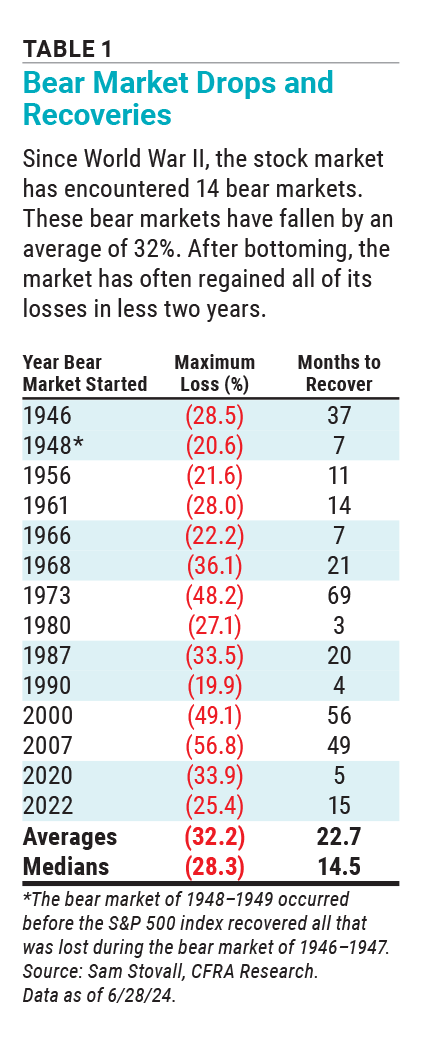
Since they are still working and have saved enough already, they don’t anticipate that a downturn in the stock market will impact their ability to withdraw money. This could be different if they had less wealth and/or if they were not continuing to receive paychecks.
The couple acknowledges their need for positive real (inflation-adjusted) returns. Creating long-term wealth is about more than just hitting a certain number. It is also about ensuring that one’s purchasing power—the ability to buy goods and services with the dollars you have—increases as well. Inflation for Joe and Lucinda is a big threat given the long-term nature of their goal.
The appropriate allocation stems from the timing of the goal and the financial and psychological ability to withstand fluctuations in portfolio value. Joe and Lucinda do not have a specific date they are targeting. Rather, they want to continue building their long-term wealth as long as they are able.
The couple has also never pulled out of stocks during a downturn. This shows they have the psychological ability to withstand downside volatility. Since they are still working, they do not need to take any portfolio withdrawals. They believe their current savings are adequate to cover future retirement expenses as long as their real returns are positive on an annualized basis.
This combination makes an aggressive allocation a good fit for them. Joe and Lucinda opt to follow AAII’s Aggressive Asset Allocation Model. This calls for allocating 90% to a diversified mix of stocks and stock funds and 10% to safe assets like short-term Treasurys and money market accounts. The 10% allocation to safe assets can be reduced if desired.
Joe and Lucinda use stocks, exchange-traded funds (ETFs) and mutual funds to provide exposure to different categories of stocks. They also maintain an emergency fund large enough to cover unexpected expenses and to provide a bridge should either of them become unemployed. This fund is invested in a high-yield savings account.
The couple owns taxable brokerage accounts, individual retirement accounts (IRAs), Roth IRAs and 401(k) plan accounts. They note these taxable and tax-preferred accounts on their one-page wealth-building plan.
The investment offerings in Joe and Lucinda’s 401(k) accounts are limited to mutual funds. This is a constraint because the couple can only choose from the plan’s offerings. In contrast, they can choose from individual stocks, ETFs, mutual funds and other securities for their taxable brokerage accounts, IRAs and Roth IRAs.
Joe and Lucinda’s default investment choices are low-cost ETFs. They prefer such funds for their low expense ratios. They supplement their ETFs with individual stocks.
Within their 401(k)s, the couple looks for low-cost funds—particularly index funds when available. They use their workplace retirement plans to supplement their brokerage accounts with an eye on their overall allocation. The couple seeks to avoid unintentionally overweighting one category of equities (e.g., foreign stocks).
Like others, Joe and Lucinda seek to limit their tax liability. The couple avoids high-turnover strategies in favor of buying and holding—including the stock strategies they follow. Mutual funds are only held in tax-preferred accounts, like their 401(k) plans, to avoid owing taxes on capital gains distributions.
Joe and Lucinda feel comfortable managing their own portfolio without the assistance of a financial planner or adviser. However, they include a note to consult with an estate attorney as necessary. All of this is listed on the couple’s one-page financial plan.
AAII’s PRISM Wealth-Building Process purposely puts key preferences or constraints ahead of finding investments to match the chosen allocation. Identifying preferences and constraints first simplifies the process of choosing investments by narrowing down the vast number of options.
As previously noted, the couple holds three types of investments: individual stocks, ETFs and mutual funds.
Joe and Lucinda have a key underlying rule for ETFs and mutual funds: Focus on the ones with low expense ratios. This makes broad index funds their primary option. They compare the mutual fund options in their 401(k) plans to the ETFs they hold in their taxable brokerage accounts, IRAs and Roth IRAs to ensure their overall allocation is where they want it to be.
Following the AAII Aggressive Asset Allocation Model, the couple holds domestic large-, mid- and small-cap stock funds, developed international funds and emerging markets funds. They do not hold any bond funds given their high tolerance for risk. Joe and Lucinda intend to follow AAII founder James Cloonan’s advice to build up a buffer of money market holdings as they near retirement.
Joe favors growth at a reasonable price (GARP) stocks, whereas Lucinda considers herself to be a true value investor. This can be seen in their approach to selecting stocks.
Joe uses the AAII Stock Screens that identify stocks with growth and value characteristics such as the Dreman With Estimate Revisions screen. He sells stocks when their valuations become pricey or when earnings either turn negative or are projected to drop significantly.
Lucinda follows AAII’s Model Shadow Stock Portfolio. She adheres to the portfolio’s rules, typically following any addition and deletion alerts in a timely manner.
Combined, the couple allocates about 20% of their portfolio to individual stocks. They believe that this is large enough to give their portfolio returns a potential boost but not so large that a mistake will cause significant damage. The ongoing use of 401(k) plan accounts also affects how much they can allocate to investing in individual stocks.
Note: The percentage to allocate to individual securities relative to ETFs and mutual funds is dependent on preferences and constraints. There is no proportionate mix that makes sense for every investor.
The final step of the PRISM Wealth-Building Process calls for periodic monitoring. Even without a defined dollar amount of how much long-term wealth Joe and Lucinda want to build, it is still possible and recommended to complete this final step.
Checking the portfolio allocations when just stocks are used entails ensuring that the proportionate weightings of the different categories are within an acceptable range of what they desire. AAII’s Aggressive Asset Allocation Model calls for a 20% weighting to large-cap, mid-cap, small-cap and foreign developed country stocks. Emerging markets stocks and cash/cash equivalents are weighted at 10% each.
The couple is willing to accept a wider range of fluctuations in weightings in exchange for seeking higher returns. As such, they will rebalance their portfolio if the weighting of any of the four major categories rises above 30% or falls below 10%.
Progress toward their goal is measured via a combination of savings contributions and growth. They check their savings contributions annually to ensure they are hitting their targets. The couple also uses this annual check to boost contributions if either’s compensation changes (e.g., a raise). Joe and Lucinda monitor their returns on an annual and five-year annualized basis to ensure they are outpacing growth. In doing so, they consider the timing and duration of any bear markets that might have occurred.
In terms of life-stage changes, the couple marks approximate dates on their calendar for when they plan to start phasing into retirement. The couple also includes a note to revisit their plan if there are any significant changes in their children’s lives, such as marriage, or in their own health. Should this occur, Joe and Lucinda will contact their estate attorney to determine what documents need to be updated.
The one-page PRISM Wealth-Building Plan discussed here helps Joe and Lucinda even though they don’t specify a dollar amount of wealth they seek to accumulate. It provides them with a framework upon which to make decisions.
A simplified plan is always more effective than not having a plan at all. It is also better than a plan that is too complex or detailed for you to follow. A big advantage of the PRISM Wealth-Building Process is its flexibility. It gives you the framework to create a personalized plan with the information that works best for you.
First Cut Stocks

PRISM Wealth-Building Process


ROBERT A from NC posted over 2 years ago:
BARRY J from TX posted over 2 years ago:
JOHN L from NJ posted over 2 years ago:
TERRANCE O from OH posted over 2 years ago:
JOHN C from FL posted over 2 years ago:
You need to log in as a registered AAII user before commenting.
Log InCreate an account