

Related

Portfolio Strategies
The years leading up to retirement involve many important decisions. A simplified plan is essential to keep you on track.
by Charles Rotblut | May 2023

Charles Rotblut leads a class in AAII's new Essential Investing Video Course. Go to https://www.aaii.com/ves for more information and to subscribe.
The last few years leading up to retirement are some of the most complex from a financial planning standpoint.
There is the obvious decision of when to retire, with the date not always chosen voluntarily. Retirement savings might need to be increased before withdrawals start. There are key deadlines that require prudent decision-making: filing for Medicare at age 65 (and picking a plan) and claiming Social Security benefits by age 70. On top of all this, soon-to-be-retired investors need to decide on a withdrawal strategy, adjust their portfolio allocation accordingly and plan for their in-retirement lifestyle.
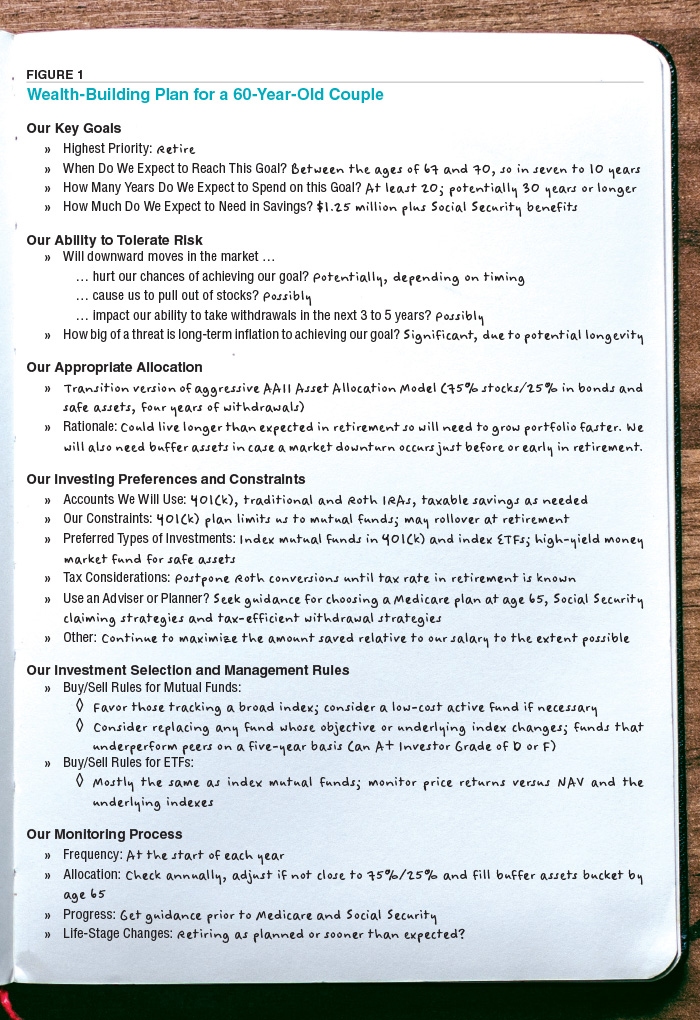
In this article, we present a one-page PRISM Wealth-Building Plan intended to help a 60-year-old couple—Tom and Tina—achieve their goal of retiring within 10 years. We purposely limited the plan length to one page to demonstrate how even a basic plan can be highly effective in helping investors achieve their goals.

The first step, and the cornerstone of the AAII PRISM Wealth-Building Process, is prioritizing goals. Every investor has a reason for accumulating and managing wealth. For someone who is age 60, retiring is a very big, forthcoming goal.
Even if your goal is for something other than retiring (e.g., helping with college expenses, leaving a legacy for heirs, supporting charities, being financially independent, etc.), writing the goal down increases the odds of achieving it. An oft-cited study from Dominican University found “Those who wrote their goals accomplished significantly more than those who did not write their goals.”
Tom and Tina aim to retire within seven to 10 years. They don’t list a specific date because unexpected changes in their health or employment status could alter the decision. Nonetheless, writing down an approximate retirement date helps establish a time frame that can be used to recognize risk tolerance and allocation as well as set key milestones to reach along the way.
Since both are in good health, the two think they could live into their late 80s/early 90s or potentially longer. This means they are still looking at a long investing time horizon and a lengthy period over which they will have to rely on their savings.
The couple has been monitoring their Social Security statements and has an idea of what their benefit amounts could be. They’ve also given consideration to what their lifestyle will be in retirement and the cost of supporting it. Based on these assumptions, they estimate that they will need $1.25 million in savings for retirement.
The years leading up to retirement and the first several years after retirement are periods where a range of risks overlap. Portfolio values are large thanks to years of saving and compounding, salary will come to an end or at least be significantly reduced and withdrawals will start. Longevity risk, the cost of a longer-than-anticipated life, should not be ignored.
For the purpose of recognizing an investor’s risk tolerance, we divide risk into four different types.
All four play a role for Tom and Tina, with sequence risk and inflation risk of particular importance.
Sequence risk matters greatly when withdrawals are taken. Withdrawals are, obviously, outflows from a portfolio. Rising financial markets help to fund withdrawals by providing capital gains. Falling financial markets are a different story: Withdrawals reduce the amount of dollars left in the portfolio to benefit from the eventual rebound.
To the extent Tom and Tina have control over when they retire, they can navigate sequence risk somewhat by postponing their retirement date should a bear market occur just prior to the planned date. Such flexibility is not a guarantee because even when there is control from an employment standpoint, health issues can alter plans.
A bear market could occur during the first few years after Tom and Tina retire instead of just before it. This would result in asset prices falling once withdrawals have started, and the option (or desire) to return to full-time work may not exist. Plus, because the couple’s retirement savings will still be large, their wealth will take a significant hit in terms of dollar value. We found that retirement portfolios following percentage withdrawal strategies (aka the 4% withdrawal rule) often ran out of money when a bear market occurred during the early years of retirement.
While sequence of returns poses a short-term risk, inflation poses a long-term risk. There is currently a 1-in-4 chance of at least one person in a married couple living to 90. This longevity risk requires taking into consideration the likelihood of significantly higher future expenses for living (food, shelter, etc.), medical and lifestyle requirements. Thus, while Tom and Tina need to factor in sequence risk, they cannot ignore the eroding effects of inflation either.
The two other primary factors used to determine risk tolerance in the PRISM Wealth-Building Process framework are systematic and behavioral. Systematic risk will be an ongoing threat throughout retirement. Periodic market drops and potential bouts of disappointing market returns will impact the couple’s ability to take withdrawals and their long-term wealth. Social Security helps to diversify against the risk by providing annuity-like income.
Behavioral risk varies with each investor. Tom and Tina have gotten nervous during previous bear markets. Though they’ve managed to ride through prior downturns, the possibility of having to take withdrawals during a bear market is an additional layer of concern for them and something they will need to address in their allocation.
The appropriate allocation stems from the goal prioritized and the risk tolerance recognized. Once these first two steps are done, choosing an appropriate allocation becomes much easier.
Let’s look at what we know about Tom and Tina so far. They plan to retire within the next seven to 10 years. They are currently employed and adding to their retirement savings but will start taking withdrawals upon retiring. They expect to live into at least their late 80s with the possibility of one or both living past age 90. This longevity risk means they will need to embrace systematic risk to continue growing their savings while balancing the need for withdrawals.
There is a lot of debate about what the correct allocation for this couple should be. Retirement allocation camps include annuitizing all dollars required for living expenses, glide paths that increase bond allocations based on age (e.g., the bond allocation equals 100 minus your age), V-shaped strategies that reduce stock exposure heading into retirement and then increase it once in retirement, using buffer assets, and bucket approaches that allocate based on when withdrawals are needed.
The Level3 approach to asset allocation introduced by AAII founder James Cloonan in “Investing at Level3” (AAII, 2016) is an example of a buffer asset approach. The strategy allocates up to four years of planned withdrawals into so-called safe assets. Safe assets include short-term Treasury securities, certificates of deposit (CDs) and money market accounts. The remainder of the portfolio is invested aggressively, meaning in equities.
Behaviorally, Tom and Tina aren’t comfortable handling the volatility of an aggressive allocation heading into retirement. At the same time, they realize the need to continue growing their portfolio, as their combined investing time horizon (pre- and post-retirement) could be 30 years or longer.
Looking at the AAII Asset Allocation Models, they opt for the transition option listed under the aggressive allocation model. This calls for 75% exposure to equities and 25% exposure to fixed-income assets. Since their planned retirement date is unknown, the couple will use part of the fixed-income allocation to build up buffer assets to an amount equal to four years of expected withdrawals. This will help them to navigate any sequence risk that occurs just as they start to take withdrawals or thereafter.
AAII’s PRISM Wealth-Building Process purposely puts key preferences or constraints ahead of finding investments to match the chosen allocation. Identifying preferences and constraints first simplifies the process of choosing investments by narrowing down the vast field of options.
Tom and Tina have 401(k) accounts, traditional IRAs, Roth IRAs and taxable savings accounts. The couple prefers investing in passively managed (index) mutual funds and exchange-traded funds (ETFs) over picking individual stocks. They are constrained by the offerings in their 401(k) plans, but index options are available to them in those plans. Their brokerage accounts—both for the IRAs and taxable savings—allow them much greater flexibility in terms of investment choices.
Realizing the need to begin building up an allocation to safe assets, the couple notes a preference for high-yielding money market funds in their PRISM Wealth-Building Plan.
Taxes are a consideration for this couple, as they will be required to take distributions from their 401(k) and traditional IRAs once they turn 73. They realize that withdrawals from Roth accounts are not taxable, but Roth conversions are. So, they write down a note to postpone any Roth conversions until they are retired and their tax rate is lower.
While Tom and Tina are comfortable managing their own portfolio, they would like assistance with making three forthcoming decisions: selecting a Medicare plan, filing for Social Security benefits and determining a withdrawal strategy. While working with a professional for each of these decisions is not mandatory, the couple does not feel comfortable making such decisions without speaking to someone with expertise in each area.
Whereas preferences define what types of investments you’ll consider, rules—even basic ones—establish clear standards for what makes an investment a buy and, more importantly, what makes it a sell. These rules should always be tailored to the type of investment being purchased, with the inclusion of any style, factor or other preferences.
Since Tom and Tina prefer passive investing, their investment rules are straightforward. They will continue to hold mutual funds and ETFs tracking broad, well-known indexes. Should the underlying index change for one of their funds, they will evaluate the new index and determine if the change is significant enough to replace the fund.
They will monitor the price returns realized by their ETFs relative to their net asset value (NAV) returns and the performance of the underlying indexes. Differences between the price return of the ETF—meaning returns based on how the ETF trades in the open market—and the returns of its underlying assets are typically minimal to essentially nonexistent for ETFs tracking broad indexes. Still, it is prudent to periodically monitor relative performance.
The final step of the PRISM Wealth-Building Process calls for periodic monitoring. The portfolio’s allocation is checked to ensure it remains within an acceptable range of the specified target. Progress toward the goal is reviewed to ensure it is still on track. Changes in one’s life are considered to determine whether the specified goal is still valid or if it needs to be revised. This step ensures that one’s wealth-building plan evolves as their life does.
This step is more involved for a 60-year-old couple because they are entering a transition phase with key decisions to be made along the way. As previously noted, we’ve simplified the plan to fit on a single page. There is no reason to limit the length of the wealth-building plan to a single page if you wish to include more detail in it.
Tom and Tina have been monitoring their portfolio once per year. They are comfortable with this schedule and there isn’t much reason for them to change it since they are using index funds.
Their allocation target is 75% stocks and 25% bonds. They will begin transitioning the portfolio now and will check the allocation once per year. If any of their funds representing a specific asset class category is more than five percentage points off target, they will rebalance.
The couple will also gradually build up their buffer asset allocation to an approximate amount needed to help fund living expenses during the first four years of retirement. Tom and Tina would like to have this bucket filled within five years (at age 65). Though Cloonan suggested filling the bucket starting four years prior to retirement, the couple wants to do this sooner in case they end up retiring earlier than their projected time frame.
This ties into life-stage changes. Tom and Tina will review their portfolio, health, job status and desire to continue working full-time each year as they decide when to retire. Though their current plan is to work until at least age 67 and possibly 70, they realize their retirement date may change due to voluntary or involuntary factors.
There are certainly many decisions to make in the years leading up to retirement. We’ve simplified some of those in this article, including more detailed tax-planning decisions. This is the trade-off between limiting the PRISM Wealth-Building Plan to one page and allowing it to be more comprehensive.
It is extremely important to realize that having a simplified plan is far more effective than having no plan or a plan that is too complex or detailed for you to follow. A big advantage of the PRISM Wealth-Building Process is its flexibility. It provides a framework to create a personalized plan with the information that works best for your needs.
Portfolio Strategies

Retired Investor


DAVE G from TX posted over 3 years ago:
DAVE G from TX posted over 3 years ago:
JOHN L from NJ posted over 3 years ago:
Andrew O from MD posted over 3 years ago:
You need to log in as a registered AAII user before commenting.
Log InCreate an account