


Related

PRISM Wealth-Building Process
How to go about identifying holes in your portfolio allocation and finding funds or ETFs that may be good candidates to fill those asset deficits.

Charles Rotblut leads a class in AAII's new Essential Investing Video Course. Go to https://www.aaii.com/ves for more information and to subscribe.
It’s not uncommon for investors to discover a hole in their portfolio allocation during a review—a missing asset class that would bring them closer to their ideal mix to achieve the optimal return given their risk tolerance. What’s the best way to find the mutual funds or exchange-traded funds (ETFs) to fill that hole?
How you allocate your portfolio is the most important investment decision you will make. Both the asset classes you choose to invest in, and the proportion of your portfolio allocated to each class, will be the primary determinant as to whether you achieve your financial goals or not.
An asset class is a broad category of related securities. Asset classes include equities (stocks), fixed income (bonds), commodities (gold, oil, etc.), real estate and alternative investments (venture capital, etc.). Within each asset class are various types of investments. For example, equities encompass individual stocks, stock options, stock-based mutual funds and stock-based ETFs. The key concept to remember is that an asset class is a broad category covering many types of assets.
Portfolio allocation decisions are based on when the money will be needed for withdrawal and the size of the portfolio (wealth). An investor with a low risk tolerance (shorter period until the money will be withdrawn and lesser wealth) should follow a strategy that places a greater emphasis on income and capital preservation. An investor with a higher risk tolerance (a longer period until the money will be withdrawn and greater wealth) should follow a strategy focused more on increasing wealth.
Each asset class has its own, unique return profile. Equities are considered to be more of an aggressive type of asset because historically they have produced higher returns, but they have also encountered bigger fluctuations in value. Fixed income is considered to be more conservative because bonds tend to pay a steady stream of income, fluctuate less in value and typically return an investor’s money at a predetermined date. (However, no bond is guaranteed to return the amount invested.) Commodities and real estate often produce returns that are different than either stocks or bonds.
An allocation strategy seeks to use the characteristics of each asset class to help an investor reach their goal. For example, an investor with a low tolerance for risk may be primarily focused on preserving capital. As a result, they would allocate a greater proportion of their portfolio to bonds and other fixed-income investments. Conversely, an investor with a high risk tolerance will want a greater proportion of their portfolio allocated to equities.
In either case, investors should not allocate their portfolios solely to one single asset class, because it puts the investor at risk of losing part of their wealth. Diversification seeks to reduce this risk. By combining various asset classes, an investor increases the odds of having a portion of their portfolio allocated to the “right” asset class at the “right” time. In other words, as one asset class drops in value, another may rise.
How do you know which asset class to be invested in? The answer depends on your risk tolerance and financial goals. AAII’s PRISM Wealth-Building Process at the Planning area of AAII.com provides a framework for aligning your investment decisions with your goals.
Members can view three Asset Allocation Models for three investor “personas” that are based on investment time horizon and risk aversion: aggressive, moderate and conservative. The AAII Asset Allocation Models are displayed at www.aaii.com/asset-allocation, where they show suggested asset allocation breakdowns based on the three different investor profiles (Figure 1).
Investors with lower risk tolerances (“conservative”) should consider allocating 60% of their portfolios to bonds and the remainder to stocks. Investors with higher risk tolerances (“aggressive”) should consider allocating up to 90% or more of their portfolios to stocks and the remainder to safe assets.
Keep in mind that these are just benchmarks to use as a starting point. Your own financial plan may require a more conservative allocation (bigger percentage of fixed income) or a more aggressive allocation (bigger percentage of stocks). Furthermore, investors with long time horizons and higher risk tolerances may want to consider allocating a small percentage to real estate and commodities to provide additional diversification.
The suggested asset allocations are meant to serve only as a guideline because everyone’s situation differs and no one knows how the markets will perform in the future.
For the equity portion, the AAII Asset Allocation Models use five different categories of stocks: domestic large-cap, mid-cap and small-cap as well as international and emerging markets.
For the bond portion, short-term bonds (maturing in three years or less) and intermediate-term bonds (maturing within three to 10 years) are used by AAII’s Asset Allocation Models.
An alternative to holding short-term bonds would be to use so-called cash equivalents. These include money market funds, certificates of deposit (CDs) and high-yield savings accounts.
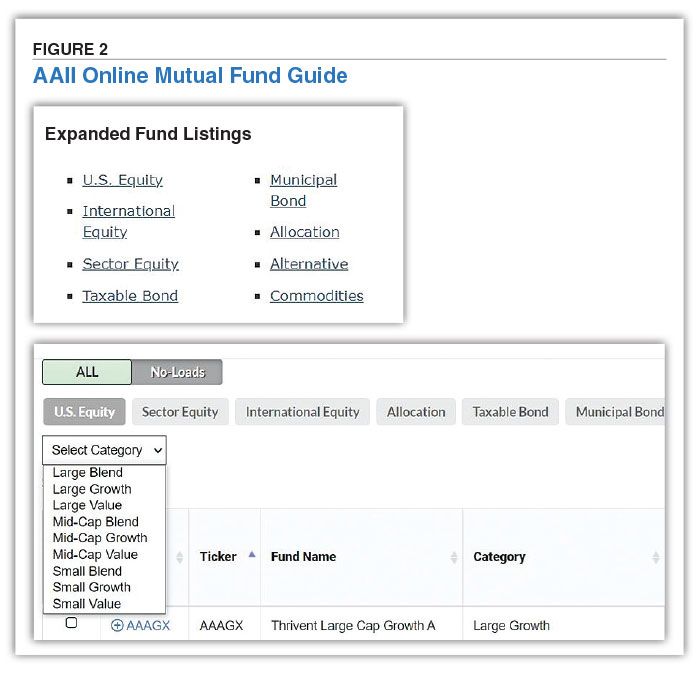
To find mutual funds or ETFs that may be good candidates to fill an asset deficit you’ve identified, AAII members can use our comprehensive Mutual Fund Guide or ETF Guide to easily filter by asset classes and fund categories (Figure 2). Then, click the checkbox in the Compare column at the far left next to a few funds that look attractive to view key data points on each side by side. Descriptions of the asset classes as determined by Morningstar are available at www.aaii.com/etfs/definition.
A+ Investor subscribers looking for funds can use the additional functionality of the A+ Funds and ETF Screeners to choose a fund asset group and category and then add filters on performance, cost and other characteristics to whittle down the list and save screens for reuse.
Not sure if your portfolio is missing an asset class?
The Diversification Analyzer in My Portfolio checks allocation for A+ Investor subscribers. This tool provides a detailed analysis of your asset allocation. It also shows how your allocation compares to the appropriate allocation model for your stated risk tolerance. You can use this information to consider changing your exposure to an asset.
PRISM Wealth-Building Process

Portfolio Strategies

MATTHEW P from TX posted over 4 years ago:
ROBERT A from NC posted over 4 years ago:
ROBERT A from NC posted over 4 years ago:
You need to log in as a registered AAII user before commenting.
Log InCreate an account