




Related

Portfolio Strategies
The mix of assets held primarily determines the returns you will realize. The other keys are sticking to your strategy and making periodic adjustments to keep your allocations at the desired level.

Charles Rotblut leads a class in AAII's new Essential Investing Video Course. Go to https://www.aaii.com/ves for more information and to subscribe.
Allocation may be the most important decision an investor makes. The mix of assets held—and the percentage of the portfolio allocated to each asset class and categories within each asset class—primarily determines the returns you will realize. One study put the influence that allocation has on portfolio returns at 90%.
Though the actual magnitude of the influence has been debated, one thing remains clear: Your returns and your ability to fund goals are directly influenced by both your choice of and how consistently you stick with an allocation strategy. To grow wealth, greater exposure to equities and the tolerance to put up with their volatility is required. Shorter-term goals require a greater emphasis on preserving wealth. Such needs call for a greater exposure to less volatile assets. This is because an ill-timed drop in stocks can cause the goal to be missed.
Beyond time, your financial and psychological tolerance also play a role in determining the proper allocation. Where many investors fail is not following an allocation appropriate for their risk tolerance. Allocation strategies only work as well as your ability to stick with them. An allocation strategy with a somewhat lower expected rate of return can result in greater long-term wealth if you are able to consistently stick with it. More wealth will, of course, be realized by consistently following an aggressive allocation.
 In this article, we discuss the role of three key building blocks to a successful allocation strategy: stocks, bonds and cash. Though other asset classes can be incorporated, it’s important for most investors to focus first on getting the basic of mix of these three asset classes right over the long term. We also discuss the AAII Asset Allocation Models and offer suggestions on how to implement them in real-world portfolios using mutual funds, exchange-traded funds (ETFs) and individual securities.
A key component of allocation is diversification. Diversification is holding a mix of different investments. By diversifying, you limit your odds of being completely wrong in your investment decisions.
There are two major types of risk that diversification helps to mitigate.
The first is systematic risk. This is more commonly known as market risk. It is the risk all investors take by simply doing something with their money. Changes in the economy, adjustments to monetary policy, inflation trends, natural disasters, war and bear markets are among the many causes of systematic risk. It can’t be avoided, though the types of systematic risk an investor is exposed to can be controlled through the choice of assets held. Stocks, for instance, will do well when the economy is growing. Bonds can rise when there is fear about the economy slowing.
Investors are compensated for systematic risk through higher returns. Stocks have historically outperformed bonds by a wide margin because they have more volatile returns. Similarly, bonds have outperformed cash because they require investors to part with their dollars for a longer period of time.
The second type of risk is idiosyncratic risk. This is the risk of a particular investment falling in value. An example would be shares of a company whose CEO makes bad business decisions. It can also be bonds of an issuer who defaults. At the portfolio level, it could be a choice to overweight an asset class group that goes out of favor.
Systematic risk can be reduced by diversifying across asset classes. Idiosyncratic risk can be reduced by holding a mix of different investments as well as by holding different asset class groups.
Figure 1 demonstrates how diversification has helped an investor reduce both types of risk. Each asset class group is color-coded so that you can more easily track them from year to year.
As you look at the chart, one thing should jump out—the lack of a consistent leader. The top-performing asset class group (left-most column) frequently changed. Since crystal balls are always cracked, diversification reduces the risk of being wrong. The flip side of this coin is that by diversifying, you increase the odds of being exposed to the right asset class group at the right time.
Stocks provide growth of wealth. More specifically, stocks provide growth of wealth in excess of the rate of inflation.
This is important to ward off the deteriorating effect inflation has on purchasing power. Purchasing power is our ability to buy goods and services with the dollars we have. If our savings grow at a rate slower than inflation, more and more money will need to be spent relative to our wealth to buy the same goods and services. Over the short term this may not be noticeable, but over the long term, purchasing power can be significantly compromised—even at low inflation rates.
Historically, stocks have been exceptional inflation fighters. Between the period of 1926 and 2019, large-cap stocks returned 10.2%. Small-cap stocks returned 11.9%. Inflation over the same period was 2.9% on an annualized basis.
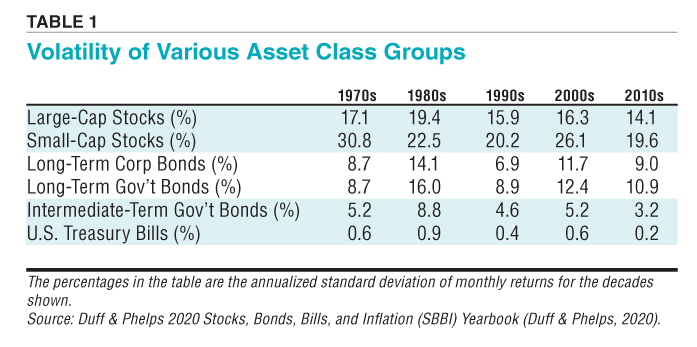
The “price” of realizing this growth was higher volatility. Data from the Ibbotson Stocks, Bonds, Bills, and Inflation (SBBI) 2020 Yearbook shows the typical annualized volatility in monthly returns for large-cap stocks over the past five decades ranging from a low of 14.1% in the 2010s to a high of 19.4% in the 1980s. The volatility of returns was even higher for small-cap stocks. It ranged from 19.6% in the 2010s to 30.8% in the 1970s. Stock prices fluctuate … sometimes by significant amounts.
To achieve the higher long-term returns realized by stocks, investors need the wherewithal to put up with the volatility of stocks. This is why the Individual Investor Wealth-Building Process asks you to identify your goals and risk tolerance before deciding upon an allocation.
Holding different types of stocks can reduce some of the volatility. As Figure 1 shows, the category of stocks with the best and worst returns varies on a calendar-year basis. In addition, stock groups can experience serial returns—consecutive years when they outperform or underperform.
The AAII Asset Allocation Models use five different categories of stocks: domestic large-cap, mid-cap and small-cap as well as international and emerging markets.
Bonds can provide preservation of wealth plus a stream of income.
Bonds are debt instruments. They represent a loan (typically $1,000 per bond, known as par value) with fixed interest payments (coupons) and a set date for repayment (maturity). These characteristics make it possible to calculate the return of a bond from purchase to its maturity. This certainty is a big part of what makes bonds less volatile than stocks.
Two primary factors influence a bond’s price:
If the role of bonds in a portfolio is to reduce the overall level of volatility and risk, investment-grade bonds should be favored. Such bonds will be less affected by economic and business cycle downturns—two events that can also adversely impact stock prices.
Short-term and intermediate-term bonds are used by AAII’s Asset Allocation Models. Short-term bonds are those maturing in three years or less. Intermediate-term bonds mature within three to 10 years. Relative to long-term government bonds, intermediate-term government bonds have realized a little less in annualized returns (5.1% versus 5.5%) but experienced even less volatility (5.2% versus 6.0%), according to the Ibbotson SBBI 2020 Yearbook.
An alternative to holding short-term bonds would be to use so-called cash equivalents. These include money market funds, certificates of deposit (CDs) and high-yield savings accounts.
Cash holdings are not subject to changes in the bond market or the stock market. The interest you receive will change but not the absolute value of the dollars you deposited. On the other hand, the interest rates paid are often close to or below the rate of inflation. Over time, the value of your cash holdings will decrease in relative terms as the purchasing power of each dollar deteriorates. So while holding cash-like assets for shorter-term needs makes sense, cash is not a good asset for goals expected to be reached well into the future.
The AAII Asset Allocation Models are displayed in Figure 2. They can also be accessed at www.aaii.com/asset-allocation.
Each model applies to investors with different levels of risk tolerance. Historically, investing time horizons of approximately 20, 15 and 10 years, respectively, have been presented as guidelines to avoid a chance of loss for the respective models. Investors willing to accept some risk of an extended period of bad returns can shorten those periods. For example, the moderate portfolio allocation has had a low—but not completely zero—chance of incurring a loss on a 10-year basis.
The moderate and conservative allocation models were revised in 2020. In both cases, the bond allocations were increased, reducing the models’ volatility to make it easier for investors to continuously follow them. As previously stated, a lower-returning allocation can result in greater wealth if you are better able to stick with it over a long period of time.
The aggressive allocation uses a 90% stock weighting. It should realize the highest level of return but will also incur the greatest level of volatility. Investors intending to use it should have both a high level of tolerance of risk and a lengthy investment time horizon.
Large-cap, mid-cap, small-cap and international stocks are each assigned a 20% weight. An additional 10% is assigned to emerging market stocks. Just 10% is assigned to intermediate-term bonds.
The key to the model is to maintain a heavy allocation to stocks. The bond holdings can be substituted with cash equivalents. A retired investor who is using the Level3 withdrawal strategy may opt to hold up to four years’ worth of planned withdrawals in short-term bonds or cash equivalents in lieu of the 10% allocation, for instance. Alternatively, the investor could allocate just enough to bonds or cash equivalents to provide a source of assets for shorter-term spending needs or to take advantage of temporary drops in stock prices.
The moderate allocation uses a 60% stock weighting and 40% bond weighting. It is intended to provide long-term growth though with more income, less volatility and also lower returns than the aggressive allocation model.
This model is based on the traditional 60/40 allocation. The traditional 60/40 approach allocates 60% to large-cap stocks and 40% to bonds. It is a well-established and time-tested allocation model. It works well for investors with long time horizons but who do not have the tolerance to stick with an aggressive allocation as well as for retirees who are taking withdrawals.
The AAII moderate allocation uses a more diversified approach than the traditional 60/40 model. Mid-cap, small-cap and international stocks are held to provide exposure to a broader range of stocks. Intermediate- and short-term bonds are held but not long-term bonds.
The conservative allocation uses a 40% stock weighting and a 60% bond weighting. It places a greater emphasis on preservation of capital and reduction of portfolio volatility. A sizable weighting to stocks is still included to provide growth in excess of the rate of inflation. The expected rate of return is lower than either the aggressive or moderate models.
This model excludes both small-cap and emerging market stocks. Though both offer the potential for higher long-term returns, they are also more volatile. Investors following this model may also wish to emphasize dividend-paying stocks for the equity portion of the portfolio. The higher short-term bond allocation is intended to provide a larger pool of assets that can be used to fund shorter-term goals.
The returns shown on the asset allocation models page are based on hypothetical portfolios comprising mutual funds that represent each asset class. Funds, instead of indexes, are used to better represent the returns investors would realize in a tax-preferred account such as a traditional or Roth IRA account. The box below provides the funds used plus similar exchange-traded funds. Other options for fund investors can be found in our mutual fund and ETF guides.
Sample Mutual Funds and ETFs for Implementing the Asset Allocation Models
As of December 2020, the following mutual funds used to track the models are:
 (VFIAX)(VIMAX)(VSMAX)(VTMGX)(VEMAX)(VSIGX)(VFISX)
Other mutual funds that can be used for implementing the allocation models can be found in AAII’s mutual fund guide.
Exchange-traded funds (ETFs) that can serve as proxies for the allocation models include, but are not limited to:
(VOO)(VO)(VB)(VEA)(VWO)(VGIT)(VGSH)Other ETFs that can be used for implementing the allocation models can be found in AAII’s ETF guide.
Investors who prefer to hold stocks instead of mutual funds and ETFs can do so. One example would be to use a combination of stocks from AAII Dividend Investing, Stock Superstars Report, VMQ Stocks and the Model Shadow Stock Portfolio for the domestic allocation.
Investors with an aggressive risk tolerance could also use the Model Shadow Stock Portfolio as their primary exposure to equities. Alternatively, a variety of investing ideas can be found via the AAII stock screens on AAII.com.
Exposure to foreign stocks is often best done through mutual funds or ETFs.
For the bond portion, investors can opt for traditional bond mutual funds or ETFs. Those concerned about interest rates can alternatively consider using defined-maturity bond funds. Offered by Fidelity, Invesco and iShares, these mutual funds and ETFs mature like bonds. They can be laddered at different maturity dates.
Individual bonds are another option. Again, laddering—buying bonds with different maturity dates—can work here. Municipal bonds can be substituted by those who prefer their tax-free characteristics. Treasuries can be purchased directly from the U.S. Treasury department.
AAII’s My Portfolio provides you with a breakdown of how much you have allocated to each investment. It also breaks out your bond and cash weightings.
A+ Investor subscribers have access to the Diversification Analyzer in My Portfolio. This tool provides a more detailed analysis of your allocation. It also shows how it compares to the appropriate allocation model for your stated risk tolerance.
There are two keys to successfully following any asset allocation strategy.
The first is to simply stick to your strategy no matter what happens with the financial markets. The benefits of allocation and diversification are realized over long periods. Over short periods, you may not notice these benefits. In fact, you may even think they are not working. This is because both different asset classes and groups within asset classes can become temporarily more correlated—particularly when there is a macro event such as a recession. Rest assured, diversification is still working even when it’s not as noticeable. The second you abandon the allocation strategy is the second you stop benefiting from it.
The other step is to periodically adjust (rebalance) your portfolio. When left completely unchanged, portfolio allocations will gradually tilt more toward the best-performing asset class. A portfolio following the moderate allocation can see its equity allocation drift from 60% to nearly 90% or higher if no periodic adjustments are made to maintain the desired allocation.
Should your tolerance for risk change, you can opt to gradually change your allocation. An investor switching from the aggressive to the moderate allocation model could target a 75% stocks/25% fixed-income allocation before fully changing the portfolio to 60/40. An investor switching from the moderate to the conservative allocation model could target a 50% stocks/50% fixed-income allocation before fully changing the portfolio to 40/60. Doing so would reduce the timing risk associated with a big portfolio change.
A one-time change could also be made. This not only may incur timing risks but could also expose the investor to higher taxes in the year the transition is made. By spreading out the timing of the change, the tax costs may be spread out into different tax years.

Go to the Learn & Plan section of AAII.com to walk through the entire five-step Individual Investor Wealth-Building Process. To aid in building your plan, there are short videos to watch and fun challenges to work through.
Portfolio Strategies

Mutual Funds

Retired Investor

GREGORY D from TN posted over 5 years ago:
DAVID W from VT posted over 5 years ago:
CHARLES R from IL posted over 5 years ago:
CHARLES R from IL posted over 5 years ago:
RODNEY M from NM posted over 5 years ago:
GREG H from GA posted over 5 years ago:
ROBERT A from NC posted over 5 years ago:
JOE C from NJ posted over 5 years ago:
J M from NJ posted over 5 years ago:
H from FL posted over 5 years ago:
You need to log in as a registered AAII user before commenting.
Log InCreate an account