


Charles Rotblut leads a class in AAII's new Essential Investing Video Course. Go to https://www.aaii.com/ves for more information and to subscribe.

- Women often view investing as gambling but excel with education
- Key is to start investing early with any amount and hold for the long term
- Laffer Tengler’s strategy focuses on dividends for income and sales to identify growth
Nancy Tengler is the CEO and chief investment officer (CIO) of Laffer Tengler Investments. She is also a committed advocate for women’s financial literacy. Her latest book is “The Women’s Guide to Successful Investing” (Second Edition, Palgrave Macmillan, 2023). Cynthia McLaughlin and I discussed the importance of women being actively involved in investing decisions and Tengler’s approach to identifying attractive stocks.
—Charles Rotblut, CFA
Charles Rotblut (CR): In your book, you describe women as both being better investors and having different goals than men. Could you elaborate?
Nancy Tengler: It’s not just my opinion. The research supports that women—when compared directly with their men counterparts—generate better returns. The assumption is because they aren’t as concerned about beating the [S&P 500] index, women do more research, trade less and are willing to hold onto stocks. Over time, this generates excess total return.
As you know, all the great investors that are talked about are men. So, it’s not to say that men, or most men, don’t make good investors. It’s just that women don’t think they make good investors. And it turns out, they do.
CR: Do you think that’s due to a lack of experience or financial education? Or is it just that the industry itself unfortunately caters to the alpha personality of investing?
It’s all of the above. Women tend to excuse themselves from the conversation. They identify as great savers, but they think investing is gambling and are less likely to actually invest unless encouraged.
I’ll give you an example. I left the industry for a while and just did not want to have to have the daily grind of managing money. So, my husband and I interviewed a bunch of firms in San Francisco, where I had been the chief investment officer (CIO) of one of the largest asset management firms in the city. I knew all these people. We went to the meeting, and they spent the whole time asking my husband the questions. He would then turn and ask me the questions. It was just remarkable because I had been a CIO at that point for 20 years.
It wasn’t that I was offended as a feminist. I was offended because it was a waste of time. It wasn’t efficient. But that’s typical. Most women just sort of sit back while professionals tend to use a lot of jargon in this industry. So, when I’m talking to all our clients, I try to speak English, in particular just to engage the women.
CR: Many of our members are men. Is there guidance you could give them about engaging their wives and daughters in investing?
It’s important to note that the average age of a widow in the U.S. is 59½. There are 11.8 million widows and one million new widows every year. The numbers say something like 95% of women are going to end up taking care of the family wealth. So, you must have a proactive strategy for including them.
I have women clients who are married but don’t know the passwords to the financial accounts. Their husbands don’t engage them about finances. That doesn’t work well if the husband goes first.
I think it’s important to talk about it. I use a lot of case studies in the book about women and wealthy investors in general. The one that stands out the most to me is about a woman named Stephanie Mucha. Mucha didn’t manage her portfolio until five years after her husband’s death when she was age 57. Once retired, she lived on a fixed income during her retirement. Mucha wasn’t a financial person; she simply bought what she knew. By the time Mucha died, she had over $5 million that she’d either given away or accumulated.
Women have a tendency to think, “Oh, it’s too late and I’m not smart enough.” This just isn’t true.
CR: To someone who is taking over their finances following the death of a spouse or a divorce, what guidance would you give?
I used to write a column for USA Today. The first one I wrote was on this subject. The headline the newspaper gave it was, “You just got married. It’s time to prepare for divorce and death (sorry).” It reflected the fact that the average age of the first divorce for women in the U.S. is 30. Women need to engage in the investing process early in their careers and marriage.
I was 59 when my husband passed away. I had managed all the family money, but it was not easy with all the grief and all the other things I had to manage. Widowhood is certainly not a good time to add “learn how to invest” to the list.
There is typically one person who is what we call the money spouse. Whichever person that is, they need to actively include the non-money spouse in the conversations with the adviser. Two-thirds of women end up firing their adviser a year after their husband dies. It’s expensive, it’s disruptive and it hurts total return. But those women just don’t feel like they have a relationship with the adviser. There is no trust.
CR: If the household’s portfolios are being self-managed, then the analogy would just be making sure kitchen table conversations are being held.
Yes, and with your kids included. I think that the lack of financial education is the biggest crisis in our country. I used to sit on the board of the Arizona Council on Economic Education (ACEE). There’s a chapter in almost every state. The national organization gives a basic test on economics. The average adult gets a grade of C and the average high school student gets an F.
We used to sit at the table and talk about companies with our kids. Or when I was shopping at, say, the grocery store, I’d tell my children that they could only buy General Mills cereal. I know that sounds dumb, but our family owned that stock. I also got great ideas from my kids because they were looking at things and could identify emerging trends. So, we talked about that a lot.
I think just talking about investing all the time demystifies it and helps your children believe they can do it. So, we encourage all our clients to have a portfolio that they invest themselves. I think it makes them better clients.
Cynthia McLaughlin (CM): Do you have specific advice for women regarding what they should or should not do?
When your family is young, you’re buying soccer cleats, swim goggles, etc. At the end of the month, the temptation is to think, “I could save 50 bucks but it’s such a small amount that it is not even worth it.” For many years, I didn’t save to invest like I advise women to do. It doesn’t matter how small the amount is, put it to work.
You can open an account with no minimum balance at Charles Schwab or any of the other discount brokers. You can add $10, $20, $25 or $50 per month and buy fractional shares of stocks or exchange-traded funds (ETFs). There’s no excuse not to invest. Just put it away.
Buy great companies that you can own for a lifetime. Then, as Peter Lynch said, don’t let the market scare you out of stocks. That’s what I recommend people do, whether they own growth stocks or value stocks, just keep adding to them over time.
One of the case studies in my book is titled, “When Starbucks Got Roasted, I Bought the Stock.” I bought Starbucks Corp.  (SBUX) in 2007, and you know what happened in 2008 and the early part of 2009. I didn’t add to my shares at the market’s bottom because I refused to look at my statements. When we’re in a bear market, I just don’t look. The fact that I held onto the stock allowed me to generate an average annualized return of 14.0% between 2007 and 2022 versus 8.4% for the S&P 500 (Figure 1).
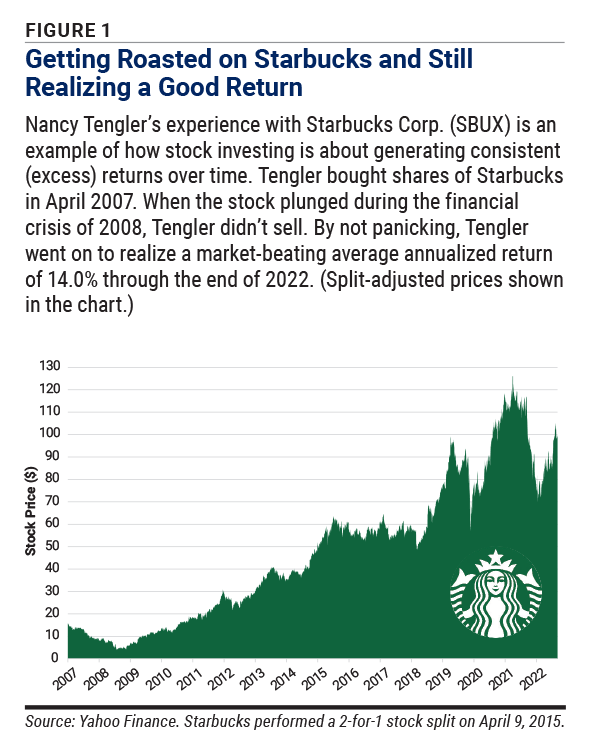
I think when you hammer this type of lesson home, what people learn is that investing isn’t trading, it’s a longer-term game. You need time to compound. I also dollar-cost average. This is what everyone should do. It is what they do with their 401(k). They dollar-cost average every pay period.
CR: Speaking about your investment approach, would it be fair to describe it as a combined growth at a reasonable price (GARP) and income strategy?
Yes. We run a dividend/growth strategy. Every company in that portfolio has to pay a dividend, and that’s really the workhorse.
When you’re investing, you have to have either stocks or a portfolio that does the heavy lifting. Think of it as the little black dress. You can wear it anywhere. You can dress it up, you can dress it down, you can wear it to work and you can wear it out. It just works for you. You also accessorize it based on your risk profile.
Our dividend/growth strategy is the little black dress. It provides protection in declining markets because of the dividend growth and the higher yield. It tends to keep up in rising markets because we’re buying growth at a reasonable price.
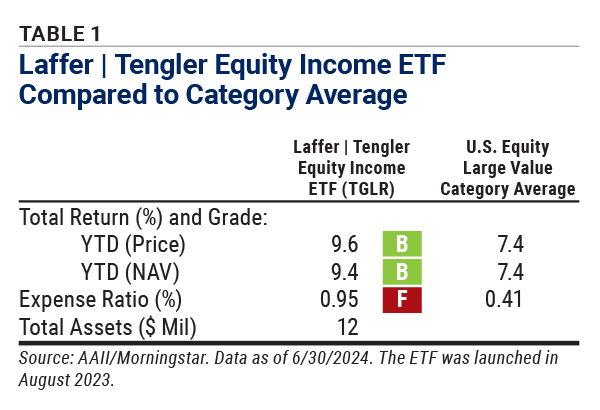
Over the last 10 years, it has returned 12.5% through March 31, 2024. That’s way ahead of the Russell 1000 Value index and slightly ahead of the S&P 500, but we take a lot less risk. That’s why we developed the Laffer | Tengler Equity Income ETF (TGLR) last year (Table 1).
CR: Your strategy provides access to both growth and income?
Yes. I don’t go into the highest-yielding segments of the market, because you can’t make any money there. What you’re looking for when you buy shares of a company is what its management is saying about the dividend. Dividends are set by management and boards as a portion of long-term sustainable earnings power.
It also fits our investing theme, which is old economy companies that are pivoting to digitization: cloud computing, generative artificial intelligence (AI), etc. The perfect poster child for that is Walmart Inc. (WMT). It’s expanding margins. Plus, after decades of raising the dividend by around a penny per share, it just raised it 9%. That increase reflects management’s confidence in the future.
CR: What traits do you seek in terms of growth?
In the 1990s, when I was managing money, I only had relative dividend yield as a tool. That kept me out of all the really enjoyable parts of technology that ultimately crashed. So, I developed a secondary metric, which we use in our growth strategy. We asked ourselves, “What is as reliable as the dividend?” We settled on sales, because with earnings, you could drive a truck through the holes in GAAP and pro forma numbers. We wanted to have something that could not be manipulated. If you manipulate sales, you go to jail.
Then we graph it just like we do relative dividend yield. What would I have had to pay for a unit of sales compared to the market and compared to this stock’s history? And what am I paying for it now?
Relative price to sales has led us into some great names. Tesla Inc. (TSLA) is a name you wouldn’t maybe expect us to own, but we’ve been able to buy it a couple times over the last 10 years and sell it based on the relative price-to-sales (P/S) ratio. We also own a lot of the usual suspects in technology and outside of technology. We’ve been able to access Chipotle Mexican Grill Inc. (CMG) and Spotify Technology S.A. (SPOT) thanks to using this relative price-to-sales ratio.
The ratio is accessible to everyone. Most people don’t need to look at it as closely as we do. But you can now find the data calculated for free on investment websites.
One of the best opportunities for us is when a stock has a yield and it’s also a buy based on its relative price-to-sales ratio. When we were buying Apple Inc. (AAPL) back in 2013, it was attractive on both of those metrics. Apple had a yield of almost 3% at that time, which was above the yield on the 10-year Treasury bond. I always like to say we got in before Carl Icahn and Warren Buffett did.
CR: Is there anything you look for in terms of underlying fundamental strength, besides the dividends?
I talk about our 12 fundamental factors in my book. We look at three qualitative factors, which are really the most important, and nine quantitative factors.
We’re really focused on management. So, how does a lay person assess management? You watch companies, but you can also read the proxy statement. I think it’s more interesting than the annual report. You can also just read the news. If you can pay attention to what the companies are doing to orient themselves for the future, that becomes very powerful.
The second-most-important thing is identifying the catalyst for outperformance. Just buying stocks because they’re cheap leads you to buy what we call terminally cheap stocks—I don’t want to own those. Sometimes I buy them, but it’s learning how to pivot away that matters. Take a company like CVS Health Corp. (CVS). A great new CEO came in and she paid down the debt. So, I’m thinking this means the company is moving in the right direction. And then what does this CEO do? She turns around, makes a bunch of acquisitions and drives the debt up. All the while, post-pandemic problems with the stores occurred. So, we skedaddled out of there.
You want to give such stocks a chance to work. But if management doesn’t deliver after two years and/or cuts the dividend, we look for better places to be.
CR: What are some of the biggest or most common mistakes you’ve seen investors make—individual or institutional?
Well, I talk a lot about discipline, because you’re not going to get them all right. Investing is like being in a perpetual state of dissatisfaction. If you buy it and it goes up, you didn’t buy enough. And if you buy it and it goes down, you bought too much. So, you have to have a discipline that you stick with.

Related

Financial Planning
12 Guidelines for Widows, and Suggestions for Husbands
Related

AAII Stock Ideas
A Top-Line Approach: The Price-to-Sales Ratio Screen
Discussion
FREE REPORT

Get your free copy of our special
report analyzing the tech stocks
most likely to outperform the
market.
ROBERT A from NC posted over 2 years ago:
JOHN L from NJ posted over 2 years ago:
BARRY J from TX posted over 2 years ago:
THOMAS S from OR posted over 2 years ago:
PATTI R from AZ posted over 2 years ago:
JOHN L from NJ posted over 2 years ago:
ROBERT A from NC posted over 2 years ago:
EVA M from PA posted over 2 years ago:
You need to log in as a registered AAII user before commenting.
Log InCreate an account