



Related


First Cut Stocks
As a starting point for investors, this First Cut lists stocks possibly neglected due to their removal from the S&P 500 index.

While companies celebrate inclusion into the S&P 500 index, for every company added, one must be removed. Many have observed the “index effect,” the initial price boost after the announcement of a stock being added to the index, as well as the initial price decline for stocks removed from the index for reasons other than a buyout or merger.
However, William Hester of Hussman Funds observed that when you examine full-year performance, portfolios of stocks removed from the index for reasons other than buyouts outperformed those of added stocks. He points out that these neglected and underappreciated stocks may have “more life left in them than most investors expect.”
More recently, research by Rob Arnott of Research Affiliates found that companies dumped from major indexes fare surprisingly well on average. As it turns out, these discretionary dumped stocks are typically temporarily out-of-favor, unloved stocks priced attractively relative to the stocks replacing them in the index. As a whole, deletions have fallen by more than half relative to the market in the year prior to their removal from the index. Arnott’s research noted that deletions outperformed the market by more than 5% per year for the next five years after the change. The research led to the creation of the Research Affiliates Deletion ETF (NIXT).
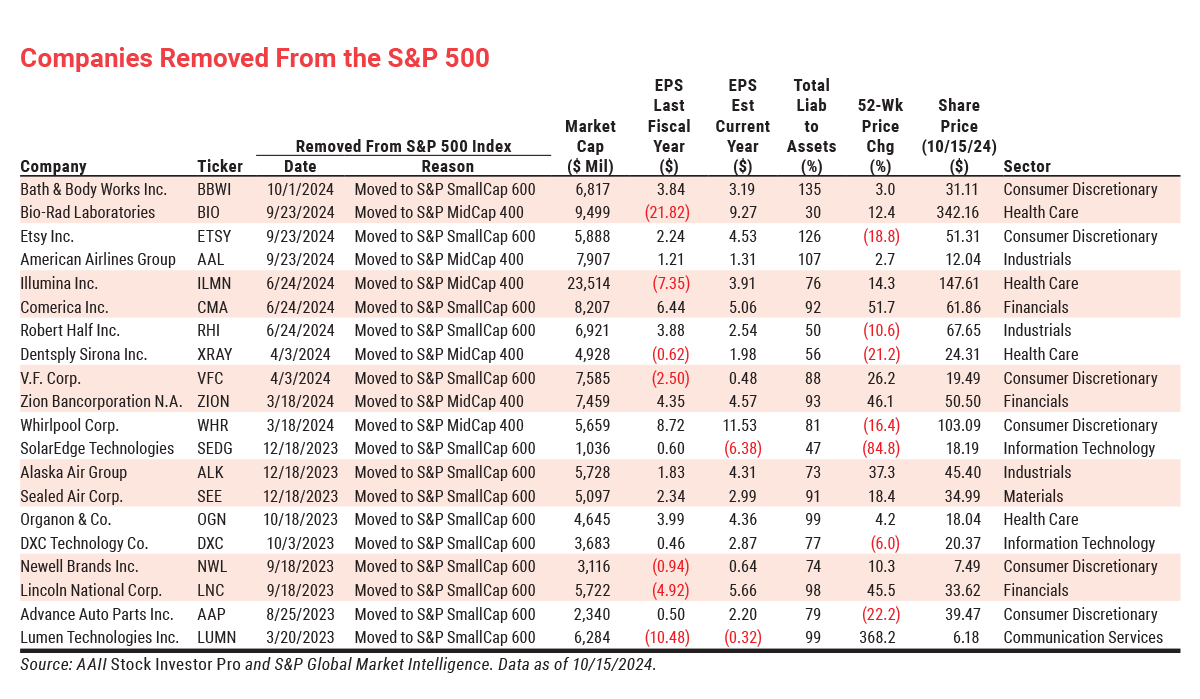
This issue’s First Cut shows the most recent 20 firms that have been removed from the S&P 500 for reasons other than being bought out or taken private. The First Cut listing indicates when and why a stock was removed from the index. Market capitalization (price times share outstanding) is used by S&P to measure size, and companies must currently have a minimum market cap of $18.0 billion for inclusion in the S&P 500. Most companies were removed because they became too small. The listing also includes the earnings for the most recent year and the consensus earnings estimate for the current fiscal year to help measure near-term profitability. The ratio of total liabilities to assets is a simple measure of financial leverage. The 52-week price change highlights recent stock market performance.
Not all stocks removed from the S&P 500 go on to outperform the market. However, a contrarian investor may find a few true bargains among these outcast stocks.
Tudor Pop provided research assistance.
First Cut Stocks


ROBERT A from NC posted almost 2 years ago:
JOHN L from NJ posted almost 2 years ago:
MARY M from CA posted almost 2 years ago:
BARRY J from TX posted over 1 year ago:
You need to log in as a registered AAII user before commenting.
Log InCreate an account