

Related


Investor Professor
Online Exclusive: Defining Inflation for Your Portfolio

Stock Strategies
The Federal Reserve uses the personal consumption expenditure (PCE) price index as the preferred method of measuring inflation instead of the more familiar consumer price index (CPI).
by Tudor Pop | November 2024

The Federal Reserve uses the personal consumption expenditure (PCE) price index as the preferred method of measuring inflation instead of the more familiar consumer price index (CPI).
Researchers looked at layered charts comparing the growth rates of different price indexes that are used to measure inflation. The two main indexes examined were the PCE price index, constructed by the U.S. Bureau of Economic Analysis (BEA), and the CPI, calculated by the U.S. Bureau of Labor Statistics (BLS). The core PCE price index and core CPI exclude food and energy prices because of their volatility.
The article notes the core PCE price index is preferred by the Fed as an inflation gauge because it is less volatile than the CPI, providing a more consistent measure of long-term inflation trends. However, prior to 2022, the core PCE price index exhibited a disinflationary trend, which puts into question the effectiveness of the Fed’s monetary policy.
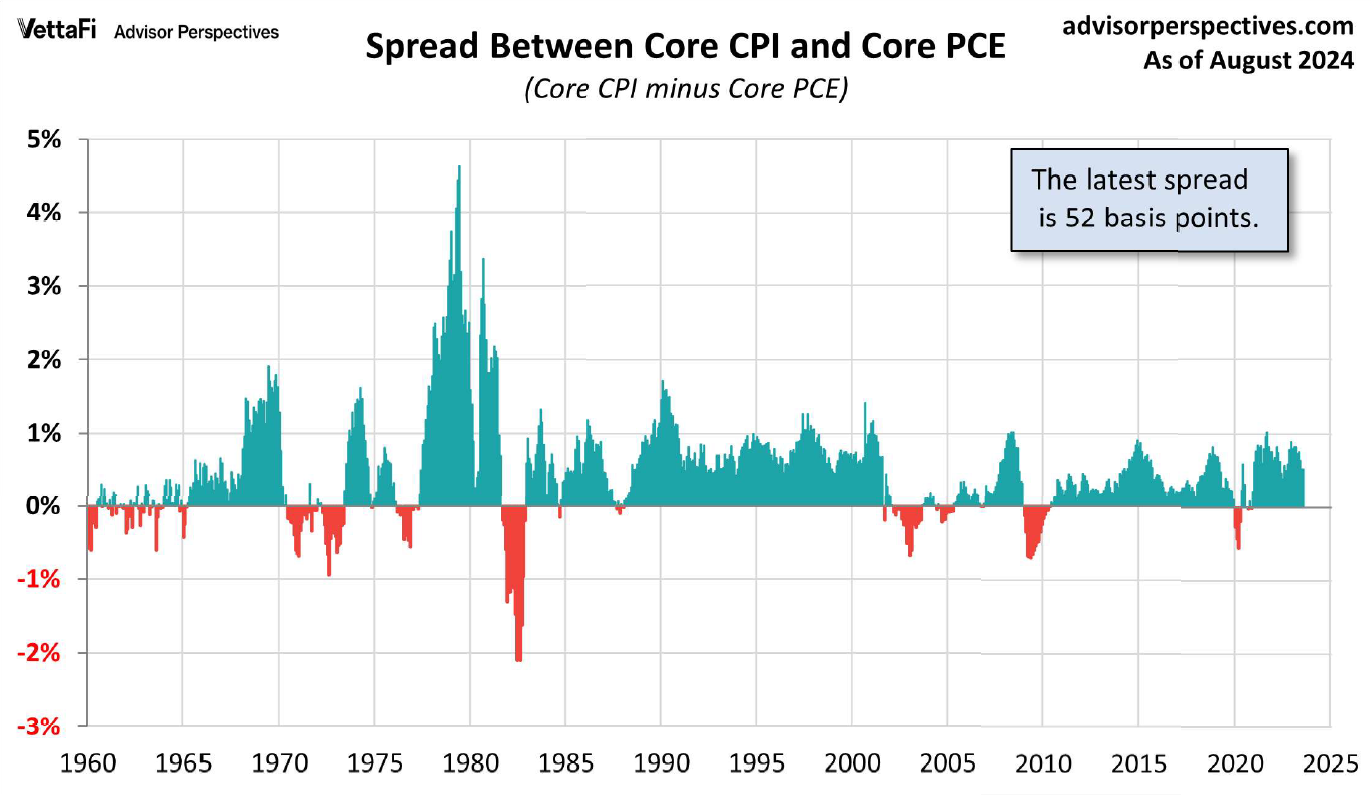
A chart of the two indexes shows that they track each other closely over the long term and tend to move in the same direction. However, the core CPI is the more volatile of the two. Comparing the cumulative change in the two measures since 1960 illustrates that although the PCE price index and the CPI seem to grow at a similar rate, the core CPI has grown 974%, while the core PCE grew 677% over the same period.
Source: “Two Measures of Inflation: August 2024,” by Jennifer Nash; Advisor Perspectives, October 2, 2024.
Investor Professor
Stock Strategies

ROBERT A from NC posted almost 2 years ago:
You need to log in as a registered AAII user before commenting.
Log InCreate an account